Explains the concept of multicast demands and how they relate to discovered and simulated multicast flows.
A multicast demand is a network traffic requirement that
specifies how multicast flows are to be handled within a network simulation
can be inserted manually for discovered multicast flows, and
must be created manually for simulated multicast flows.
Simulated multicast demands
For manually inserted demands, all SSM demand traffic for the (S,G) pair (multicast flow) goes through any interface that is traversed by that demand. SSM demands are routed to take the shortest path from the destination to the source, rather than from the source to the destination, as unicast demands do. By default, multicast multipath is disabled. If two paths of equal cost exit from a node on the route back to the source, the path is chosen based on:
The remote interface with the highest IP address is used.
If IP addresses are not available, the router name with the lowest lexicographical name is used.
However, you can set Cisco Crosswork Planning to use the Cisco next-hop multicast, multipath selection method. For more information, refer to Configure Cisco next hop for multicast flows.
The sources of these multicast demands can be nodes, interfaces, external ASes, or external endpoints. Using interfaces lets you specify the exact interface on which demand traffic is entering. Using external endpoints lets you model situations where the multicast source is outside of the nodes in the plan, and there is more than one possible entry point of the traffic flow into and through the interfaces in the plan.
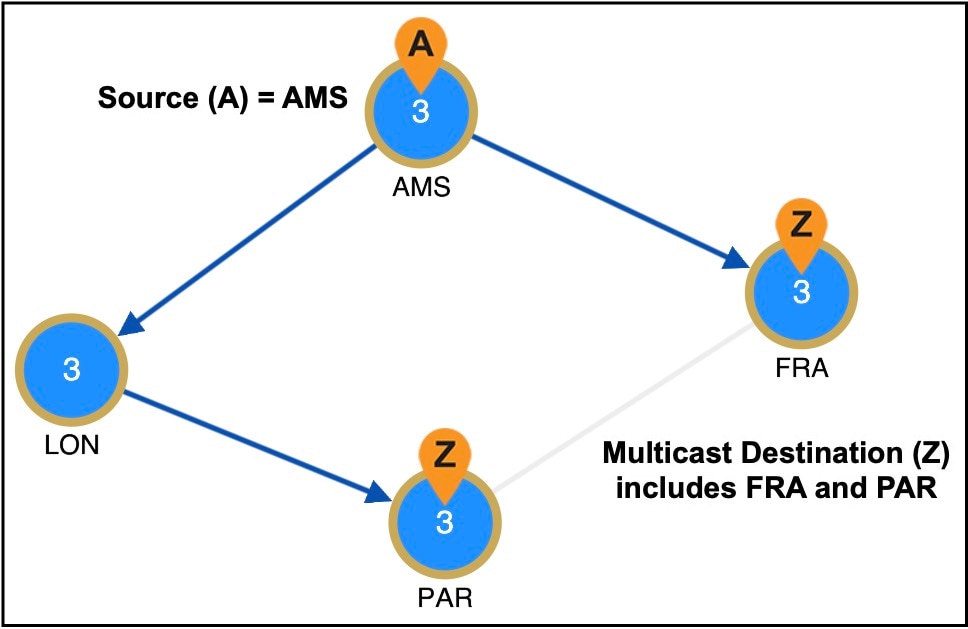
In this example, the selected demand has a node source of AMS, and a multicast destination containing two nodes: FRA and PAR. The source node (S) is marked by A, and the destinations in the receiver group (G) are marked by Z.
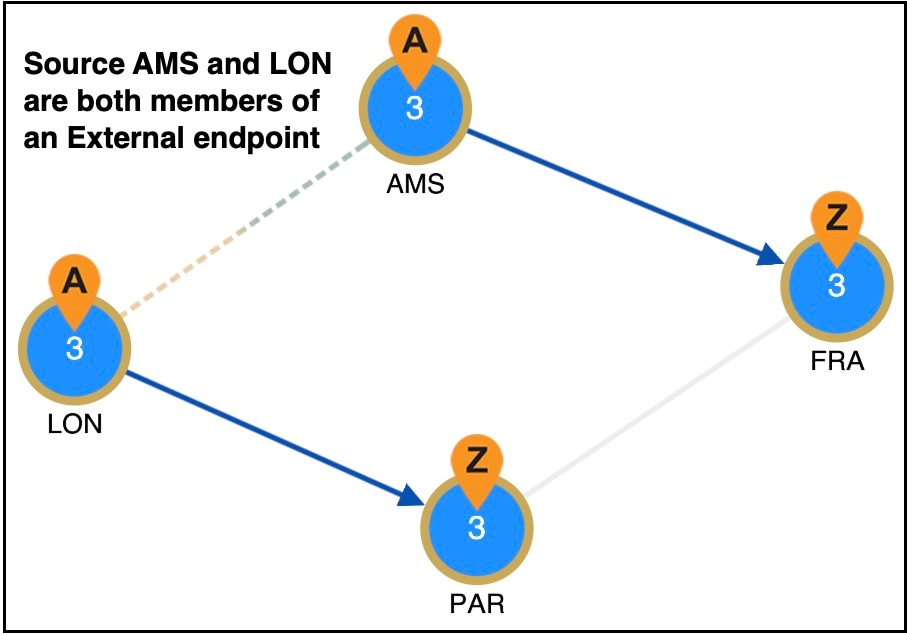
You can model a source that is outside the plan using external endpoints. In this example, the demand’s source is an external endpoint that contains AMS and LON as members. The multicast destination includes both FRA and PAR.