Provides an example that illustrates how reservable bandwidth constraints affect RSVP LSP routing and rerouting during simulation analysis workflows.
This example demonstrates RSVP LSP routing in a simple network and examines how reservable bandwidth influences routing outcomes during simulation analysis.
Network configuration
In this example, there are four LSPs, each with a setup bandwidth (Setup BW) of 600 Mbps. All interfaces have a reservable bandwidth (Resv BW) of 1000 Mbps.
-
LSP details
-
LSP-1, LSP-2, and LSP-3 go from LON to FRA.
-
LSP-4 goes from LON to ROM.
-
-
IGP metrics
-
Interfaces between PAR and FRA, and interfaces between FRA and ROM have an IGP metric of 2.
-
All other interfaces have an IGP metric of 1.
-
Figure 1 shows the LSP reservations view of this simple network in both simulations modes: the usual where reservable bandwidths are observed and the capacity planning version wherein they are ignored. In this latter mode, the two red circuits indicate they are being over utilized and likely need their capacity increased. (For information about the LSP Reservations view, refer to View LSP reservations.)
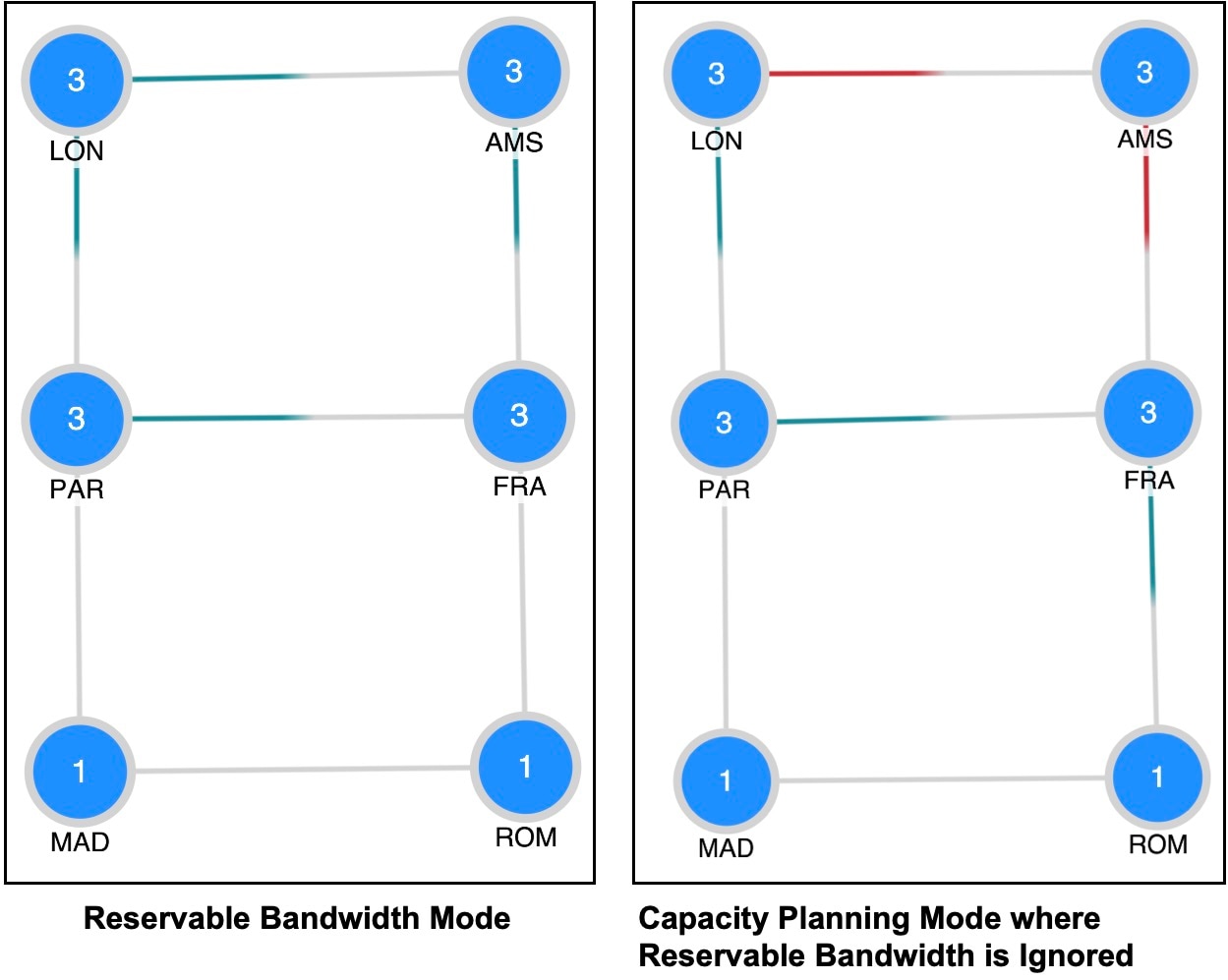
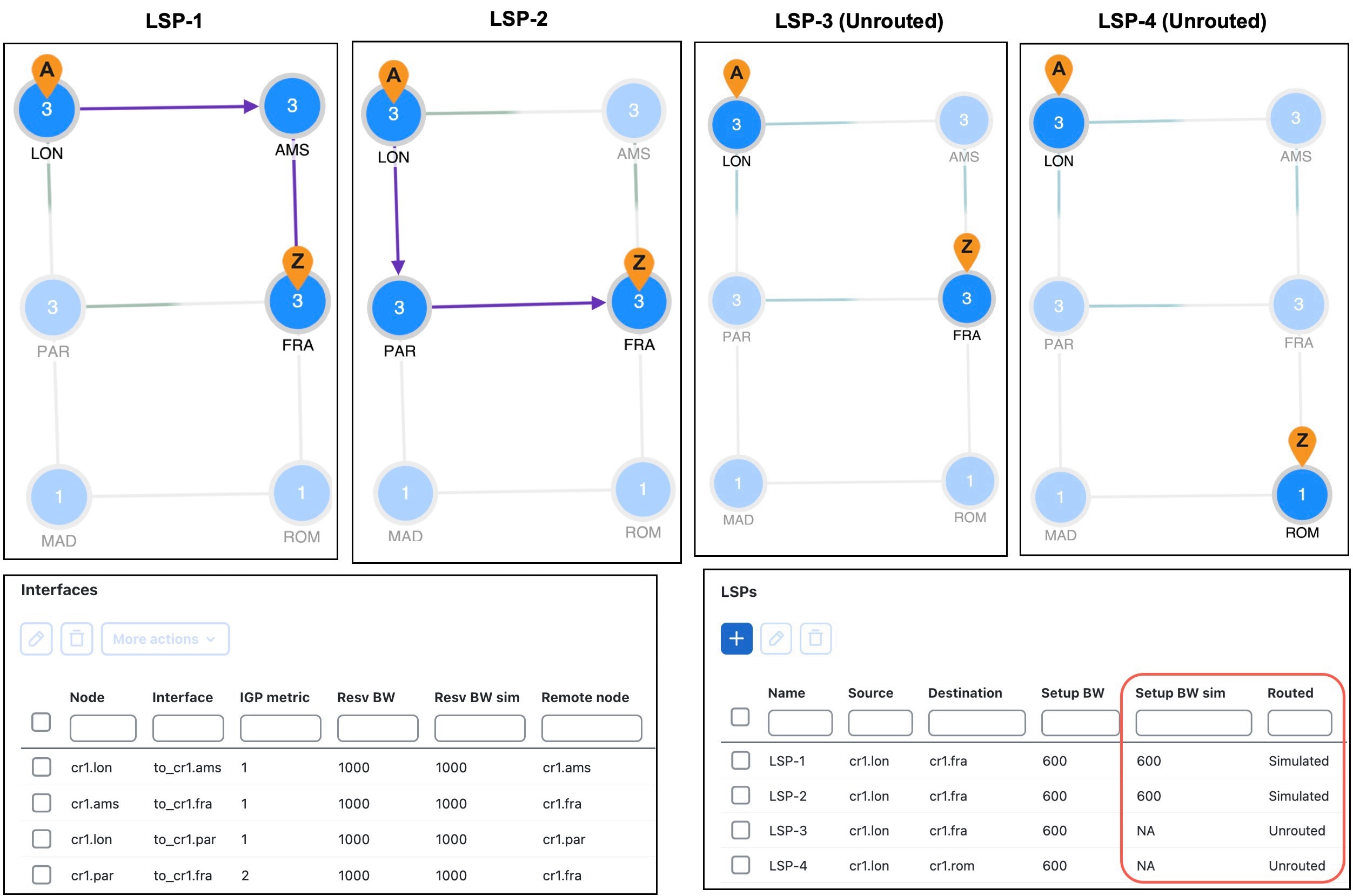
Figure 2 demonstrates routing simulations where reservable bandwidth constraints are applied (LSP capacity planning mode unchecked), which is the default behavior.
-
LSP-1 routes across LON-AMS-FRA, leaving circuits LON-AMS and AMS-FRA each with only 400 Mbps of available bandwidth.
-
LSP-2 routes across LON-PAR-FRA, leaving circuits LON-PAR and PAR-FRA each with only 400 Mbps of available bandwidth.
-
LSP-3 cannot be routed because there is not enough available bandwidth on LON-AMS or LON-PAR. Its Setup BW sim value in the LSPs table is set to “NA” and the Routed column is set to “Unrouted.”
-
LSP-4 cannot be routed, again because there is not enough available bandwidth. Its Setup BW Sim value in the LSPs table is set to “na” and the Routed column is set to “Unrouted.”
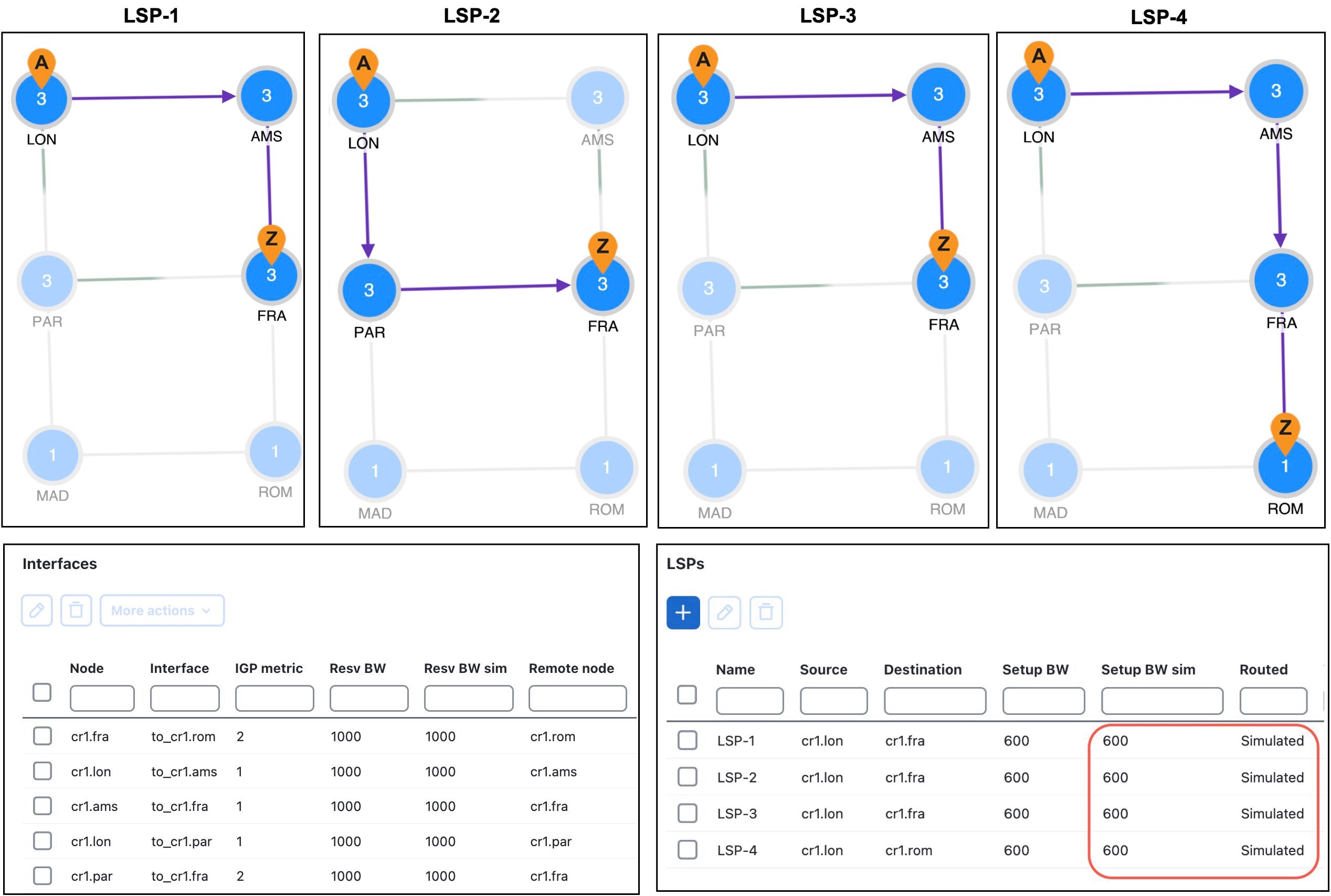
In Figure 3, the use of reservable bandwidth constraints has been disabled (LSP capacity planning mode checked). The LSP routes are:
-
As with the default behavior, LSP-1 routes across LON-AMS-FRA and LSP-2 routes across LON-PAR-FRA.
-
Once it is determined that there is not enough reservable bandwidth for LSP-3 to route, it takes the shortest path, LON-AMS-FRA. The reservable bandwidth on interfaces LON-to-AMS and AMS-to-FRA is ignored for the remainder of this simulation. LSP-3’s Setup BW sim value in the LSPs table is set to 600.
-
LSP-4 routes across LON-AMS-FRA-ROM because these reservable bandwidth constraints have been removed and because it is the only route available. Even though LON-PAR-MAD-ROM is the shortest path, there is not enough reservable bandwidth on LON-to-PAR or PAR-to-FRA. LSP-4’s Setup BW sim value in the LSPs table is set to 600.
If, however, LSP-4 were routed before LSP-3, then LSP-4 would route across its shortest path of LON-PAR-MAD-ROM, and the LON-to-PAR interface would have its reservable bandwidth constraint ignored. With this routing, LSP-3 would still route LON-AMS-FRA, and the interfaces LON-to-AMS and AMS-to-FRA would still be set to remove their reservable bandwidth constraint.