The Cisco NCS 1014 is an advanced multihaul optical platform supporting transponders and line system cards.
The Cisco NCS 1014 chassis is an advanced multihaul optical platform that supports transponders and line system cards.
It is a 2RU chassis,
delivers a universal transponder solution, and
provides excellent performance for metro, long-haul, and submarine applications.
Cisco NCS 1014 modules and supported line cards
The NCS 1014 chassis includes these modules:
Removable controller
Removable backup solid state drive (SSD)
Two replaceable power supply units (PSU)
Three replaceable fan modules
Four line cards
The NCS 1014 chassis supports these line cards and modules:
Table 1. NCS 1014 supported line cards and modules
From release
PID
Description
7.11.1
NCS1K14-2.4T-K9
2.4T DWDM transponder card
NCS1K14-CCMD-16-C/L
16-port colorless multiplexer and demultiplexer optical line card.
NCS1K4-1.2T-K9
1.2T DWDM transponder card
24.1.1
NCS1K14-2.4T-X-K9
2.4T-X DWDM transponder and muxponder card
NCS1K4-QXP-K9
3.2T QXP transponder card
25.2.1
NCS1K4-2-QDD-C-K9
2-QDD-C C-band line card
26.1.1
NCS1K14-2.4T-A-K9
NCS1K14-2.4TAL-K9
2.4TA and 2.4TA-L DWDM transponder and muxponder card
1.2T line cards
A 1.2T DWDM line card is a transponder that
enables high-capacity optical transport for Cisco NCS 1014 chassis,
secures client-side data with AES256-based Layer-1 encryption, and
delivers flexible client and trunk configurations for 100GE and OTU4 traffic.
Key features
The NCS1K4-1.2T-K9 line card is a single-slot unit.
It provides 12 client ports for 100GE and OTU4 traffic and two trunks, which can be configured anywhere from 100G to 600G in 50G steps.
It supports C-band traffic.
2.4T line cards
A 2.4T line card is a coherent optics transponder and muxponder that
fits a single slot on the Cisco NCS 1014 chassis,
supports C-band traffic at trunk ports, and
delivers 400GE, 100GE, and OTU4 client traffic over two trunk ports operating at speeds from 400G to 1.2T each.
CCMD-16 line cards
The CCMD-16 optical line card is a type of optical line card designed for multiplexing and demultiplexing functions in an optical network.
It features two line ports to transmit and receive using the same LC connectors,
includes 16 ports for add/drop functionality with LC connector-based interfaces, and
is available in two variants: NCS1K14-CCMD-16-C (C-band) and NCS1K14-CCMD-16-L (L-band).
CCMD-16 optical line card variants and specifications
The CCMD-16 optical line card is available in two main variants, each supporting different wavelength bands:
NCS1K14-CCMD-16-C: This is a C-band, 16-port Colorless Direct attach optical line card with EDFA. It can host up to 16 channels and supports any signal distribution between 191250 and 196200 GHz, for example, a 64-channel grid with 75-GHz spacing.
NCS1K14-CCMD-16-L: This is an L-band, 16-port Colorless Direct attach optical line card with EDFA. It can host up to 16 channels and supports any signal distribution between 186025 and 191000 GHz, for example, a 64-channel grid with 75-GHz spacing.
2.4TX line cards
The 2.4TX line card (NCS1K14-2.4T-X-K9) is a coherent optics Transponder and Muxponder for the Cisco NCS 1014 chassis.
It is a single-slot card that supports C-band traffic at trunk ports,
delivers 400GE and 100GE client traffic over two trunk ports operating at speeds ranging from 400G to 1.2T each, and
operates in two configurable card modes: Muxponder mode and Muxponder Slice mode.
Table 2. Feature History
Feature Name
Release Information
Feature Description
NCS1K14-2.4T-X-K9 Line Card
Cisco IOS XR Release 24.1.1
The new NCS1K14-2.4T-X-K9 line card is a single-slot Transponder and Muxponder card that delivers up to 1.2T C-band traffic at each trunk port. It has six QDD client ports that support 400GE and 4x100GE traffic on each port. This card provides two trunk ports that support 1.2T traffic on each port. The mxponder-slice and muxponder keywords in the hw-module command enable this card to operate in the following modes.
Muxponder slice mode:The card virtually splits into two slices in this mode. It is possible to configure both trunks to carry different data rates. The supported trunk rates are 400G, 500G, 600G, 800G, 1000G, and 1200G.
Muxponder mode:The card acts as one unit in this mode, configuring both trunks to the same data rate. The supported trunk rates are 600G and 1000G. Additionally, the capacity of a specific shared client port is consumed by two trunk ports.
2.4TX line card features and specifications
The card's operation modes are enabled using the mxponder-slice and muxponder keywords in the hw-module command:
Muxponder slice mode: The card virtually splits into two slices, allowing both trunks to carry different data rates. Supported trunk rates are 400G, 500G, 600G, 800G, 1000G, and 1200G.
Muxponder mode:The card acts as one unit, configuring both trunks to the same data rate. Supported trunk rates are 600G and 1000G. Additionally, the capacity of a specific shared client port is consumed by two trunk ports.
Note
In Release 24.1.1, the 2.4TX line card supports only 400G, 500G, 600G, 800G, 1000G, and 1200G trunk payloads.
The 2.4TX card supports various pluggable form factors and data rates for its client and trunk ports, as detailed in this table:
Table 3. Interfaces and data rates
Interfaces
Form factor
Ports
Data rates
Client
QSFP-DD56
1, 2, 3, 4, 5, 6
400G
QSFP-DD112
2, 5
400, 800G
Trunk
Coherent Interface Module 8 (CIM8)
0, 7
up to 1.2T in each port
Note
In Release 24.1.1, ports 2 and 5 support only up to 400G data rates.
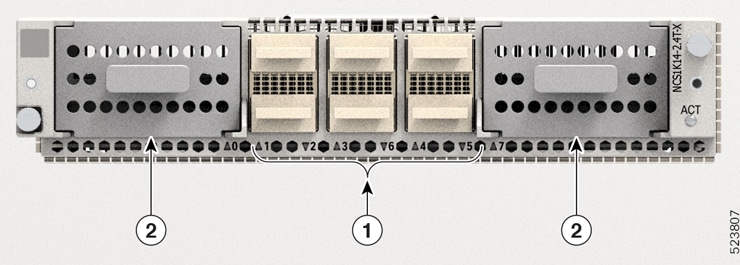
The 2.4TX card has two trunk ports and six client ports, as shown in the this figure:
Figure 1. 2.4TX Line card front view
Table 4. 2.4TX line card interfaces
Callout
Interface
1
Client port
2
Trunk port
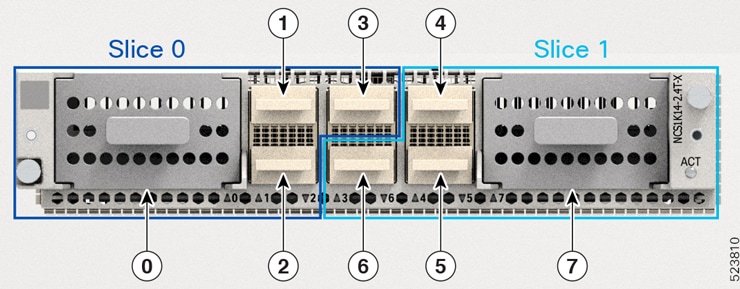
This figure illustrates the mapping between the client and trunk ports:
Figure 2. 2.4TX card client and trunk mapping
Table 5. Client-to-trunk port mapping
Trunk port
Client ports
0
1, 2, 3
7
4, 5, 6
Note
This client-to-trunk port mapping is only applicable for the mxponder-slice mode.
For more information about the 2.4TX card, refer to the datasheet.
2.4TA line cards
The Cisco NCS 1014 supports a 2.4TA (NCS1K14-2.4T-A-K9) line card or a 2.4TA-L (NCS1K14-2.4TAL-K9) line card from Release 26.1.1. It is a 2.4TA DWDM coherent optics transponder and muxponder single-slot line card that
supports up to 2.4 Tbps of payload using two pluggable CIM8 coherent sub-modules,
provides six QSFP-DD client ports for various Ethernet and OTN class payloads, and
operates on the Peta Linux operating system.
Table 6. Feature History
Feature Name
Release Information
Feature Description
NCS1K14-2.4T-A-K9 and NCS1K14-2.4TAL-K9 Line Card
Cisco IOS Release 26.1.1
The NCS1K14-2.4T-A-K9 and NCS1K14-2.4TAL-K9 line cards are introduced as 2.4T DWDM coherent optics transponder and muxponder solutions for the NCS 1014 chassis, empowering service providers to deliver ultra-high-capacity transport services while maximizing fiber efficiency.
Key features of the 2.4TA line cards
QSFP-DD56 client ports: Three ports that support 100G, 200G, and 400G class payloads.
Coherent module trunk ports: Two ports that support CIM8 optics for up to 1.2 Tbps payload each.
Mate interface: A 200G (16x28G) interface.
Supported payloads: Ethernet (100GE and 400GE)
Encryption support: OTNSec encryption for all trunk rates.
Operational flexibility: Support for a mix of client and shared client port depending on the cross-section implementation.
Mapping support: Client-to-trunk mapping support.
QXP-K9 line cards
A QXP-K9 line card is a high-density QSFP-DD transponder card that
supports up to 3.2T traffic through its eight QSFP-DD trunk ports, and
operates each trunk port at speeds up to 400G in 50G increments.
QXP-K9 line card port capabilities
Client ports: Eight QSFP-DD client ports. Each client port supports 400GE, 4x100GE, and 100GE without FEC client rates.
Trunk ports: Eight QSFP-DD ZR+ trunk ports. Each trunk port operates at speeds up to 400G, configurable in 50G increments, contributing to the card's 3.2T total traffic capacity.
NCS1K4-2-QDD-C-K9 C-band line cards
The NCS1K4-2-QDD-C-K9 C-band line card is supported by the Cisco NCS 1014 from Release 25.2.1. It is a high-performance optical networking card that:
offers configurable client and trunk ports,
features eight client ports (QSFP28 and QSFP-DD) and two DWDM dual sub-channel module trunk ports, and
supports trunk port line rates of 200, 300, and 400 Gbps with fine control over modulation format, baud rate, and forward error correction (FEC).
Key features of the 2-QDD-C line cards
Client ports: supports up to eight 100GE or two 400GE client ports.
Trunk line rate: configurable between 200G and 400G in 100G increments.
Client-to-Trunk mapping: based on the type of configuration and the line rate.
Modulation format: supports QPSK, 8 QAM, 16 QAM, and hybrid modulation formats. Hybrid modulation formats can be configured with 1/128 bits/symbol granularity.