This section explains how loop-and-drop mechanisms isolate traffic during diagnostic loopback operations on Ethernet controllers to prevent test traffic from reaching routers and causing false alarms.
|
Feature Name |
Release Information |
Description |
|---|---|---|
|
Loop-and-drop mechanism on Ethernet controller |
Cisco IOS XR Release 24.4.1 |
The internal and line loopback configurations on the Ethernet controller have been enhanced to activate a loop-and-drop mechanism. This mechanism prevents traffic from flowing beyond the client port to the near end router in case of internal loopback, and far end router in case of the line loopback. This loop-and-drop mechanism is implemented by:
This feature is supported on these cards:
This enhancement isolates traffic during loopback, preventing it from reaching the router. A practical use case for this is when using the PRBS pattern for testing. By effectively containing the PRBS traffic, the mechanism ensures that PRBS traffic does not cause unwanted events such as error bits, which could otherwise lead to misinterpretation of network status and trigger false alarms at the router ports. |
From Release 24.4.1, configuring client loopback on Ethernet controllers activates a loop-and-drop mechanism, replacing the previous loop-and-continue mechanism. When you set up internal and line loopbacks under Ethernet controllers, these loopback types are automatically applied for both 100GE and 400GE traffic.
-
Internal loop-and-drop
-
Line loop-and-drop
Advantage
This enhancement provides a significant advantage by isolating traffic during loopback operations. It prevents traffic from reaching the router, thereby avoiding potential undesired events and alarms at the router ports. This is particularly beneficial in maintaining network stability and integrity during diagnostic activities.
A practical example of this advantage is seen when using the Pseudo-Random Bit Sequence (PRBS) pattern to evaluate network link performance and reliability. By effectively containing PRBS traffic within the loopback, the mechanism prevents unwanted events, such as error bits, from reaching the router. This containment ensures that test data does not interfere with the router's regular functions, avoiding misinterpretation of network status and preventing false alarms at the router ports.
Internal loop-and-drop
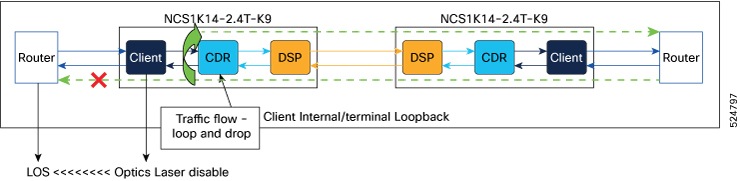
When you apply an internal loopback on a client Ethernet controller, the transmit power is disabled. This mechanism is applicable for both breakout and non-breakout setups. In a breakout setup, power is turned off on the specific lane where the loopback is configured, whereas in a non-breakout setup, power is shut down on all the lanes. This power shutdown prevents traffic from traveling beyond the client port to the near-end router as indicated by the cross mark in this image.
Line loop-and-drop
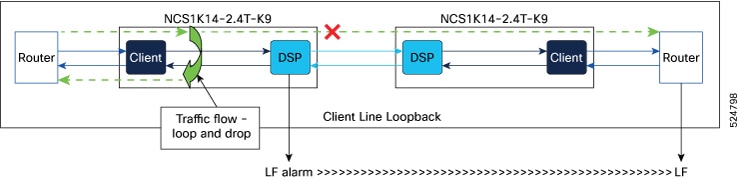
When you apply a line loopback on a specific client Ethernet controller, the system forces a local fault (LF) signal on the near-end in the egress direction. This LF signal then propagates towards the far-end, preventing the traffic from flowing towards the far-end router as indicated by the cross mark in this image.
Supported cards
This mechanism is supported on these cards:
-
NCS1K14-2.4T-K9
-
NCS1K14-2.4T-X-K9
-
NCS1K4-QXP-K9
-
NCS1K4-2-QDD-C-K9
-
NCS1K14-OXP2-K9
-
NCS1K4-1.2T-K9 (supports only internal loop-and-drop)
-
NCS1K4-1.2TL-K9 (supports only internal loop-and-drop)
Applying a line loopback on the client Ethernet controller of the NCS1K4-2-QDD-C-K9 card triggers a "Loss of Synchronization on Data Interface (SYNCLOSS)" alarm. This behavior is expected.