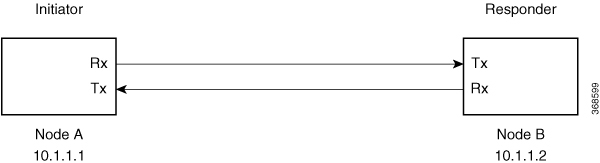
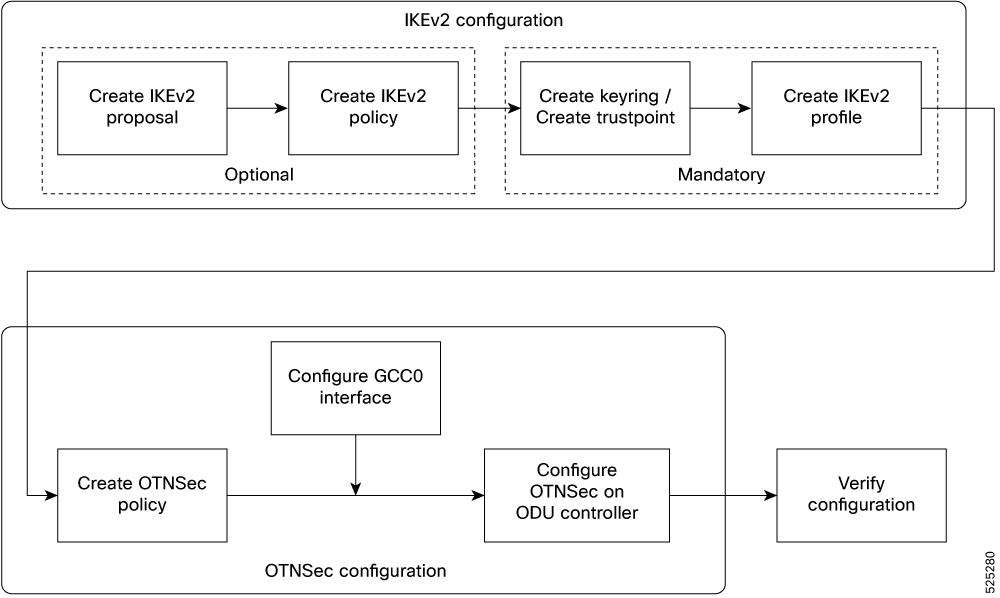
This section explains the main attributes and constructs of IKEv2 protocols used for secure authentication and encryption in Cisco NCS network environments.
IKEv2 is a request and response encryption protocol that establishes and handles security associations (SA) in an authentication suite, such as OTNSec, to ensure secure traffic.
IKEv2 is defined in RFC 7296 and consists of the following constructs:
-
Keyring
-
IKEv2 profile
-
IKEv2 proposal
-
IKEv2 policy
Keyring
A keyring is a repository of symmetric and asymmetric pre-shared keys that is configured for a peer and identified using the IP address of the peer. The keyring is associated with an IKEv2 profile and therefore, caters to a set of peers that match the IKEv2 profile. This is a required configuration for the pre-shared keys authentication method that is used for NCS 1004.
The certificate-based authentication that uses RSA signatures can be used instead of the keyring. If both methods of authentication are configured, the certificate-based authentication takes precedence. See IKEv2 certificate-based authentication.
IKEv2 profile
An IKEv2 profile is a repository of nonnegotiable parameters of the IKE SA, such as authentication method and services that are available to the authenticated peers that match the profile. The profile match lookup is done based on the IP address of the remote identity.
For security purposes, the IKE SAs have a lifetime that is defined in the IKEv2 profile. The lifetime range, in seconds, is from 120 to 86400. The SAs are rekeyed proactively before the expiry of the lifetime. The default lifetime is 86400.
An IKEv2 profile must be attached to an OTNSec configuration on the ODU controllers on both the IKEv2 initiator and responder. This is a required configuration.
IKEv2 proposal
An IKEv2 proposal is a collection of transforms that are used in the negotiation of IKE SAs as part of the IKE_SA_INIT exchange. The IKE2 proposal must be attached to an IKEv2 policy. This is an optional configuration. The transform types used in the negotiation are as follows:
-
Encryption algorithm
-
Integrity algorithm
-
Pseudo-Random Function (PRF) algorithm
-
Diffie-Hellman (DH) group
The IKEv2 proposal must have at least one algorithm of each type. It is possible to specify multiple algorithms for each type; the order in which the algorithms are specified determines the precedence.
IKEv2 policy
IKEv2 employs policies that are configured on each peer to negotiate handshakes between the two peers. An IKEv2 policy contains proposals that are used to negotiate the encryption, integrity, PRF algorithms, and DH group in the SA_INIT exchange. An IKEv2 policy is selected based on the local IP address. This is an optional configuration.
The default IKEv2 proposal is used with default IKEv2 policy in the absence of any user-defined policy.