Overview
Explains the fundamental mechanics of distance-vector routing and the specific enhancements provided by RIPv2 and RIPng. Learn how the protocol uses hop counts and OMP route tagging to maintain reachability and prevent loops in your network topology.
RIPv2 (RIP for IPv4)
The Routing Information Protocol (RIP) is a distance-vector algorithm-based routing protocol that uses broadcast or multicast User Datagram Protocol (UDP) data packets to exchange routing information. It is commonly used in small to medium TCP/IP networks. Cisco IOS software sends routing information updates every 30 seconds, termed as advertising, at regular intervals and when the network topology changes.
RIP Version 2 (RIPv2) is the Cisco IOS software implementation of RIP for IPv4 networks. Each RIP process maintains a local database containing best-cost RIP routes learned from neighboring RIP-enabled routers. Route redistribution allows routes to be specified by a prefix, using a route map and prefix list.
Routing Information Protocol next generation (RIPng) is a UDP-based protocol designed for communicating routing information to compute routes through IPv6 networks. RIPng enhancements for IPv6, detailed in RFC 2080, include support for IPv6 addresses and prefixes.
Key Features of RIPv2
The Cisco implementation of RIPv2 supports:
-
Plain text and Message Digest Algorithm 5 (MD5) authentication.
-
Route summarization.
-
Classless Inter-Domain Routing (CIDR).
-
Variable-Length Subnet Masks (VLSMs).
If you are sending and receiving RIPv2 packets, we recommend that you enable RIP authentication on an interface because RIPv1 does not support authentication. Plain text authentication is the default authentication in every RIPv2 packet.
Default Behavior and Configuration (RIPv2)
By default, the software receives RIP Version 1 (RIPv1) and RIPv2 packets but sends only RIPv1 packets. You can configure the software to receive and send only RIPv1 packets, or only RIPv2 packets. The RIP version that an interface sends can be configured to override this default behavior, and the processing of received packets can also be controlled. RIPv2 is supported on both the service side and transport side.
For network configuration, we recommend that you use Classful IP Network ID Addressing.
RIPng Redistribution Support
As an Interior Gateway Protocol (IGP), RIPng supports the redistribution of:
-
OMP routes into RIP
-
RIP routes into OMP
-
RIP routes into OSPFv3
-
OSPFv3 routes into RIP
-
Static routes into RIP
-
RIP routes into static
-
Connect routes into RIP
-
RIP routes into connect
Each router that implements RIPng requires a routing table containing the following fields:
-
The IPv6 prefix of the destination.
-
Metric: The total cost of the metric advertised for the address.
-
Route Tag: A route attribute that must be advertised and redistributed with the route.
-
Next-hop IPv6 address of the destination.
-
Various timers associated with the routes.
RIPng VRF-aware Support
When not in Virtual Routing and Forwarding (VRF) mode, every IPv6 RIPng process and its associated configuration maintain all routes in the same routing table. IPv6 RIPng VRF-aware support enhances isolation, modularity, and potential performance by reducing the number of routes stored in a single routing table. It also allows network administrators to create different RIP routing tables and share a single protocol configuration block.
RIPng Loop Avoidance
RIPng in large networks is prone to routing loops, which can result in traffic taking longer paths. To avoid route looping, RIP and RIPng routes are identified using the well-known OMP RIP tag.
The following process illustrates how OMP route tagging helps avoid routing loops in RIPv2 and RIPng:
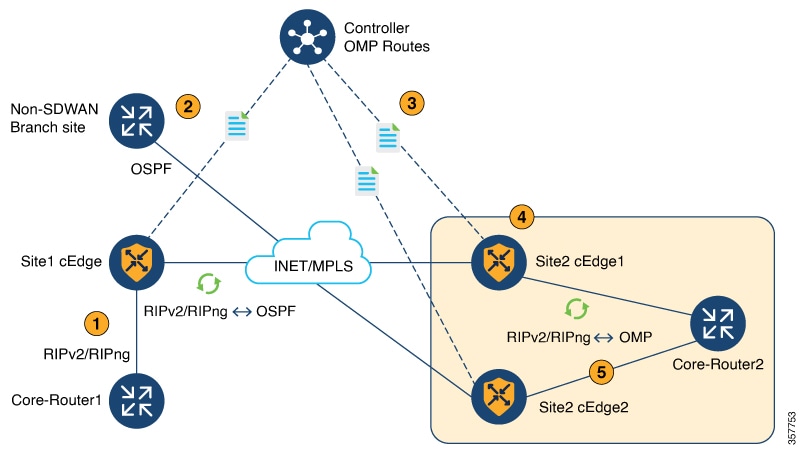
Core-Router1 advertises RIPv2 and RIPng routes to Site1.
RIPv2 and RIPng routes have a default administrative distance of 120, while OMP routes have a default administrative distance of 251.-
The RIPv2 and RIPng route is redistributed and advertised in OMP.
-
The Cisco Catalyst SD-WAN Controller advertises an OMP route to the other branch.
-
Site-2 Edge1 router adds an OMP route tag of a unique value (e.g., 44270) and redistributes the OMP-learned route into RIPv2 and RIPng.
-
When the Site-2 Edge2 router receives this route with the tag 44270, it will not install this route because it is already learning a route through OMP, which has an administrative distance (AD) of 251 (preferred over 120).
If the OMP route is withdrawn, the Site-2 Edge2 router installs the route learned through the RIPv2 and RIPng protocol via a service-side VPN with the tag 44270, into the routing table with an administrative distance of 252 (one value higher than that of OMP).
Additionally, a Cisco Catalyst SD-WAN tagged route will not be readvertised in OMP when the RIPv2 and RIPng route is redistributed to OMP.
See Configure RIPng using the CLI for more details on RIPng configurations using the CLI.