Cisco Routed Optical Networking Solution Guide, Release 4.0

PDF

Components of automation

Want to summarize with AI?

Log in

Overview

This section provides details about the automation software components that manage, provision, monitor, and orchestrate Routed Optical Networking services. It introduces the roles of Crosswork, NSO, Cisco Optical Network Controller, Cisco Optical Site Manager, and EPNM.

Automation of the Routed Optical Networking solution follows the IETF ACTN SDN controller framework. Cisco Optical Network Controller is the Cisco optical domain PNC and Crosswork Network Controller is the multivendor IP-domain PNC. Crosswork Hierarchical Controller unifies IP and optical information from Cisco Optical Network Controller and Crosswork Network Controller. It provides multilayer and multidomain visualization, Routed Optical Networking service assurance, and Routed Optical Networking service management in the MDSC role.
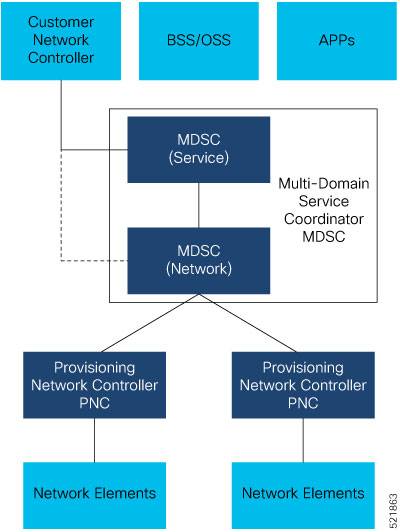
Figure 1. IETF ACTN – open automation reference framework

Components of automation

The automation stack consists of these components:

  • Crosswork Hierarchical Controller: manages Routed Optical Networking deployments by leveraging advanced multilayer and multivendor capabilities to provision and assure both IP and optical networks.

  • Cisco Optical Network Controller: (CONC) configures Cisco optical network elements, monitors the topology (physical or virtual) of networks, performs optical path computation, and collects topology information.

  • Crosswork Network Controller: simplifies and automates intent-based network service provisioning, monitoring, and path optimization in an IP multi-vendor network environment with a common GUI and API.

  • Evolved Programmable Network Manager (EPNM): performs deep inventory and is an element management system that manages device lifecycles for converged IP and optical networks. EPNM also collects fault and alarm information, and performs node-level performance measurement statistics collection.

Routed Optical Networking automation solution architecture

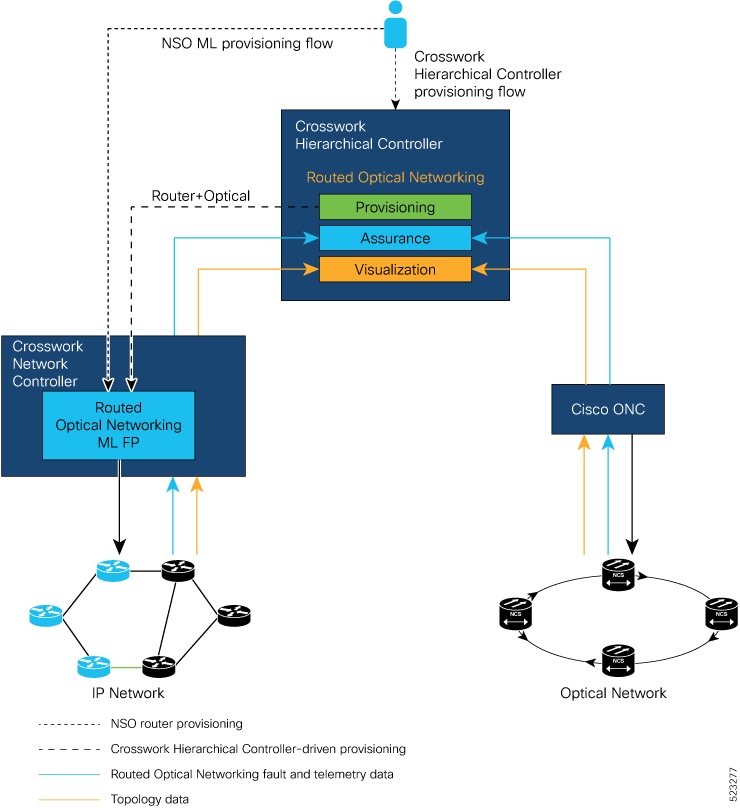
This diagram provides a high-level illustration of how the components of the solution work together.
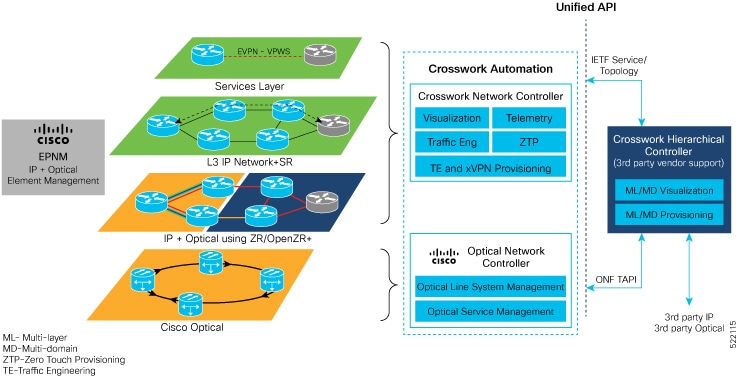
Figure 2. Routed Optical Networking automation architecture
Routed Optical Networking automation architecture
Table 1. Automation software roles

Automation software

Roles

SR-PCE
  • Packet layer PCE

  • Required to advertise IGP topology to Cisco Crosswork Network Controller

  • Uses BGP-LS to the network for IGP topology

  • Can run as virtual router or on a hardware router

Crosswork Network Controller
  • IP domain controller

  • Crosswork Network Controller Essentials package is required for Routed Optical Networking

  • RESTConf API covering provisioning, data collection, and topology

  • EMS app is recommended to collect device-level inventory and alarms

Cisco Crosswork Data Gateway
  • Router data collection

  • Required by Cisco Crosswork Network Controller for all data collection

  • Required by the Hierarchical Controller for DCO-PM collection

Network Services Orchestrator
  • RON service management

  • RON core function pack is required to be installed for RON service management

  • Also used for connectivity verification

  • Communicates to routers using CLI NED

Cisco Optical Network Controller
  • Optical domain EMS and controller for NCS 101x

  • Exposes the TAPI NBI interface for OLS topology, provisioning, and inventory

  • Communicates with Cisco Optical Site Manager for optical node management and provisioning

  • Power level data available for NCS 1010 as part of connection verification

Cisco Optical Site Manager
  • Optical site manager for NCS 1010

  • Embedded in 1010 XR, a cluster is treated as a multishelf node and can run in active or standby mode.

  • Required component for Cisco Optical Network Controller 3.1 and later releases to communicate to nodes through NETCONF

Cisco Crosswork Hierarchical Controller
  • Multivendor or legacy IP plus optical

  • Communicates to Cisco Crosswork Network Controller through RESTCONF, telemetry through CDG through gRPC

  • Communicates to Cisco Optical Network Controller through RESTCONF TAPI, 1010 through RESTCONF and gRPC

  • Router inventory through XR CLI adapter

Cisco Evolved Programmable Network Manager
  • Router and OLS element management

  • Not used for RON service management in this solution

  • Collects inventory, alarm, and PM data from routers directly using NETCONF over CLI, syslog

  • Collects inventory, alarm, and PM data from NCS 2000 and NCS 1010


Features of Cisco Crosswork Hierarchical Controller

Cisco Crosswork Hierarchical Controller provides an API and single-pane-of-glass user interface for Routed Optical Networking infrastructure and services. It manages your existing optical and packet domains with the same unified approach. Routed Optical Networking with Crosswork Hierarchical Controller dramatically simplifies the operation of multilayer networks. These networks were previously managed independently using NMS and EMS products.

Crosswork Hierarchical Controller serves as a multidomain, multilayer, multivendor network controller. Crosswork Hierarchical Controller maps between IP and optical layer ports. This capability provides a comprehensive view of the network. The system interfaces with SDN Domain Controllers for the packet layers (IP, MPLS) and transport layers (WDM, OTN, and Packet-Optical) to create a coherent view of the entire transport network. Crosswork Hierarchical Controller enables automation of its functions. It also supports simplified, abstracted interactions with service orchestrators and OSS tools.

Key capabilities

The key capabilities of Crosswork Hierarchical Controller used by Routed Optical Networking are:

  • Multilayer discovery and visualization of Routed Optical Networking links allows you to create a trustworthy digital twin of your network. This digital twin can assist with operations and provide data to OSS tools.

  • Multilayer provisioning of 400G Routed Optical Networking links with a multi-layer provisioning interface through domain controllers.

  • End-to-end assurance of service across all domains enables you to meet strict service requirements.

This figure shows the workflow of Crosswork Hierarchical Controller.

Figure 3. Crosswork Hierarchical Controller workflow
Crosswork Hierarchical Controller workflow

Crosswork Hierarchical Controller adapters

Crosswork Hierarchical Controller uses adapters to connect to a device or management system and to collect information for the network model and configure the device.

The adapters installed as part of the Crosswork Hierarchical Controller installation are:

  • cisco-cnc-adpt: collects IP network topology, link state information, and router hardware inventory including discovery for DCO.

  • cisco-onc-adpt: adapter for Cisco optical network controller.

You can have multiple adapters of the same type. Each domain uses a separate Cisco Optical Network Controller adapter when several optical domains have different Cisco Optical Network Controller instances.

Crosswork Hierarchical Controller applications

The Crosswork Hierarchical Controller is a customized bundle of applications and adapters. This can be installed using an executable installer. The Crosswork Hierarchical Controller Web interface can be accessed using a custom URL.

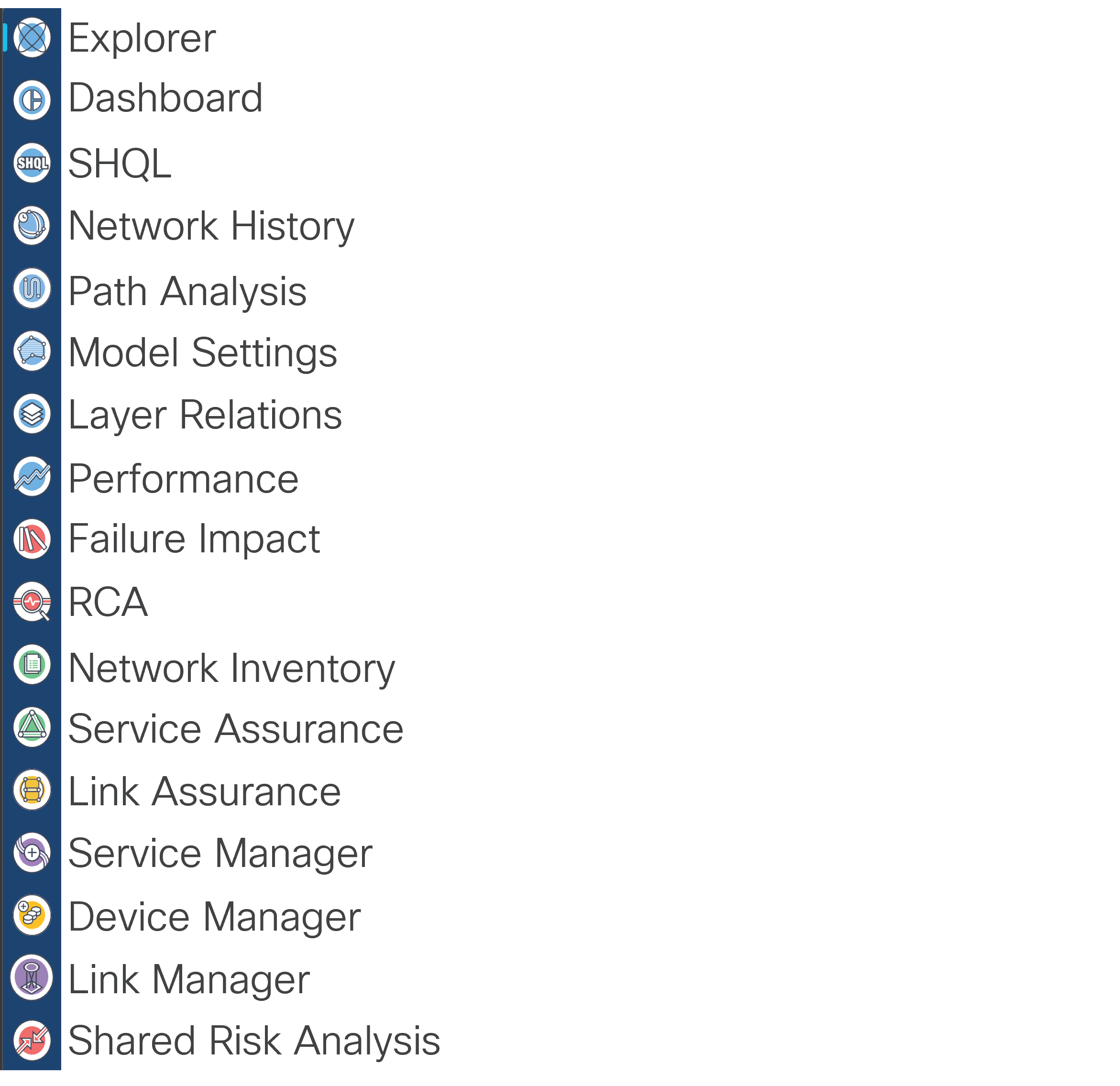
This figure shows the applications included in Crosswork Hierarchical Controller.

For more information about Cisco Crosswork Hierarchical Controller, see Cisco Crosswork Hierarchical Controller


Features and components of Cisco Crosswork Network Controller

Cisco Crosswork Network Controller (Crosswork Network Controller) is a network automation solution for deploying and operating IP and Routed Optical Networking converged transport networks. Crosswork Network Controller delivers increased service agility, cost efficiency, and optimization for faster time-to-customer value and lower operating costs.

The solution combines intent-based network automation to deliver critical capabilities for service orchestration and fulfillment, network optimization, service path computation, device deployment and management, and anomaly detection and automatic remediation. Using telemetry gathering and automated responses, Cisco Crosswork Network Controller provides network optimization capabilities that are difficult to replicate manually.

The integrated solution uses core capabilities from several products: Cisco Network Services Orchestrator (NSO), Cisco Segment Routing Path Computation Element (SR-PCE), and the Cisco Crosswork suite of applications. Its unified user interface allows real-time visualization of the network topology and transport provisioning.

Features of Cisco Crosswork Network Controller

The features of Crosswork Network Controller include:

  • Active Topology: The logical and geographical maps in Active Topology provide real-time visibility into the physical and logical network topology, service inventory, SR-TE policies, and RSVP-TE tunnels. Operators can quickly view the health and status of devices, services, and policies.

  • Common UI and API: All Crosswork Network Controller functionality is provided within a single, common GUI. This common UI brings together the features of all components of Crosswork Network Controller, including common inventory, network topology and service visualization, service and transport provisioning, and system administration and management functions.

  • Platform Infrastructure and Shared Services: The Platform Infrastructure provides a resilient and scalable platform on which all Cisco Crosswork applications can be deployed. It is a microservices-based platform that uses streaming telemetry and model-driven APIs to improve network operations of the service provider. The platform retrieves real-time network information, analyzes the data, and applies changes using APIs. The platform uses a cluster architecture for extensibility, scalability, and high availability.

Components of Cisco Crosswork Network Controller

The essential components of Crosswork Network Controller are:

  • Cisco Crosswork Optimization Engine: Cisco Crosswork Optimization Engine provides real-time network optimization allowing operators to effectively maximize network capacity utilization and increase service velocity. Crosswork Optimization Engine provides closed loop tracking of the network state and responds quickly to changes in network conditions, supporting automated network recovery.. For more information, see Cisco Crosswork Optimization Engine Data Sheet.

  • Cisco Crosswork Data Gateway: Cisco Crosswork Data Gateway (Crosswork Data Gateway) is a secure, common collection platform for gathering network data from multivendor devices. It is an on-premise application that is deployed close to network devices. Crosswork Data Gateway supports multiple data collection protocols including MDT, SNMP, CLI, standards-based gNMI (dial-in), and syslog. Crosswork Data Gateway can collect any type of data as long as the data can be delivered over one of the supported protocols. See Cisco Crosswork Data Gateway Data Sheet.

  • Cisco Segment Routing Path Computation Element: Cisco Segment Routing Path Computation Element (SR-PCE) is an IOS-XR multidomain stateful Path Computation Engine (PCE) supporting both segment routing (SR) and Resource Reservation Protocol (RSVP). Cisco SR-PCE builds on the native PCE abilities within IOS-XR devices, and provides the ability to collect topology and segment routing IDs through BGP-LS, calculates paths that adhere to service SLAs, and programs them into the source router as an ordered list of segments. A Path Computation Client (PCC) reports and delegates control of headend tunnels that are sourced from the PCC to a PCE peer. The PCC and PCE establish a Path Computation Element Communication Protocol (PCEP) connection that the SR-PCE uses to push updates to the network and reoptimize paths where necessary.

  • Cisco Network Services Orchestrator (NSO) Function Packs: Cisco Crosswork Network Controller is packaged with these Cisco NSO function packs:

    • SR-TE core function pack (CFP)

    • Sample function packs for provisioning IETF-compliant L2VPN and L3VPN

    • Sample RSVP-TE function pack that is IETF-compliant

The optional components of Crosswork Network Controller are:

  • Cisco Crosswork Health Insights: Cisco Crosswork Health Insights is a network health application that performs real-time Key Performance Indicator (KPI) monitoring, alerting, and troubleshooting. Cisco Crosswork Health Insights enables programmable monitoring and analytics. It provides a platform for dynamically addressing changes to the network infrastructure. See Cisco Crosswork Change Automation and Health Insights Data Sheet.

  • Cisco Crosswork Zero-Touch Provisioning: The Cisco Crosswork Zero-Touch Provisioning (ZTP) application is an integrated solution for onboarding and provisioning new IOS XR devices automatically. ZTP results in faster deployment of new hardware at lower operating costs. Operators can provision devices using a Cisco-certified software image and a day-zero software configuration. Once provisioned in this way, the new device is onboarded to the Crosswork device inventory where it can be monitored and managed like other devices. See Cisco Crosswork Zero–Touch Provisioning Data Sheet.

  • Cisco Service Health: Service Health substantially reduces the time required to detect and troubleshoot service quality issues. It monitors the health status of provisioned Layer 2 and Layer 3 VPN services and enables operators to pinpoint why and where a service is degraded. It provides service-specific monitoring, troubleshooting, assurance, and proactive root cause identification using a heuristic model that visualizes these elements:

    • Health status of subservices to a map when a single service is selected.

    • Service logical dependency tree and help the operator in troubleshooting in case of degradation by locating where the problem resides, an indication of possible symptoms, and impacting metrics in case of degradation.

    • Historical view of service health status up to 60 days.

  • Crosswork EMS Services: Element Management System (EMS) services are bundled with the Crosswork Network Controller Advantage pack. The EMS functions include inventory, fault, and Software Image Management (SWIM).

    • Inventory service integrates deep inventory collection with the Device Lifecycle Management (DLM) feature of Cisco Crosswork. It enriches the existing device onboarding workflow to gather more insights about the device. Built-in device packages enable deep inventory collection when the user manually attaches a device to the Crosswork Data Gateway. The system stores the collected information in the database and monitors it using the Inventory APIs.

    • Fault service is associated with alarm management. It provides API support for subscription, request, retrieval, and auto-clearing of alarms for Topology Visualization services. Monitored using the Fault APIs, the fault service improves the existing topology views by showing the alarm status for devices and links.

    • SWIM is integrated with Crosswork Change Automation and managed with SWIM APIs. It enables operators to view, import, delete, and push software images to devices in the network. SWIM accelerates upgrades, improves compliance, and enhances the network engineer experience.

Cisco Crosswork Network Controller is multivendor capable for

  • network service orchestration,

  • telemetry data collection,

  • topology and transport discovery,

  • transport path computation, and

  • device performance measurement.

For more information about Cisco Crosswork Network Controller, see the Cisco Crosswork Network Controller Data Sheet.


Features of Cisco Optical Network Controller

Cisco Optical Network Controller (Optical Network Controller) is a domain controller for optical networks and provides data to Hierarchical Controllers. Optical Network Controller provides centralized network management and control for optical environments.

Features

The features of Optical Network Controller include:

  • SDN domain controller functionality: collects and abstracts optical network data for higher-layer controllers.

  • Standardized TAPI model support: abstracts device-level details, enabling hierarchical control and orchestration.

  • Provisioning and monitoring: configures network elements, monitors physical and virtual topologies, and collects topology information.

  • Application extensibility: supports addition of optical applications to improve hardware capability.

  • Centralized control loop functions: maintains and programs optical hardware components efficiently.

For more information about Cisco Optical Network Controller, see the Cisco Optical Network Controller Data Sheet.


Features of Cisco Optical Site Manager

Cisco Optical Site Manager is a software application deployed on NCS 1010 or NCS 1014 controller cards. The software application can be enabled on one or two controllers to provide high availability. Cisco Optical Site Manager software instances use open Netconf or YANG Northbound Interfaces to aggregate current and future NCS 1000 devices at a site. The application provides an abstracted site or node view to the Cisco Optical Network Controller or a third-party controller. Cisco Optical Site Manager also provides a Web user interface for site-level operation and maintenance.

Features

Cisco Optical Site Manager provides these features:

  • Seamless integration with Cisco Optical Network Controller for SDN automation

  • OLS (Open Line System) site, OT (Open Terminal) site, or OLS+OT site abstraction

  • Site aggregation, topology, and nodal functional view

  • Site-level database information including inventory, site topology, correlated alarms, and performance monitoring

  • Retention of current performance monitoring data up to the last 32 bins

  • Connection verification, loopbacks, PRBS, OTDR, and TCA

  • Web user interface with site-level management

  • Mechanical layout for chassis, cards, and passive devices

  • Card and module configurations

Cisco Optical Site Manager works with Cisco Optical Network Controller. It can also function as a standalone tool for Local Craft, which is useful for deployments or local management.

For information about installing and setting up Cisco Optical Site Manager, see System Setup and Software Installation Guide for Cisco Optical Site Manager

For more information about Cisco Optical Site Manager, see the Cisco Optical Site Manager Data Sheet.


Features of Cisco Network Services Orchestrator

Cisco Network Services Orchestrator (NSO) provides comprehensive orchestration and lifecycle management across physical and virtual network functions.

Features

The features of Cisco NSO include

  • pluggable function packs to translate network wide service intent into device-specific configuration

  • flexible service orchestration and lifecycle management across physical and cloud based virtual network functions (VNFs)

  • multivendor support and compatibility with multiple technology stacks

  • rich set of APIs that enable developers to implement service applications and extend automation

  • support for YANG data models to define and execute customer service configurations

  • consistent operational model for physical and virtual network elements, and

  • seamless orchestration in multivendor environments and across different device types.

For more information about Cisco Network Services Orchestrator, see Cisco Network Services Orchestrator Data Sheet.


Functions of Cisco NSO Routed Optical Networking function pack

The NSO Routed Optical Networking CFP uses NSO to automate device management in a Routed Optical Networking network. It also performs end-to-end service provisioning across the IP and optical layers. The NSO Routed Optical Networking CFP uses the same NSO instance as Crosswork Network Controller.

Routed Optical Networking ML service

The Routed Optical Networking ML service connects two DWDM optical ports with a fixed bandwidth of either 100G, 200G, 300G, or 400G between the routers. This service is characterized by a single DWDM wavelength.

The Routed Optical Networking ML service helps to

  • provision line card modes to support 100G and 400G digital coherent optics

  • configure the optical parameters on the digital coherent optics

  • assign IP address to Ethernet interfaces or bundle interfaces, and

  • bundle discrete Ethernet interfaces.

Functions of Routed Optical Networking ML function pack

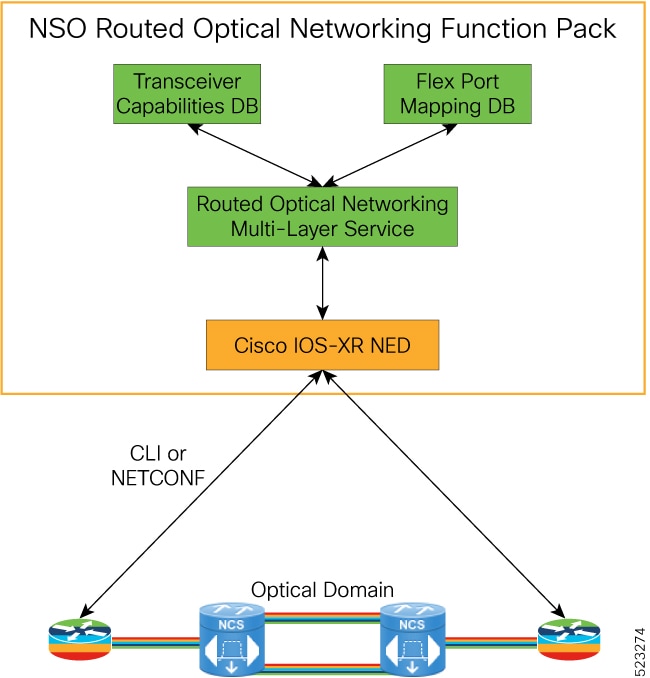
Figure 4. Routed Optical Networking ML function pack

This table describes the functions of various components of the Routed Optical Networking ML function pack.

Component

Function

Flex-port mapping DB

Maintains chassis and line card PID database for ports that must be pre-provisioned before the ZR configuration. NCS57-18DD-SE and ASR 9000 multi-rate line cards must be pre-provisioned.

Transceiver capabilities DB

Maps ZR and ZR+ optics PIDs to capabilities. For example, ZR supports 400G, 4x100G; ZR+ supports 100G, 2x100G, 3x100G, 4x100G, or 400G.

Routed Optical Networking ML service

Performs ZR and ZR+ optical layer configuration. The function pack can also optionally configure IP layer LAG membership and IP addressing.

Cisco IOS-XR NED

Provisions router elements. NSO network equipment driver used for southbound communication with routers.

Note

The inter-layer link services are user-defined. Flex-port mapping and transceiver capabilities are installed as part of the function pack, but can be modified by the user.


Features of Cisco Evolved Programmable Network Manager

The Cisco Evolved Programmable Network Manager (EPNM) is an all-in-one management solution for today’s converging packet and optical networks. Cisco EPNM supports the Cisco Routed Optical Network architecture. It provides Cisco Optical and IP full device management, as well as Cisco optical circuit network assurance. Cisco EPNM discovers the physical and logical configuration of managed devices and represents them. Cisco EPNM provides full software image management and configuration management for Cisco optical and IP devices.

Network operators see a live view of the device through a graphical chassis with status indications. EPNM stands out from other network management systems by discovering optical circuits from the network and maintaining an up-to-date representation of both the optical circuit and infrastructure dependencies.

EPNM reduces the time required to identify conditions that affect the network or optical circuits. It correlates raw events and associates alarm conditions with affected managed network elements, network connectivity, and circuits. Contextual dashboards and 360-degree device and port-level views present relevant information that helps network operators identify and resolve problems quickly and efficiently.

EPNM reduces restoration and repair time by guiding troubleshooting. It uses alarm correlation, identifies affected components or optical circuits, and analyzes connectivity. EPNM collects fault and alarm information. It performs node-level performance statistics measurement.

For more information about Cisco Evolved Programmable Network Manager, see the Cisco Evolved Programmable Network Manager Data Sheet.


Software versions of Routed Optical Networking components

Component Software version

SR PCE

IOS-XR 25.2.1

Cisco Crosswork Infrastructure

7.1
Crosswork Network Controller cApps 7.1
Crosswork Data Gateway 7.1
Network Services Orchestrator 6.4.1.1
Cisco Optical Network Controller (CONC) 25.1.2
Cisco Optical Site Manager (COSM) 25.1.1
Crosswork Hierarchical Controller 11.0
Cisco Evolved Programmable Network Manager 7.1.x or 8.x
Cisco Optical Network Planner 7.1