This section compares traditional multilayer network designs with the Routed Optical Networking model. It shows how collapsing functions into a converged architecture reduces duplication and improves service visibility across IP and optical layers.
Routed Optical Networking architecture unifies the WDM, OTN, and packet transport layers into a single, easy-to-control layer.
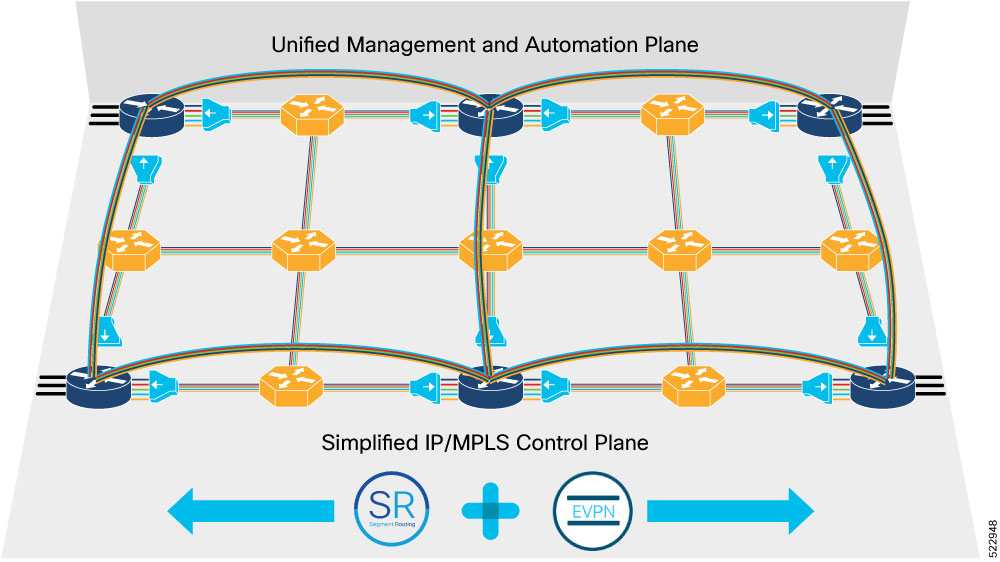
Agile Services Networking transport architecture
The Agile Services Networking architecture simplifies the network by converging services on a unified, automated infrastructure, providing scalability and agility for new services in the AI era and beyond. See Agile Services Networking.
Routed Optical Networking as part of Cisco’s Agile Services Networking architecture brings network simplification to the physical network infrastructure, just as EVPN and Segment Routing simplify the service and traffic engineering network layers. Routed Optical Networking collapses complex technologies and network layers into a more cost efficient and easy to manage network infrastructure.
Routed Optical Networking achieves this architecture by leveraging high-density routers, high-capacity digital coherent pluggable optical modules, simplified optical elements, and advanced automation capabilities. Components of Routed Optical Network are also fully compliant ROADM-based networks and can interoperate seamlessly with a mix or traditional transponders and Routed Optical Networking pluggable DCO.
The converged architecture enables
-
unified planning and design
-
seamless multi-layer provisioning
-
unified multi-layer management
-
end-to-end multi-layer and multi-domain network visibility
-
end-to-end network optimization for IP and private line services, and
-
convergence of IP and private line services on a single converged packet network infrastructure with guaranteed SLAs.
Comparison of legacy multilayered and Routed Optical Networking architectures
This table compares legacy multilayered and Routed Optical Networking architectures.
| Layered architecture | Routed Optical Networking architecture |
|---|---|
|
Trades off port density and capacity on router line cards for coherent optical transmission |
Higher port density and capacity on the router line cards using digital coherent pluggable optical modules |
|
Proprietary components; noninteroperable |
Standards-based approach; interoperable across vendors |
|
Siloed approach; separate control and management planes |
Common control and management planes for converged optical and IP layer |
|
Manual service stitching necessary across network domains |
Enables end-to-end closed-loop automation and manageability |
|
Independent capacity planning on IP and optical layers, where additional capacity is dimensioned on each layer separately leading to CapEx inefficiencies. |
Unified capacity planning on a converged network optimizing CapEx investments |