Overview
This section describes the workflow used by the NSO Routed Optical Networking multilayer service. It describes how service requests are validated, mapped to transceiver capabilities, translated into device configuration, and pushed to endpoints.
Summary
The Routed Optical Networking ML service performs several operations to provision an end-to-end service using Cisco routers with ZR or ZR+ optics.
Workflow
This diagram displays the NSO Routed Optical Networking ML service workflow for an end-to-end service using Cisco routers with ZR or ZR+ optics.
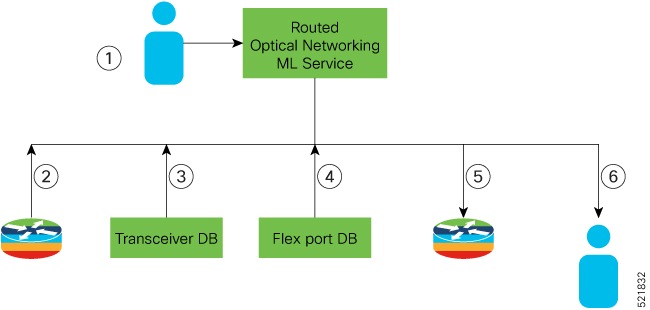
These stages describe the workflow of the Routed Optical Networking ML service.
-
The user initiates the Routed Optical Networking ML provisioning request.
-
The Routed Optical Networking ML service retrieves the transceiver and line card PIDs for each router endpoint using Routed Optical Networking CLI NED.
-
The Routed Optical Networking ML service compares the received transceiver PIDs and determines whether the transceivers can support the service.
-
The Routed Optical Networking ML service compares the received line card PIDs and determines whether the line cards require configuration.
-
The Routed Optical Networking ML service provisions the router optics ports. It optionally performs bundle and IP configuration using the Cisco YANG models.
-
The Routed Optical Networking ML service stores the service information as NSO operational data and also returns the service state to the user.