This section provides details about the target Routed Optical Networking architecture and its service capabilities. It describes how the solution supports end-to-end visibility, optimization, and convergence of IP and private line services.
Multilayer architecture
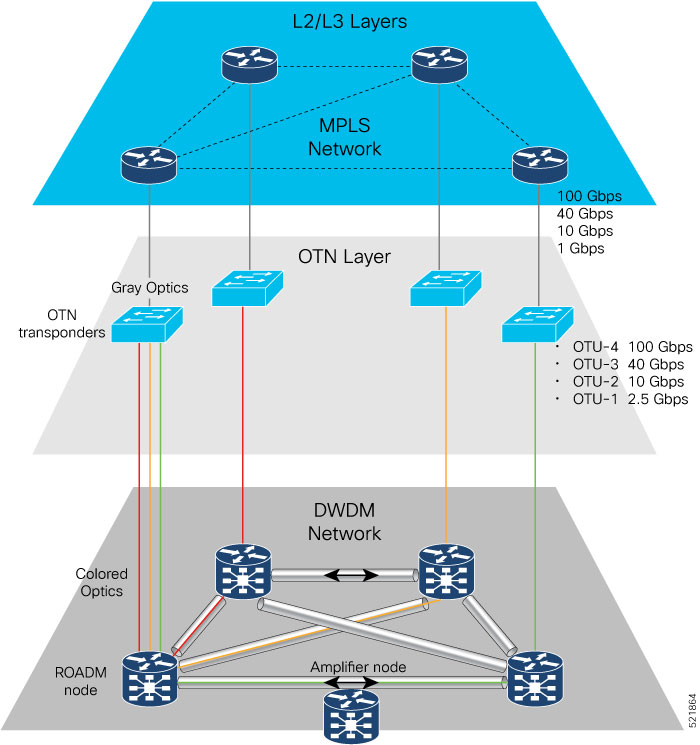
This diagram displays the current multilayer architecture.
Routed Optical Networking architecture
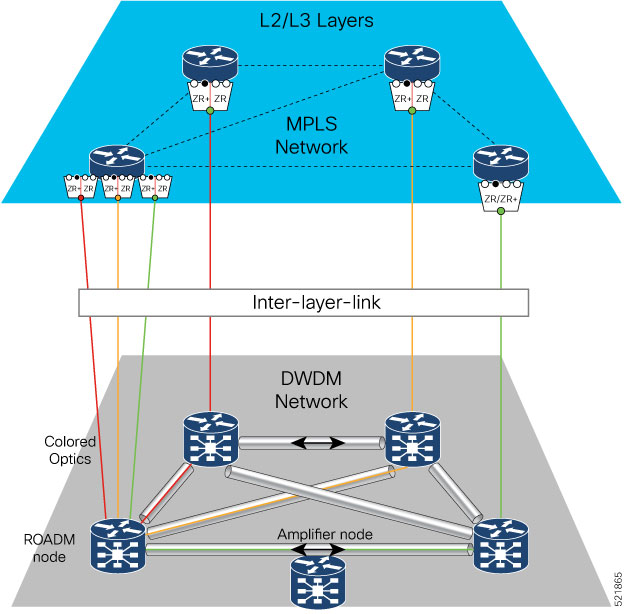
Routed Optical Networking is a transformative architecture that disrupts the existing multilayer network architecture. It converges all network services into a single layer.
The routers are connected through dark fiber or a DWDM network using standardized pluggable digital coherent optics, such as ZR and ZR+ transceivers. These transceivers reduce cabling, power consumption, and physical footprint compared to traditional external transponders.
With a single service layer based on IP, flexible management tools can leverage telemetry and model-driven programmability to streamline lifecycle operations. This simplified architecture integrates open data models and standard APIs, enabling a provider to focus on automation initiatives for a simpler topology.
This diagram displays the Routed Optical Networking architecture.