Overview
This section explains the core IP and optical components used in traditional hierarchical networks. It helps readers understand the router, transponder, ROADM, amplifier, and management elements that form the baseline network architecture.
Traditional hierarchical networks consist of an IP layer and an optical transport layer.
IP layer
The IP layer creates and maintains the routing table and forwards packets accordingly. The IP layer of traditional networks consists of interconnected routers.
Routers
Routers are the building blocks of packet networks. They efficiently forward IP or MPLS packets. Routers create any-to-any fabrics to carry most networking traffic, including global Internet traffic. Routers are also responsible for providing different functions based on their role in the network.
Two examples of routers are Core and Provider Edge routers. Core routers use a simplified set of implemented features and supply high capacity interconnect between different regions in a network. Provider Edge (PE) routers support high scale overlay VPN services.
Optical layer
This diagram shows a typical DWDM network.
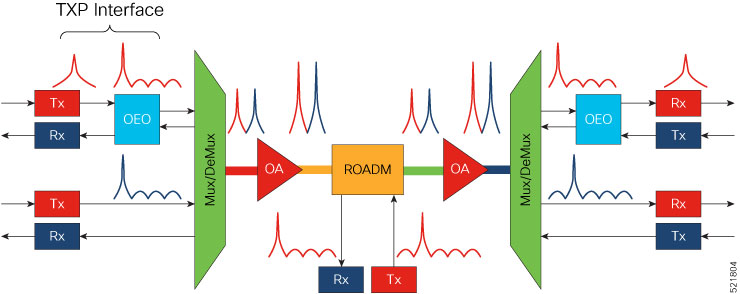
This table lists the abbreviations in this image and their expansions.
| TXP |
Transponder |
| OEO |
Optical-electrical-optical |
| Mux |
Multiplexer |
| DeMux |
Demultiplexer |
| OA |
Optical amplifier |
| ROADM |
Reconfigurable optical add/drop multiplexer |
Building blocks of a typical DWDM network
These are the key building blocks of a typical DWDM network.
-
Optical Transmitters and Receivers: Transmitters provide source signals. They convert digital electrical signals into a light stream of a specific wavelength. Optical receivers detect pulses of light on optical fibers and convert the optical signals into electrical signals.
-
Transponders: Transponders take signals on gray wavelengths and send them in colored wavelengths. Colored wavelengths are wavelengths in the WDM standard. Gray wavelengths are wavelengths not in the WDM standard. A bidirectional transponder also receives a WDM standard bit-stream and converts the signals back to the wavelength used by the client device.
-
Muxponders: Muxponders are similar to transponders. Muxponders take multiple gray wavelength signals and send them in a single colored-wavelength using Time Division Multiplexing (TDM).
-
Multiplexers and Demultiplexers: Multiplexers combine multiple wavelengths from separate fibers into a single composite signal within one fiber. The output of a multiplexer is a composite signal. Demultiplexers take composite signals that compatible multiplexers generate and separate the individual wavelengths into individual fibers.
-
Optical Amplifiers: Optical amplifiers amplify an optical signal. Optical amplifiers increase the total power of the optical signal, enabling its transmission across longer distances. Without amplifiers, the signal attenuation over such distances makes it impossible to coherently receive signals. We use different types of optical amplifiers in optical networks, such as preamplifiers, booster amplifiers, inline amplifiers, and optical line amplifiers.
-
Optical Add and Drop Multiplexers (OADMs): OADMs are devices capable of adding one or more DWDM channels into or dropping them from a fiber.
-
Reconfigurable Optical Add and Drop Multiplexers (ROADMs): ROADMs are programmable versions of OADMs. With ROADMs, you can change the wavelengths that are added or dropped. ROADMs make optical networks flexible and easily modifiable.