This section explains how conventional IP, DWDM, and optional OTN layers are organized and managed. It highlights the separate control and management planes that increase coordination effort across network teams.
Traditional network infrastructure consists of an Internet Protocol (IP) layer and an optical transport layer. The optical layer includes a Dense Wavelength Division Multiplexing (DWDM) layer, and optionally, an Optical Transport Network (OTN) switching layer. Each layer possesses its own independent control and management planes.
Types of control planes
-
Distributed control plane: communicates network information between network elements to enable end-to-end communication between network clients.
-
IP control plane: distributes routing information.
-
Optical control plane: performs resource and connection management between optical endpoints.
Network layers and control planes
This table lists the network layers and their corresponding control planes.
| Network layers | Control planes |
|---|---|
| Packet layer or IP layer | BGP, IGP, and segment routing |
| OTN layer | Automatically Switched Optical Network (ASON) and Generalized Multiprotocol Label Switching (GMPLS) |
| DWDM layer | Wavelength Switched Optical Network (WSON) and Shared Services and Outsourcing Network (SSON) |
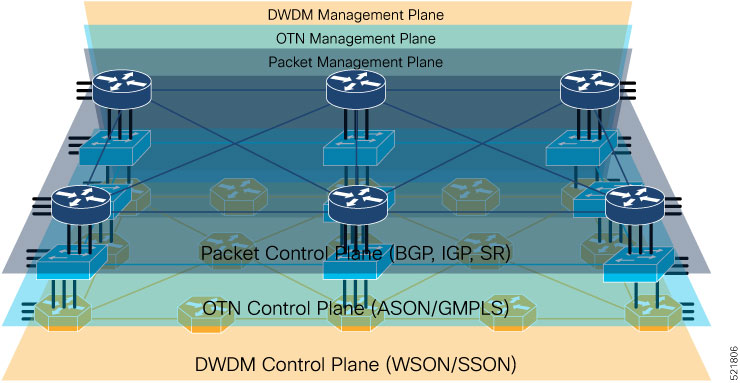
Each layer operates independently with separate redundancy and life cycles. Separate teams are needed to establish and maintain each layer.