This section explains circuit-style segment routing properties for PLE transport. It describes bandwidth reservation, working and protect paths, candidate path behavior, liveness detection, and path constraints used to emulate circuit behavior.
Segment routing provides an architecture that caters to both IP-centric transport and connection-oriented transport. IP-centric transport uses the benefits of ECMP and automated protection from Topology-Independent Loop-Free Alternate (TI-LFA).
Connection-oriented transport, which was historically delivered over circuit-switched SONET/SDH networks, must require
-
end-to-end bidirectional transport that provides congruent forward and reverse paths, predictable latency, and disjointness
-
bandwidth commitment to ensure that there is no impact on the SLA due to network load from other services
-
monitoring and maintenance of path integrity with end-to-end 50-millisecond path protection, and
-
persistent end-to-end paths regardless of the state of the control plane.
Properties of circuit-style segment routing policies
Circuit-style segment routing (CS-SR) policies provide these properties:
-
Guaranteed latency over non-Equal-Cost Multi-Path (ECMP) paths
-
Control-plane independent persistency
-
Corouted bidirectional path
-
Liveness monitoring with path protection switching
-
Guaranteed bandwidth
Guaranteed latency over non-ECMP paths
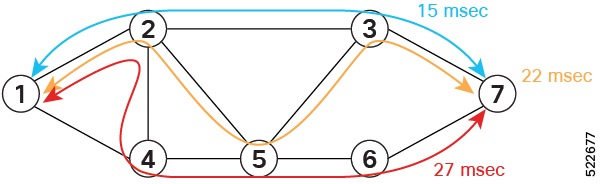
Consider this network with three possible paths from node 1 to node 7. Of the three paths, the best end-to-end delay is provided by the blue path (1 -> 2 -> 3 -> 7). The chosen path is then encoded with adjacency SIDs corresponding to the traversed interfaces to avoid any ECMP. This approach guarantees latency over the path.
Control-plane independent persistency
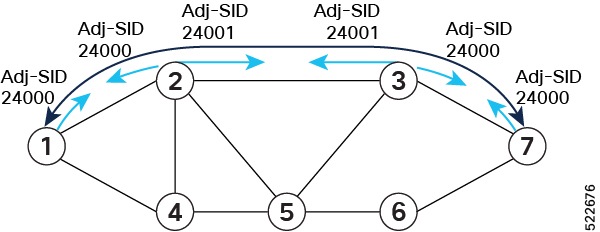
Adjacency SIDs can provide a persistent path independent from control-plane changes such as IGP neighbor flaps and network events such as interface additions, interface flaps, or even the presence of IP on an interface. To achieve this, manually allocate adjacency SIDs to ensure persistent values. For example, this applies after a node reload event. You can also program adjacency SIDs as non-protected to avoid local TI-LFA protection.
The path from node 1 to node 7 is encoded with the segment list of {24000, 24001, 24000} with the adjacency SIDs depicted in this figure. You can encode the path from node 7 to node 1 with the same segment list: {24000, 24001, 24000} by manually allocating the same adjacency SID values for the other direction.
Corouted bidirectional path
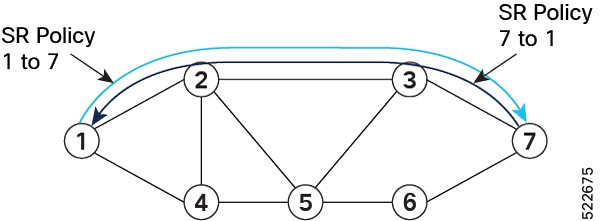
Forward and return segment routing policies with congruent paths are routed along the same nodes.
Liveness monitoring with path protection switching
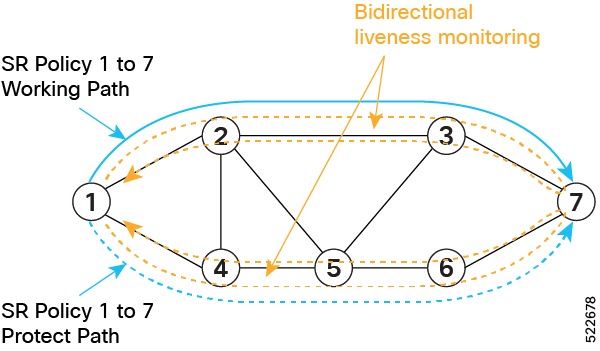
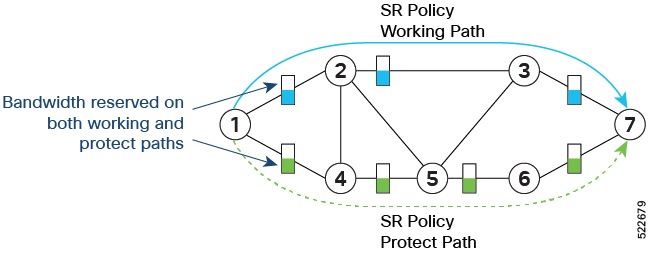
Bidirectional liveness monitoring on the working and protect paths ensures fast and consistent switchover. The protect path is pre-programmed over disjoint facilities.
Guaranteed bandwidth
Most services carried over CS-SR policies are constant-rate traffic streams. Any packet loss due to temporary congestion leads to bit errors at the service layer. To prevent this, bandwidth must be tightly managed and guaranteed to the services mapped to CS-SR policies.
A centralized controller manages the bandwidth reservation. The controller maintains the reserved bandwidth on each link based on the requested bandwidth by performing these actions:
-
Monitors the amount of traffic
-
Uses knowledge of the active path used by the policy
-
Computes the per-link reservable bandwidth
Bandwidth is reserved on both the working and protect paths.
Usage guidelines and limitations
-
Candidate path (CP) behavior:
-
The working path has the highest CP preference value.
-
The protect path has the second highest CP preference value.
-
The restore path has the lowest CP preference value and is configured as "backup ineligible."
-
Paths with the same role in both directions—working, protect, and restore—must have the same CP preference value.
-
-
Bidirectional path behavior:
-
All paths must be configured as corouted.
-
All paths with the same role in both directions (working, protect, and restore) must have the same bidirectional association ID value.
-
The bidirectional association ID value must be globally unique.
-