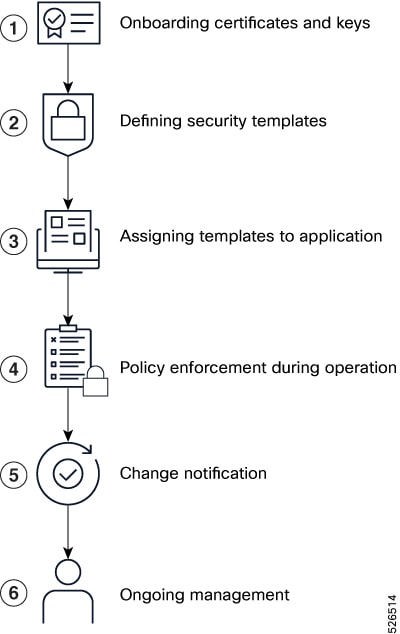
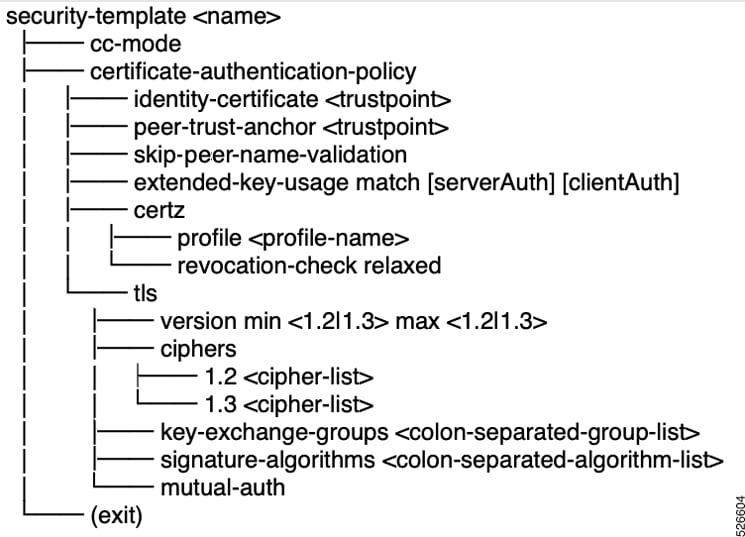
Describes reusable security templates that centralize certificate authentication, Transport Layer Security (TLS) controls, and compliance settings for multiple Cisco IOS XR applications.
A security template is a named configuration bundle for TLS-enabled applications that
-
centralizes and standardizes security policy configuration,
-
encapsulates certificate authentication policies, TLS protocol controls, and compliance mode settings, and
-
provides a reusable source of truth that multiple applications can reference instead of embedding security settings locally.
The framework supports TLS version and cipher-suite control, elliptic-curve and digital-signature selection, certificate onboarding through SCEP, file-based methods, and Certz profiles, and dynamic change notifications for registered applications.
|
Feature Name |
Release Information |
Feature Description |
|---|---|---|
|
Security template framework for TLS enabled applications |
Release 25.4.1 |
Introduced in this release on: Fixed Systems (8200 [ASIC: Q100, Q200, P100], 8700 [ASIC: P100, K100], 8010 [ASIC: A100]); Centralized Systems (8600 [ASIC: Q200]); Modular Systems (8800 [LC ASIC: Q100, Q200, P100]) Security templates reduce misconfiguration risks and operational overhead by centralizing and standardizing security policy configuration for TLS-enabled applications. A security template bundles certificate authentication policy, TLS controls, and compliance mode settings. It acts as a single source of truth that applications reference, avoiding local embedding of security settings. This template defines how certificates are handled and controls various aspects of the TLS handshake. The feature introduces these changes: CLI: |
Key terminologies
|
Term |
Description |
|---|---|
|
Certificate authentication policy |
Rules that specify how certificates authenticate servers or clients, including trust-anchor selection and certificate validation settings. |
|
Common Criteria (CC) mode |
An enhanced security mode that enforces stricter compliance-focused behavior. |
|
Certz profile |
A profile that provides identity certificates, private keys, and certification authority bundles from a centralized certificate management service. |
Benefits and use cases
The security template framework provides these benefits:
-
Centralized security management for templates used by multiple applications
-
Flexibility for Common Criteria mode, certificate authentication policies, and future security policies
-
Simplified configuration by reducing application-specific settings
-
Consistency and compliance through uniform policy application
-
Extensibility for additional fields and configurations
-
Operational efficiency through automated notifications and faster updates
Use cases include these activities:
-
Managing TLS settings for syslog
-
Supporting web-scale environments with many root certification authorities and custom certificate validation needs
-
Enforcing advanced cryptographic policies for each application, such as application-specific elliptic curves and signature algorithms