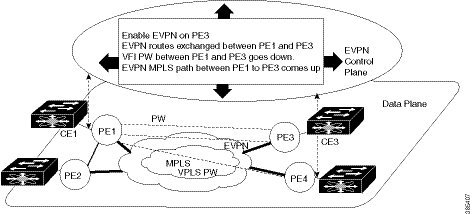
Explains how service providers can migrate their VPLS networks to EVPN without service disruption, highlighting key attributes, benefits, and technical aspects.
A migration from VPLS to EVPN is a process that
-
enables service providers to gradually upgrade their VPLS networks to EVPN without disrupting services
-
facilitates the coexistence of legacy VPLS and EVPN-VPLS dual-stack configurations, and
-
leverages MP-BGP for efficient MAC learning and propagation.
| Feature Name |
Release Information |
Feature Description |
|---|---|---|
| Seamless Migration of VPLS Network to EVPN Network |
Release 26.2.1 | Introduced in this release on: Modular Systems (8800 [LC ASIC: K100])(select variants only*) *This feature is supported on Cisco 88-LC1-48Y8H-EM line cards. |
| Seamless Migration of VPLS Network to EVPN Network |
Release 25.4.1 | Introduced in this release on: Fixed Systems (8010 [ASIC: A100])(select variants only*) *This feature is now supported on:
|
| Seamless Migration of VPLS Network to EVPN Network |
Release 25.3.1 |
Introduced in this release on: Fixed Systems (8200 [ASIC: Q200, P100], 8700 [ASIC: P100, K100]); Centralized Systems (8600 [ASIC:Q200]); Modular Systems (8800 [LC ASIC: Q100, Q200, P100]) You can configure local static MPLS labels for unicast IP traffic under the EVPN EVI configuration, which ensures remote PEs use a consistent, common label for the same EVPN service, improving forwarding consistency and operational control. The feature introduces these changes: CLI: |
| Seamless Migration of VPLS Network to EVPN Network |
Release 25.1.1 |
Introduced in this release on: Fixed Systems (8010 [ASIC: A100]) (select variants only*) *This feature is now supported on the Cisco 8011-4G24Y4H-I routers. |
| Seamless Migration of VPLS Network to EVPN Network |
Release 24.4.1 |
Introduced in this release on: Fixed Systems (8700) (select variants only*) *The seamless VPLS-to-EVPN migration is now extended to the Cisco 8712-MOD-M routers. |
| Seamless Migration of VPLS Network to EVPN Network |
Release 24.3.1 |
Introduced in this release on: Fixed Systems (8200, 8700); Modular Systems (8800 [LC ASIC: P100]) (select variants only*) *The seamless VPLS-to-EVPN migration is now extended to:
|
| Seamless Migration of VPLS Network to EVPN Network |
Release 24.2.11 |
Introduced in this release on: Modular Systems (8800 [LC ASIC: P100]) (select variants only*) *The seamless VPLS-to-EVPN migration is now extended to routers with the 88-LC1-36EH line cards. |
| Seamless Migration of VPLS Network to EVPN Network |
Release 7.11.1 |
You can now provision an EVPN service on existing VPLS-enabled PEs individually, thus ensuring a seamless VPLS-to-EVPN migration without traffic disruption. This feature is supported only on Q200-based line cards. |
Transitioning from VPLS to EVPN
Although VPLS is a widely deployed Layer 2 VPN technology, customers are increasingly migrating their VPLS networks to EVPN to benefit from improved scalability and simplified deployment. Recognizing the importance of preserving existing investments in VPLS, service providers are exploring ways to seamlessly integrate their legacy VPLS networks with new EVPN-based networks.
Key benefits of migration
The migration of VPLS to an EVPN network offers these benefits:
-
Incremental migration: Service providers can migrate PE nodes from VPLS to EVPN gradually, ensuring no service disruption.
-
Dual-Stack coexistence: Legacy VPLS and EVPN-VPLS can coexist in the same MPLS network, enabling a smooth transition.
-
Control plane efficiency: EVPN uses MP-BGP for MAC learning and propagation, unlike VPLS, which relies on the data plane.
Technical highlights
These points highlight the key aspects of VPLS to an EVPN migration:
-
EVPN instance grouping: VPN instances in EVPN are grouped by EVPN Instance ID (EVI-ID) and associated with route targets and route distinguishers.
-
MAC learning: EVPN employs a control plane for MAC learning, while VPLS uses a flood-and-learn technique in the data plane.
-
Route Types:
-
Type-2: Advertises customer MAC addresses.
-
Type-3: Handles broadcast, unknown unicast, and multicast (BUM) traffic using ingress replication multicast routes.
-
Migration process
These stages describe the migration process for transitioning from VPLS to EVPN.
-
Gradual PE node upgrade: Upgrade one PE node at a time without requiring a network-wide software update.
-
Route exchange: EVPN-enabled PEs advertise both BGP VPLS autodiscovery (AD) routes and EVPN multicast routes (Type-3) for seamless integration.
-
BUM traffic handling: Type-3 routes ensure that PEs with matching route targets receive BUM traffic.
| Feature |
VPLS |
EVPN |
|---|---|---|
| MAC learning |
Data plane |
Control plane |
| Protocol |
Flood and learn |
MP-BGP |
| Route Types |
Not applicable |
Type-2 (MAC), Type-3 (BUM) |
MPLS static label support for EVPN ELAN
From Release 25.3.1, you can assign a static MPLS label to an EVPN service. This static assignment overrides the default dynamic label allocation by Cisco IOS XR software.
When you configure a static MPLS label on Provider Edge (PE) routers, this ensures that remote PEs receive traffic for the same service with a consistent, common label.
You can configure static MPLS labels for unicast IP traffic in EVPN ELAN by assigning local static labels under the EVPN EVI configuration mode. The range for these static MPLS labels is from 16 to 1,048,575.
Configure static MPLS labels within the range of 16 to 15,000 to avoid conflicts with existing dynamic labels and the default Segment Routing Local Block (SRLB) range of 15,000 to 15,999. For more information, see About the Segment Routing Local Block in the Segment Routing Configuration Guide for Cisco 8000 Series Routers.