Explains the operational principles and service mechanisms of EVPN E-Tree, covering traffic forwarding, network segmentation, and integration within EVPN architectures.
Summary
The key components involved in the EVPN E-Tree service are:
-
Root node (PE4): Acts as the central communication hub within the service provider’s network. It connects to all leaf nodes and manages traffic forwarding.
-
Leaf nodes (PE1, PE2, PE3): Represent customer sites or remote locations. They communicate only with the root node and do not forward traffic to other leaf nodes.
-
EVPN protocol: Enables dynamic learning of MAC addresses and supports efficient communication between root and leaf nodes.
The EVPN E-Tree process ensures that leaf nodes communicate only with the root node, preventing direct leaf-to-leaf traffic to enhance network isolation and reduce congestion. Dynamic MAC address learning through EVPN supports efficient traffic forwarding between the root and leaf nodes.
Workflow
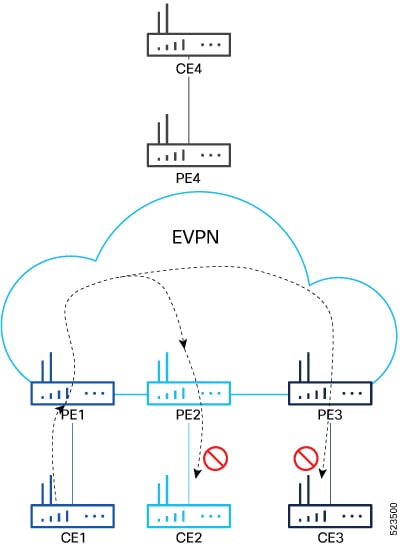
These stages describe how EVPN E-Tree service works.
- ACs are defined as either root or leaf nodes. If a PE is not configured as a leaf, it defaults to root.
- The root node establishes connections with all leaf nodes, serving as the central point of communication.
- Leaf nodes send and receive traffic exclusively to and from the root node.
- The root node forwards traffic to all leaf nodes, ensuring communication is maintained without direct leaf-to-leaf traffic.
- Direct communication between leaf nodes is restricted to prevent unnecessary traffic and enhance network isolation.
- EVPN facilitates dynamic MAC address learning across the network, enabling flexible and efficient communication between root and leaf nodes.
Result
This process ensures hierarchical traffic segregation, maintaining communication between the root and leaf nodes while isolating leaf nodes from each other. It reduces unnecessary traffic, enhances security, and improves network efficiency.