Details EVPN E-Line Single-Homing, including service restrictions, operational concepts, configuration instructions, feature support, flow label functionality and configuration, and private line emulation concepts with key processes, MPLS label handling, supported YANG models, and configuration tasks.
An EVPN E-Line single-homing is a network connectivity mode that
-
provides point-to-point Ethernet connectivity between two customer endpoints
-
operates over a single physical connection to the PE router, and
-
ensures simplicity and cost-effectiveness for scenarios where redundancy is not required.
EVPN E-Line operates over both IP and MPLS cores: the IP core supports BGP functionality, while the MPLS core enables efficient packet switching between endpoints.
| Feature Name |
Release Information |
Feature Description |
|---|---|---|
| EVPN E-Line Single-Homing |
Release 26.2.1 | Introduced in this release on: Modular Systems (8800 [LC ASIC: K100])(select variants only*); *This feature is supported on Cisco 88-LC1-48Y8H-EM line cards. |
| EVPN E-Line Single-Homing |
Release 25.4.1 | Introduced in this release on: Fixed Systems (8010 [ASIC: A100])(select variants only*) *This feature is now supported on:
|
| EVPN E-Line Single-Homing |
Release 25.1.1 |
Introduced in this release on: Fixed Systems (8010 [ASIC: A100]) (select variants only*) *This feature is now supported on the Cisco 8011-4G24Y4H-I routers. |
| EVPN E-Line Single-Homing |
Release 24.4.1 |
Introduced in this release on: Fixed Systems (8700) (select variants only*) * The EVPN E-Line single-homing is now extended to the Cisco 8712-MOD-M routers. |
| EVPN E-Line Single-Homing |
Release 24.3.1 |
Introduced in this release on: Fixed Systems (8200, 8700); Modular Systems (8800 [LC ASIC: P100]) (select variants only*) *The EVPN E-Line single-homing is now extended to:
|
| EVPN E-Line Single-Homing |
Release 24.2.11 |
Introduced in this release on: Modular Systems (8800 [LC ASIC: Q200, P100]) (select variants only*) *The EVPN E-Line single-homing is now extended to routers with the Q200 and 88-LC1-36EH line cards. |
| EVPN E-Line Single-Homing |
Release 7.8.1 |
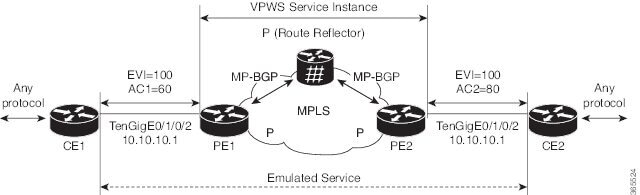
The EVPN E-Line single-homing is a BGP control plane solution for point-to-point services. It implements the signaling and encapsulation techniques for establishing an EVPN instance between a pair of PEs. It provides the service of forwarding L2 Ethernet traffic between network devices without inspecting the MAC header in the Ethernet frame. The use of EVPN for VPWS eliminates the need for signaling single-segment and multi-segment pseudowire (PW) for point-to-point Ethernet services. |
EVPN E-Line single-homing for oint-to-point Ethernet connectivity
The EVPN E-Line single-homing is a network service mode that provides point-to-point Ethernet connectivity between two customer endpoints using a single physical connection to the PE router. It is designed for simplicity and cost-effectiveness, making it ideal for small-scale deployments or non-critical applications where redundancy is not required. This service leverages EVPN technology to deliver reliable Layer 2 VPN services over an IP-MPLS network, adhering to the E-Line service type defined by the Metro Ethernet Forum (MEF).
Benefits EVPN E-Line single-homing
The EVPN E-Line single-homing mode offers these benefits:
-
Scalability—achieves scalability without the need for signaling pseudowires, simplifying network operations.
-
Ease of provisioning—simplifies the setup process, reducing the time and effort required for deployment.
-
Elimination of pseudowires—operates without pseudowires (PWs), streamlining the network architecture.
-
Optimal forwarding—leverages BGP's best path selection mechanism to ensure efficient and optimal data forwarding.
Prerequisites for E-Line single-homing
To configure EVPN E-Line, ensure these prerequisites are met:
-
BGP configuration: Verify that BGP is configured to support EVPN Subsequent Address Family Identifier (SAFI).
-
BGP session: Establish a BGP session between PEs with the address-family l2vpn evpn configuration to enable the exchange of EVPN routes.