Describes how EVPN automates network connectivity, manages redundancy, and handles traffic across Ethernet VPNs.
Summary
The key components involved in the process are:
-
VPN membership—PEs exchange EVPN routes to discover remote PE members of an EVI, build flood lists for multicast ingress replication, and exchange BUM and unicast labels during MAC learning.
-
Ethernet segment reachability—PEs perform auto-discovery of remote PEs and determine redundancy modes in multihoming scenarios. During segment failures, routes are withdrawn to trigger fast convergence via MAC mass withdrawal.
-
Redundancy group membership—PEs discover and elect a Designated Forwarder (DF) for forwarding BUM traffic in multihoming scenarios.
Starting with the Cisco IOS XR Release 24.2.1, the unknown unicast suppression (unknown-unicast-suppression) operation under a given EVI is not supported on the Cisco 8000 series routers.
Workflow
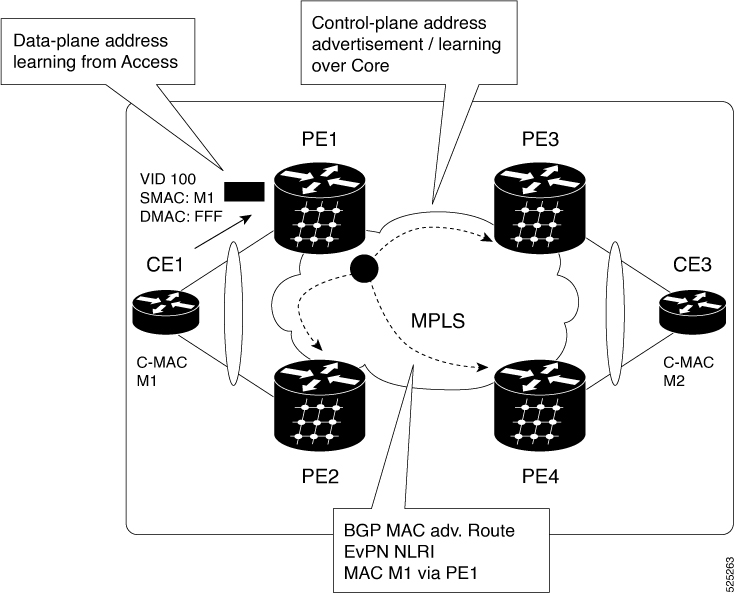
The EVPN operation involves these stages:
-
Startup—PEs exchange EVPN routes for VPN membership, segment reachability, and redundancy group discovery.
-
MAC Advertisement—unknown unicast or BUM MAC addresses are advertised as route type 2.
-
Multihoming—route types 1, 3, and 4 are exchanged to discover redundancy modes (single-active or all-active) and elect a DF.
EVPN can be set up to operate in either single-homing or multihoming modes, providing various levels of redundancy and connectivity in network configurations.
Single-homing mode stages:
The EVPN single-homing mode involves these stages:
-
Route type 3 advertisement—PEs advertise route type 3 upon enabling EVPN.
-
Discovery—PEs discover all other member PEs within the EVPN instance.
-
BUM MAC handling—unknown unicast or BUM MACs are advertised as route type 2.
-
MAC route distribution—route type 2 advertises MAC routes to other PEs.
Multihoming mode stages:
The EVPN multihoming mode involves these stages:
-
Route types 1, 3, and 4 advertisement—PEs advertise these routes to discover redundancy modes and elect a DF
-
Route type 1 usage—automatically discovers PEs hosting the same CE and enables fast rerouting during link failures.
-
Route type 4 usage—facilitates DF election for BUM traffic.
-
-
Customer traffic handling—distributes MAC reachability information through route type 2.
-
Traffic delivery—remote PEs use MPLS labels to deliver traffic to the specified MAC address.
This process ensures efficient and reliable EVPN operation in both single-homing and multihoming scenarios, enabling robust connectivity, redundancy, and seamless traffic handling for customer networks.