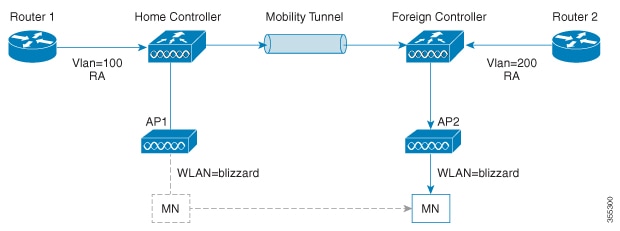
Explains how IPv6 client mobility enables seamless Layer 2 and Layer 3 roaming for IPv6-only and dual-stack wireless nodes, providing consistent connectivity and correct IP address management.
A client mobility is a wireless network feature that
-
supports seamless Layer 2 and Layer 3 roaming for IPv6-only and dual-stack clients
-
manages IPv6 client addresses and Neighbor Discovery (NDP) packet handling across controllers, and
-
retains the client's IP address and application connectivity as they move between access points and switches in the mobility group.
Link layer mobility is not sufficient for wireless client Layer 3 applications to work seamlessly while roaming. Cisco IOSd’s wireless mobility module uses mobility tunneling to retain seamless connectivity for the client’s Layer 3 PoP (point of presence) when the client roams across different subnets on different switches.
IPv6 is the next-generation network layer Internet protocol intended to replace IPv4 in the TCP/IP suite of protocols. This new version increases the global internet address space to accommodate users and applications that require unique global IP addresses. IPv6 incorporates 128-bit source and destination addresses, which provide significantly more addresses than the 32-bit IPv4 addresses.
To support IPv6 clients across controllers, ICMPv6 messages must be handled in a specific way to ensure the IPv6 client remains on the same Layer 3 network. The device keeps track of IPv6 clients by intercepting ICMPv6 messages to provide seamless mobility and protect the network from network attacks. Neighbor Discovery Protocol (NDP) packets are converted from multicast to unicast and delivered individually to each client. This unique solution ensures that Neighbor Discovery and Router Advertisement packets are not leaked across VLANs. Clients receive specific Neighbor Discovery and Router Advertisement packets, ensuring correct IPv6 addressing and avoiding unnecessary multicast traffic.
The configuration for IPv6 mobility is the same as for IPv4 mobility and does not require separate software on the client side to achieve seamless roaming. The device must be part of the same mobility group. Both IPv4 and IPv6 client mobility are enabled by default.
IPv6 client mobility provides these features:
-
Retains multiple client IPv6 addresses during Layer-2 and Layer-3 roaming.
-
Manages IPv6 Neighbor Discovery Protocol (NDP) packets.
-
Learns client IPv6 addresses.
The configuration for IPv6 mobility in SDA wireless and Local mode is the same as for IPv4 mobility and does not require different software configuration on the client side to achieve seamless roaming. Refer to the IPv4 mobility section for configuration information.
f an IPv6 address is configured on the SVI, configure the ipv6 nd ra suppress all command on all client VLAN SVI interfaces on the controller. This prevents multiple devices from advertising themselves as routers.