Describes an advanced system for coordinating spectrum allocation and utilization for access points operating within the 6-GHz band.
Automated Frequency Coordination (AFC) is an advanced system that
-
coordinates the allocation and utilization of spectrum for access points (APs) that operate within the 6-GHz band
-
utilizes the Universal Licensing System (ULS) as a regulatory database (encompassing a wide range of frequency bands used by various radio frequency services within a specific region), which is updated daily by the FCC, the regultory body, and
-
ensures seamless and efficient management of spectrum resources, enabling optimal utilization of spectrum and minimizing interference among different radio frequency services.
AFC system benefits and operation
The FCC's decision to open the 6-GHz band for unlicensed Wi-Fi usage brings about significant advantages, including accelerated connectivity and expanded capacity. By unlocking the potential of the 6-GHz band, you can experience unprecedented performance and seamless connectivity, effortlessly engage in data-intensive activities and enjoy immersive online experiences.
Several other technologies, including fixed satellite services (FSS) used in the broadcast and cable industries, are already active in the 6-GHz band. To ensure that the new unlicensed Wi-Fi entrants do not interfere with current services, FCC has implemented the AFC system for Wi-Fi operation within this band. Indoor APs operate at reduced power levels and are less likely to interfere with current 6-GHz users. The outdoor or standard power APs have a higher probability of causing interference with the existing 6-GHz users. These APs are permitted to operate only within the frequency ranges allocated to each country. For example, in the US, APs are authorized to function in the 5.925-6.425 GHz and 6.525-7.125 GHz bands.
Under the AFC system, a new wireless device is required to verify its compatibility with the existing services. This is done by accessing a registered database of the local AFC system provided by an AFC service provider before starting data transmission. This compatibility check ensures that the device's operation does not cause any interference with the current services. To facilitate the compatibility check, the AFC provider maintains an extensive database containing information about the existing 6-GHz operators, including geolocation details, frequencies in use, power levels, antenna coverage, and other relevant data. For areas where an AFC service is available, outdoor or standard power 6-GHz Wi-Fi deployments are only authorized if they comply with the AFC guidelines.
Individual standard power APs are exempt from interfacing directly with the AFC system, if the necessary registration data is communicated by a proxy device such as the wireless controller. Still, APs are responsible for providing their precise location information. In return, they receive a designated set of available frequencies suitable for that specific location.
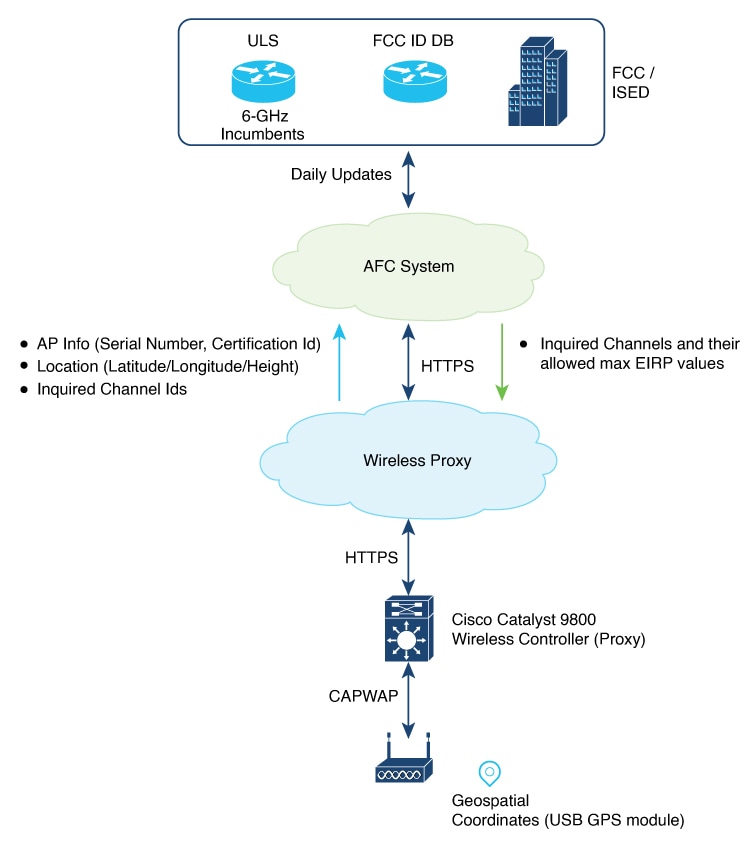
AFC architecture includes these components:
-
Cisco Catalyst APs supporting 6-GHz
-
Cisco Catalyst 9800 Series Wireless Controller acting as AFC proxy
-
A cloud-based wireless proxy tunneling the communication between the AFC proxy and the AFC system
-
AFC System
The 6-GHz AFC workflow operates as follows:
-
A standard power AP joins the system. Before enabling standard power, the AP must get the available frequencies and the power in each frequency range from the AFC system.
-
The AFC proxy sends the AP information to the AFC system.
-
The AFC system computes the available frequencies and maximum allowable power based on the information provided by the regulatory body (FCC for United States).
-
The response is sent back to controller, which may assign a standard power channel to the AP based on the allowed channel list returned by the AFC system.
Supported APs
These Wi-Fi 7 APs support AFC:
|
AP Models/feature difference |
9136I |
9166I |
9163E |
9166D1 |
9164I |
9162I |
9178I |
9176I/9176D1 |
9172I |
9179F |
9171I |
9174I |
9174E |
|---|---|---|---|---|---|---|---|---|---|---|---|---|---|
|
First Supported Release |
17.13.1, 17.12.3 |
17.13.1, 17.12.3 |
17.13.1, 17.12.3 |
17.14.1, 17.12.3 |
17.14.1, 17.12.3 |
17.14.1, 17.12.3 |
17.15.2 |
17.15.2 |
17.15.2b, 17.17.1 |
17.18.1 |
17.18.2 |
17.18.2 |
17.18.2 |
|
6GHz/6E slots in AP |
3 |
2 |
2 |
2 |
2 |
2 |
3 |
2 |
2 |
3 |
1 |
2 |
2 |
|
LPI and SP Support |
LPI, SP |
LPI, SP |
SP only |
LPI, SP |
LPI, SP |
LPI, SP |
LPI, SP |
LPI, SP |
LPI, SP |
LPI, SP |
LPI, SP |
LPI, SP |
SP only |
|
AP Type |
Indoor |
Indoor |
Outdoor |
Indoor |
Indoor |
Indoor |
Indoor |
Indoor |
Indoor |
Indoor/Outdoor |
Indoor |
Indoor |
Indoor |
|
GNSS |
External |
External |
External/Internal |
External |
External |
External |
Internal |
Internal |
External |
Internal |
External |
External |
External |
The Cisco Wireless 9178I, 9176I, 9176D1, and 9172I Wi-Fi 7 Access Points are not applicable for 17.16.1 release.
Standard power enablement using AFC for US and Canada
|
Country |
Regulatory Body |
Supported Bands |
Power Levels |
Supported Release |
|---|---|---|---|---|
|
United States (US) |
FCC |
UNII-5, UNII-7 |
PSD 23dBm/MHz EIRP 36dBm |
17.12.3 onwards |
|
Canada (CA) |
ISED |
UNII-5, UNII-6, and UNII-7 |
PSD 23dBm/MHz EIRP 36dBm |
17.17.1 onwards |
AFC is applicable or active for FCC (US) and Canada. You can verify this using the show wireless afc ap and show wireless afc statistics commands. In countries where AFC is not required, these commands will show no queries or responses for any access points, indicating that AFC is inactive inthat region.