Describes a technique that drops undesirable traffic at the network edge by forwarding it to a null interface, mitigating attacks and enforcing blocklist filtering.
Remotely triggered blackhole (RTBH) filtering is a technique that
drops undesirable traffic before it enters a protected network
quickly drops traffic at the edge of the network, and
operates based on either source or destination addresses by forwarding traffic to a null0 interface.
These are the types of RTBH filtering:
Destination-based RTBH filtering: RTBH filtering based on a destination address
Source-based RTBH filtering: RTBH filtering based on a source address
Benefits of remotely triggered blackhole filtering
This technique enhances network security by
effectively mitigating Distributed Denial of Service (DDoS) and worm attacks
quarantining all traffic destined for a target under attack, and
enforcing blocklist filtering.
How remotely triggered blackhole filtering works
Summary
The key components involved in the process are:
Remotely Triggered Blackhole (RTBH) filtering: A technique to drop undesirable traffic.
Route Policy Language (RPL): Defines the rules for discarding traffic.
set next-hop discard command: Configures the next-hop of the target prefix to a null interface.
Routing Information Base (RIB): Stores routing information, updated by the next-hop discard configuration.
Triggering device: A separate device, typically in a Network Operations Center (NOC), that sends iBGP updates.
Edge routers: Access and aggregation points that receive iBGP updates from the trigger device.
Null0 interface: A virtual interface where discarded traffic is sent.
RTBH filtering drops undesirable traffic by rerouting it to a null0 interface, based on route policies and BGP updates from a trigger device.
Workflow
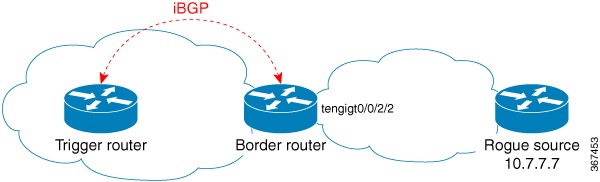
Figure 1. Topology to implement RTBH filtering
Consider this topology, where a rogue router is sending traffic to a border router.
These stages describe how RTBH filtering works.
Policy definition: You implement RTBH by defining a route policy (RPL) that uses the set next-hop discard command to discard undesirable traffic at the next-hop.
Next-hop configuration: RTBH filtering sets the next-hop of the target prefix to the null interface. Traffic destined for the target is then dropped at the ingress.
Inbound policy application: You use the set next-hop discard configuration in the neighbor inbound policy. When applied to a path, the RIB updates with the next-hop set to Null0, even if the primary next-hop is unreachable.
Best path selection: The RTBH path is considered reachable and becomes a candidate in the best path selection process.
Readvertisement: The system readvertises the RTBH path to other peers with either the received next-hop or nexthop-self, based on normal BGP advertisement rules.
Deployment scenario: In a typical deployment, an internal Border Gateway Protocol (iBGP) runs at the access and aggregation points. A separate device in the Network Operations Center (NOC) acts as a trigger.
Traffic dropping: The triggering device sends iBGP updates to the edge routers, which cause undesirable traffic to be forwarded to a null0 interface and dropped.
Result
The network effectively drops undesirable traffic at the edge, preventing it from entering the protected network.
Configure remotely triggered blackhole filtering
Follow these steps to configure destination-based RTBH filtering:
Configure the trigger router to initiate RTBH filtering.
The trigger router defines a static route redistribution policy that sets a community on static routes marked with a special tag. It also configures a static route with this tag for the source prefix to be discarded.
Configure the border router to apply RTBH filtering based on community matches.
The border router defines a route policy that matches the community set on the trigger router and configures the next-hop to discard. This policy is then applied to iBGP peers.
Procedure
1.
Configure the trigger router with a static route redistribution policy that sets a community on static routes marked with a special tag, and apply it in BGP.
Example:
Router(config)# route-policy RTBH-trigger
Router(config-rpl)# if tag is 777 then
Router(config-rpl-if)# set community (1234:4321, no-export) additive
Router(config-rpl-if)# pass
Router(config-rpl-if)# else
Router(config-rpl-else)# pass
Router(config-rpl-else)# endif
Router(config-rpl)# end-policy

Router(config)# router bgp 65001
Router(config-bgp)# address-family ipv4 unicast
Router(config-bgp-af)# redistribute static route-policy RTBH-trigger
Router(config-bgp-af)# exit

Router(config-bgp)# neighbor 192.168.102.1
Router(config-bgp-nbr)# remote-as 65001
Router(config-bgp-nbr)# address-family ipv4 unicast
Router(config-bgp-nbr-af)# route-policy bgp_all in
Router(config-bgp-nbr-af)# route-policy bgp_all out
Router(config-bgp-nbr-af)# exit
Router(config-bgp-nbr)# exit
Router(config-bgp)# exit
Router(config)# commit
2.
Configure a static route on the trigger router, tagging the source prefix that must be discarded.