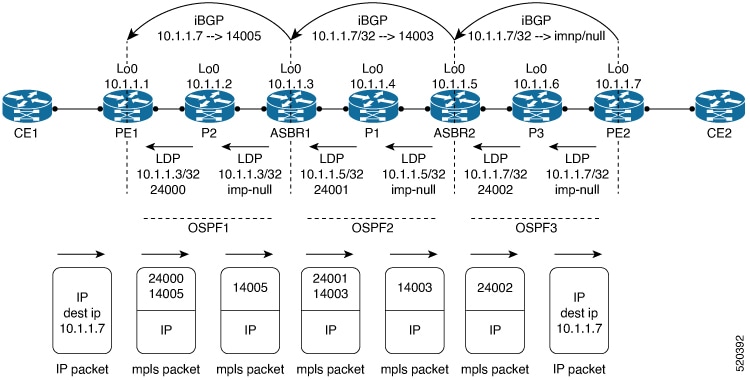
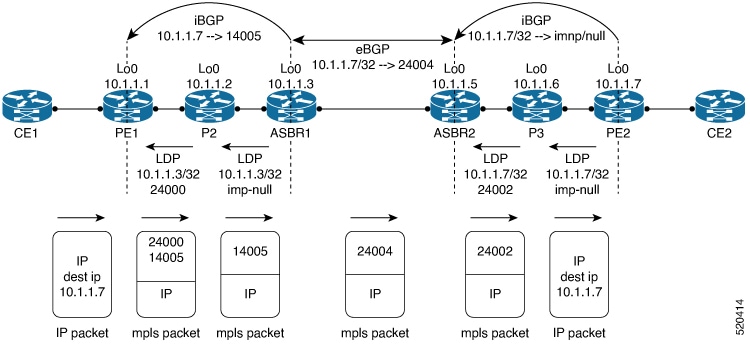
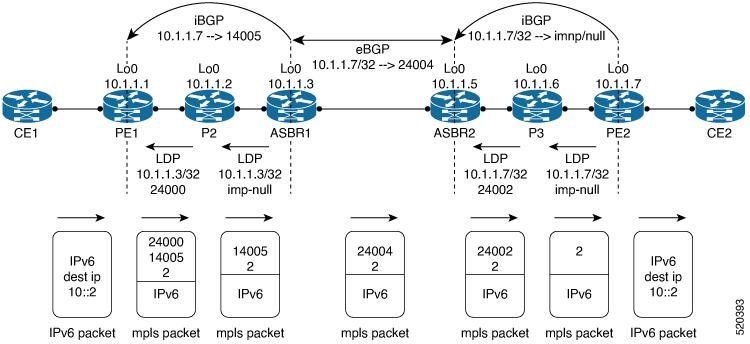
Explains BGP labeled unicast fundamentals, supported features, restrictions, intra- and inter-AS connectivity, MPLS with multihop eBGP, and provides configuration procedures to implement and verify BGP labeled unicast in MPLS networks.
BGP labeled unicast key components
The BGP labeled unicast is a routing feature that
-
provides MPLS transport between Provider Edge (PE) routers separated by multiple IGP boundaries or autonomous systems
-
uses autonomous system border routers (ASBRs) to advertise PE loopback prefixes and their MPLS label bindings via iBGP between area border routers (ABRs) and eBGP between ASBRs, and
-
supports multihop eBGP between PEs in different ASes to exchange VPN routes and enables services like 6PE over BGP LU connectivity.
-
PE routers are routers at the edge of a provider network that connect to customer networks.
-
ASBRs connect different autonomous systems.
-
iBGP and eBGP are internal and external Border Gateway Protocol sessions used for route exchange within and between ASes.
BGP labeled unicast overview
|
Feature Name |
Release |
Description |
|---|---|---|
|
BGP Labeled Unicast |
Release 25.4.1 |
Introduced in this release on: Fixed Systems (8010 [ASIC: A100], 8700 [ASIC: K100])(select variants only*) *This feature is supported on:
|
|
BGP Labeled Unicast |
Release 25.1.1 |
Introduced in this release on: Fixed Systems (8010 [ASIC: A100])(select variants only*) *This feature is supported on Cisco 8011-4G24Y4H-I routers. |
|
BGP Labeled Unicast |
Release 24.4.1 |
Introduced in this release on: Fixed Systems (8200 [ASIC: P100], 8700 [ASIC: P100, K100])(select variants only); Modular Systems (8800 [LC ASIC: P100])(select variants only*) This feature enables seamless MPLS transport between Provider Edge (PE) routers across multiple IGP boundaries or autonomous systems by utilizing Autonomous Systems Border Routers (ASBRs) to advertise loopback prefixes and MPLS label bindings through iBGP and eBGP. *This feature is supported on:
|
BGP labeled unicast, also known as unified MPLS, helps you scale MPLS transport across complex network topologies involving multiple IGP areas and AS boundaries. By using BGP LU, you reduce the scale of IGP labeled prefixes and adjacencies, which improves network efficiency.
To avoid unintended scale reduction on routers not configured for BGP LU, you must configure the hw-module command before enabling BGP LU. After configuring this command, you need to restart the router for the changes to take effect.
For example, you can run 6PE and other MPLS VPN services between PEs separated by multiple ASes or IGP areas, simplifying route advertisement and label distribution.
This approach helps you manage large-scale MPLS networks more effectively by lowering the overhead on IGP and BGP processes while maintaining connectivity and service capabilities.