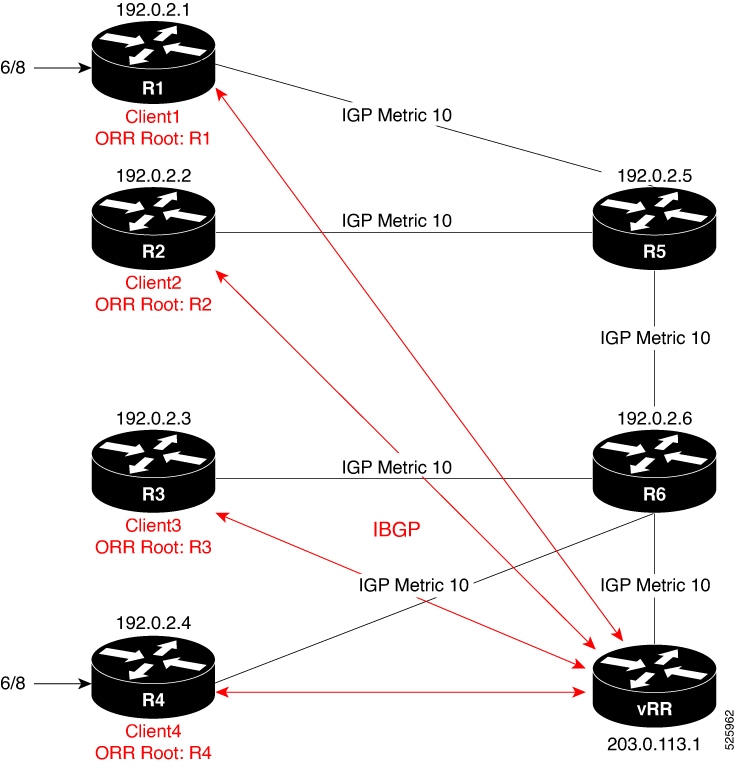
Details BGP optimal route reflector functionality, including operational restrictions, the effect of ORR on route reflector client path selection, and step-by-step procedures to configure BGP ORR for route reflector clients.
A BGP optimal route reflector (ORR) is a virtual route reflector function that
-
calculates the best BGP path from the perspective of each route reflector (RR) client
-
runs multiple shortest path first (SPF) calculations per RR client or cluster to ensure path optimality, and
-
enables flexible placement of virtual route reflectors (vRR) in service provider networks without compromising path selection accuracy.
Traditional BGP route reflector limitations
In traditional BGP deployments, a route reflector acts as a focal point within an autonomous system and advertises routes to RR clients based on the RR’s own path selection. When the RR is not optimally placed in the network topology, it can result in suboptimal routing decisions for RR clients, causing inefficient traffic flows.
Optimised client-specific routing with BGP ORR
BGP ORR addresses these limitations by running multiple SPF calculations from the perspective of each RR client or RR cluster. The system stores each client’s SPF results in a dedicated database, using these results to influence BGP best path selection. This process ensures every advertised route is optimal for the client’s specific network position, regardless of the vRR's location.
Benefits of BGP ORR
-
Calculates and advertises the best BGP path for each RR client’s viewpoint.
-
Enables vRR placement anywhere in the service provider network without sacrificing routing efficiency.
-
Allows network operators to scale RR memory and CPU resources according to operational requirements.
A service provider using network function virtualization (NFV) can deploy Cisco IOS XRv 9000 as a virtual route reflector in a central data center. BGP ORR optimizes routing for distributed RR clients, ensuring each receives the best available path despite the vRR’s remote placement.