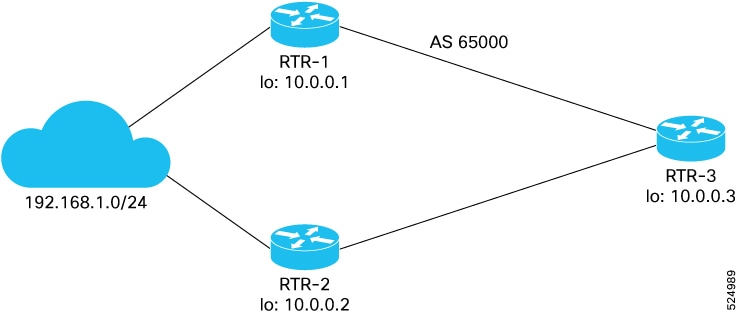
Describes support for processing DMZ transitive-bandwidth extended communities in BGP to enable bandwidth-aware routing decisions using UCMP and multivendor interoperability.
BGP DMZ transitive-bandwidth extended community is a feature that allows BGP to process and make routing decisions based on the available transitive-bandwidth extended community using UCMP.
Benefits of BGP DMZ transitive-bandwidth extended community
|
Feature Name |
Release Information |
Feature Description |
|---|---|---|
|
BGP DMZ transitive-bandwidth extended community support |
Release 26.1.1 |
Introduced in this release on: Centralized Systems (8400 [ASIC: K100])(select variants only*) * This feature is now supported on Cisco 8404-SYS-D routers. |
|
BGP DMZ transitive-bandwidth extended community support |
Release 25.1.1 |
Introduced in this release on: Fixed Systems (8200 [ASIC: Q200, P100], 8700 [ASIC: P100, K100], 8010 [ASIC: A100]); Centralized Systems (8600 [ASIC: Q200]); Modular Systems (8800 [LC ASIC: Q100, Q200, P100]) You can now enable BGP to process incoming DMZ transitive-bandwidth extended community, allowing bandwidth-aware routing decisions using Unequal Cost Multi-Path (UCMP). The feature allows RPL to manually set the DMZ transitive-bandwidth extended community for BGP neighbors. This extended propagation supports multivendor interoperability, optimizes traffic distribution, prevents link over utilization, and balances load across available paths. Previously, BGP supported only the non-transitive extended community. The feature introduces these changes: CLI: The transitive-bandwidth type is introduced as an extended community in RPL. YANG Data Models:
(see GitHub, YANG Data Models Navigator) |
You can now configure BGP to process incoming DMZ transitive-bandwidth extended communities, enabling bandwidth-aware routing decisions through UCMP. This enhancement allows the router to interpret linked bandwidth values that are attached to incoming BGP routes and use them to distribute traffic proportionally across multiple paths based on available capacity.
In addition, the feature extends RPL support to manually set the DMZ transitive-bandwidth extended community for inbound and outbound BGP updates. This extended propagation supports multivendor interoperability, optimizes traffic distribution, and prevents link over utilization.
The key benefits of the feature are:
-
Ensures multivendor interoperability and utilizes the DMZ bandwidth value across heterogeneous networks.
-
Adds a weight that enables RIB or FIB to intelligently load balance traffic across multiple paths.
-
Ensures consistent network policies across domains.