BGP Configuration Guide for Cisco 8000 Series Routers, Cisco IOS XR Releases

PDF

BGP Prefix Independent Convergence

Want to summarize with AI?

Log in

Overview

Outlines BGP Prefix Independent Convergence, describing backup path selection, operation with route reflectors, and procedures for configuring BGP PIC in provider edge networks and between autonomous systems.

A BGP Prefix Independent Convergence (PIC) feature is a network routing enhancement that

  • pre-computes and stores both primary and backup (best external) paths for each destination prefix in the Routing Information Base (RIB) and Forwarding Information Base (FIB)

  • enables instantaneous switch to a backup path in the event of a primary path failure, minimizing convergence time and network downtime, and

  • is especially beneficial for large-scale BGP deployments and networks with route reflectors.

Table 1. Feature History Table

Feature Name

Release

Description

BGP Prefix Independent Convergence

Release 25.4.1

Introduced in this release on: Fixed Systems (8700 [ASIC: K100], 8010 [ASIC: A100])(select variants only*)

*This feature is supported on:

  • 8711-48Z-M

  • 8011-32Y8L2H2FH

  • 8011-12G12X4Y-A

  • 8011-12G12X4Y-D

BGP Prefix Independent Convergence

Release 25.1.1

Introduced in this release on: Fixed Systems (8010 [ASIC: A100])(select variants only*)

*This feature is supported on Cisco 8011-4G24Y4H-I routers.

BGP Prefix Independent Convergence

Release 24.4.1

Introduced in this release on: Fixed Systems (8200 [ASIC: P100], 8700 [ASIC: P100, K100])(select variants only); Modular Systems (8800 [LC ASIC: P100])(select variants only*)

This feature ensures rapid network recovery by activating a pre-established backup path when the primary path fails, minimizing downtime in large-scale network deployments.

*This feature is supported on:

  • 8212-48FH-M

  • 8711-32FH-M

  • 8712-MOD-M

  • 88-LC1-36EH

  • 88-LC1-12TH24FH-E

  • 88-LC1-52Y8H-EM

Standard BGP convergence: prefix-dependent process

Standard BGP convergence is "prefix-dependent": each BGP router advertises only its current best path for a destination prefix. When the best path fails, routers send withdrawal messages, recalculate new best paths, and re-advertise to neighbors until all routers converge on a new path. This iterative process is slow, especially in networks with route reflectors.

Accelerated failover with Prefix Independent Convergence (PIC)

With PIC, BGP routers advertise their best external paths and pre-install backup paths in the FIB. When a failure occurs, the router can immediately switch to the backup path with a single operation, greatly accelerating convergence and reducing packet loss.

Attribute Prefix-Dependent Convergence Prefix Independent Convergence (PIC)
Awareness of backup paths No Yes
Convergence time Slow, iterative Fast, single-operation
FIB programming Only best path Best and backup paths
Scalability Limited in large networks Optimized for large deployments

Benefits of Prefix Independent Convergence

  • Rapid recovery from link or node failures with minimal traffic disruption.

  • Consistent failover times even as network scale grows.

  • Improved reliability and service continuity for business-critical applications.

Selecting backup paths

Selecting backup paths ensures network resilience by identifying and programming an optimal alternative route in case the primary path fails.

Summary

The key components involved in the process are:

  • Routing Information Base (RIB): A database that maintains all available routing information, including both primary and backup paths.

  • Forwarding Information Base (FIB): A table that programs the selected backup path to forward data packets efficiently when needed.

  • Best path algorithm: An algorithm that determines the best available path and the most suitable backup path from multiple candidates for each prefix.

The router uses the best path algorithm to select a primary path for a prefix. Next, the router removes the primary path and any paths that share its next hop. The algorithm runs again on the remaining paths to find the optimal backup path. The optimal backup is pre-programmed into the RIB and FIB for rapid failover if the primary path fails.

Workflow

These stages describe the process of selecting backup paths:

  1. The router applies the best path algorithm to the available set of paths for a prefix to identify the primary (best) path.
  2. The router excludes the best path from the set of available paths.
  3. The router removes any paths that have the same next hop as the best path.
  4. The router runs the best path algorithm again on the reduced set to select the optimal backup path.
  5. The router programs the selected backup path into the RIB and FIB to ensure it is ready to take over if needed.

How prefix-independent convergence with route reflectors works

Prefix-independent convergence (PIC) with route reflectors optimizes BGP network failover by rapidly switching traffic to pre-programmed backup paths, minimizing convergence delays when a primary path fails.

Note
To use the BGP PIC feature with route reflectors, each provider edge (PE) router must be configured with a unique route distinguisher (RD) within the same VRF. Without unique RDs, routes from different PEs appear to belong to the same network, preventing the route reflector from correctly identifying and calculating the best backup path.

Summary

The key components involved in the process are:

  • Primary provider edge (PE) router: A PE router that advertises the primary route for traffic destined to remote PEs.

  • Backup provider edge (PE) router: A PE router that maintains and advertises the backup (best external) path.

  • Remote provider edge (PE) router: A PE router that selects between primary and backup paths based on announcements from core PEs.

  • Route reflector: A router that distributes iBGP route information and requires unique route distinguishers (RDs) for proper path selection.

  • Forwarding information base (FIB) or Routing information base (RIB): Stores and switches between primary and backup forwarding entries.

The process ensures fast BGP convergence by pre-installing both primary and backup paths in router forwarding tables (RIB and FIB). During normal operation, the primary path is used, while the backup path remains ready. If the primary path fails, the router instantly switches to the pre-programmed backup, enabling immediate traffic redirection with minimal delay and packet loss.

Workflow

These stages describe the process:

  1. Pre-programming of paths: Both primary and backup (best external) routes for each prefix are programmed into the RIB and FIB of relevant routers.
  2. Initial operation:
    • The primary PE advertises the local-pref attribute to designate itself as the preferred route; the backup PE advertises the backup path.
    • The remote PE receives both primary and backup paths but prefers the primary.
    • The route reflector uses unique route distinguishers to differentiate routes from different PEs within the VRF.
  3. Primary path failure: In the event of primary path failure, primary PE signals the core to withdraw its route. The backup PE immediately advertises the backup path as the new best route.
  4. Network convergence: The remote PE quickly recalculates and updates its primary path, switching from primary to backup. The FIB instantly reassigns traffic to the backup path using the pre-installed forwarding entry for that prefix.
  5. Traffic resumption: Network traffic resumes with minimal delay, as the backup route is already available in the FIB.

Configure BGP PIC in provider edge networks

Enable Prefix Independent Convergence (BGP PIC) to improve network resiliency by ensuring rapid failover between primary and backup paths in provider edge networks.

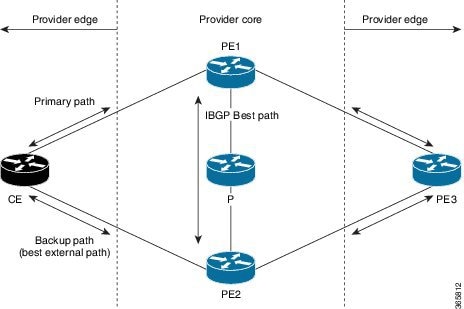
Consider this sample topology.

Figure 1. Prefix Independent Convergence in provider edge networks

For traffic traveling from the customer edge (CE) router to the provider edge (PE3) router, the BGP local preference (local-pref) attribute is used to determine the preferred path. The path CE → PE1 → PE3 is selected as the primary route, while CE → PE2 → PE3 is set as the backup route. Within the provider's core network, the path PE1 → P → PE2 is chosen as the best internal route between provider edge routers.

Before you begin

  • Confirm all loopback and network interfaces are configured according to your topology.

  • Ensure VRFs for the provider core network are set up.

Follow these steps to configure BGP PIC in provider edge networks.

Procedure

1.

On router PE1, configure BGP to install additional paths and set the label retention period.

Example:

Router(config)# router bgp 10
Router(config-bgp)# vrf foo
Router(config-bgp-vrf)# address-family ipv4 unicast
Router(config-bgp-vrf-af)# additional-path install
Router(config-bgp-vrf-af)# label-retention 10
2.

On router PE2, configure BGP to advertise the best external path, allocate labels, and enable additional path installation.

Example:

Router(config)# router bgp 10
Router(config-bgp)# vrf foo
Router(config-bgp-vrf)# address-family ipv4 unicast
Router(config-bgp-vrf-af)# advertise-best-external label-alloc-mode
Router(config-bgp-vrf-af)# additional-path install
3.

On router PE3, configure BGP to install additional backup paths.

Example:

Router(config)# router bgp 10
Router(config-bgp)# vrf foo
Router(config-bgp-vrf)# address-family ipv4 unicast
Router(config-bgp-vrf-af)# additional-path install
4.

On router PE3, verify that BGP PIC is operational. Verify the presence of backup paths in the Forwarding Information Base (FIB).

Example:

Router# show cef 10.1.1.1/32 detail
Fri Oct 10 10:24:33.079 UTC
10.1.1.1/32, version 1, internal 0x40000001 (0xa94c0574) [1], 0x0 (0x0), 0x0
(0x0)
Updated Oct 9 16:49:06.795
Prefix Len 32, traffic index 0, precedence routine (0)
gateway array (0xa8d9b130) reference count 4, flags 0x80200, source rib
(3),
[1 type 3 flags 0x901101 (0xa8ec6b90) ext 0x0 (0x0)]
LW-LDI[type=0, refc=0, ptr=0x0, sh-ldi=0x0]
Level 1 - Load distribution: 0
[0] via 10.24.0.1, recursive
via 10.24.0.1, 3 dependencies, recursive
next hop 10.24.0.1 via 10.24.0.1/32
via 10.24.0.2, 3 dependencies, recursive, backup
next hop 10.24.0.2 via 10.24.0.2/32
Load distribution: 0 (refcount 1)
Hash OK Interface Address
0 Y MgmtEth0/RP0/CPU0/0 10.24.0.1

Configure BGP PIC Option B between autonomous systems

Configure BGP PIC for inter-AS Option B scenarios to ensure fast convergence and backup path installation between autonomous systems.

Consider this sample topology:

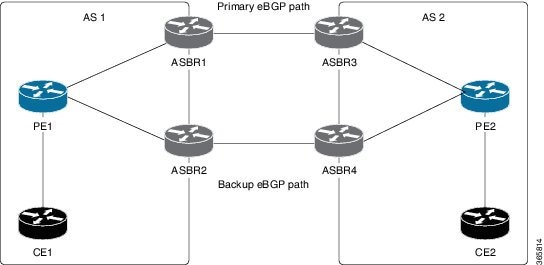
Figure 2. Prefix-Independent Convergence between autonomous systems

For traffic going from router PE1 to router PE2, ASBR1 acts as the primary router and ASBR2 as the backup router. The primary eBGP path is ASBR1 → ASBR3, while the backup path is ASBR2 → ASBR4.

For traffic traveling in the opposite direction, from router PE2 to router PE1, ASBR3 serves as the primary router and ASBR4 as the backup router. In this case, the primary eBGP path is ASBR3 → ASBR1, and the backup path is ASBR4 → ASBR2.

Before you begin

  • Ensure that you have configured the loopback and network interfaces as per the illustrated topology.

Follow these steps to configure BGP PIC Option B between autonomous systems.

Procedure

1.

On router ASBR1, configure BGP additional-path and label retention.

Example:

Router(config)# router bgp 10
Router(config-bgp)# address-family vpnv4 unicast
Router(config-bgp-af)# additional-path install
Router(config-bgp-af)# label-retention 10

2.

On router ASBR2, configure advertisement and installation of backup paths.

Example:

Router(config)# router bgp 10
Router(config-bgp)# address-family vpnv4 unicast
Router(config-bgp-af)# advertise-best-external label-alloc-mode
Router(config-bgp-af)# additional-path install

3.

Similarly, repeat the above configuration steps on router ASBR3 for traffic from PE2 to PE1, and on Router ASBR4 to advertise and install backup paths for that traffic direction.

4.

Use the show cef command on router PE2 (for traffic from PE1 to PE2) or on router PE1 (for traffic from PE2 to PE1) to verify BGP PIC operation.

Example:

Router# show cef 10.1.1.1/32 detail

Fri Oct 10 10:24:33.079 UTC
10.1.1.1/32, version 1, internal 0x40000001 (0xa94c0574) [1], 0x0 (0x0), 0x0
(0x0)
Updated Oct 9 16:49:06.795
Prefix Len 32, traffic index 0, precedence routine (0)
gateway array (0xa8d9b130) reference count 4, flags 0x80200, source rib
(3),
[1 type 3 flags 0x901101 (0xa8ec6b90) ext 0x0 (0x0)]
LW-LDI[type=0, refc=0, ptr=0x0, sh-ldi=0x0]
Level 1 - Load distribution: 0
[0] via 10.24.0.1, recursive
via 10.24.0.1, 3 dependencies, recursive
next hop 10.24.0.1 via 10.24.0.1/32
via 10.24.0.2, 3 dependencies, recursive, backup
next hop 10.24.0.2 via 10.24.0.2/32
Load distribution: 0 (refcount 1)
Hash OK Interface Address
0 Y MgmtEth0/RP0/CPU0/0 10.24.0.1
5.

Use the show bgp vrf foo command to verify the presence of the backup (best external) path for BGP.

Example:

Router# show bgp vrf foo 10.1.1.1/32

BGP routing table entry for 10.1.1.1/32
Versions:
Process bRIB/RIB SendTblVer
Speaker 6 6
Local Label: 3
Paths: (1 available, best #1)
Advertised to peers (in unique update groups):
10.10.10.1
Path #1: Received by speaker 0
10.1.1.1 from 10.1.1.1 (10.2.2.1)
Origin incomplete, metric 0, localpref 100, weight 32768, valid,
internal, best
10.2.2.2 from 10.2.2.2 (10.10.10.1)
Origin incomplete, metric 0, localpref 100, weight 32768, valid,
external, backup, best-external