Describes how ACI handoffs are handled across different Cisco APIC releases.
An ACI handoff is a network mechanism that
handles connections between ACI fabrics and external networks
uses IP handoff for releases prior to Cisco APIC Release 5.0(1), and
uses SR-MPLS handoff starting with Cisco APIC Release 5.0(1).
ACI handoffs prior to release 5.0(1): IP handoff
An ACI handoff prior to Release 5.0(1) IP handoff is a VRF-Lite configuration method that
connects ACI border leaf nodes to data center provider edge (DC-PE) devices using separate VRFs for multi-tenant networks
requires a routing protocol for each VRF and dedicated interfaces for each VRF, and
presents automation and scalability challenges when configuring large numbers of sessions.
IP handoff configuration details
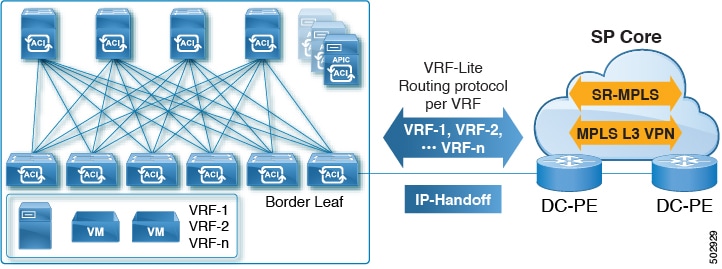
Prior to Cisco APIC Release 5.0(1), when setting up an ACI fabric connecting the ACI border leaf nodes to a data center provider edge (DC-PE), if you have a configuration with a multi-tenant network, that means that you would need multiple VRFs, and you would need a routing protocol for each VRF. You would also need to dedicate an interface for each VRF, where the interface is either a physical interface or a logical interface. This configuration is typically called VRF-Lite.
Figure 1. ACI handoff to DC-PE using IP handoff (VRF-Lite)
In this configuration, the border leaf switch is connected to the DC-PE using VRF-Lite. The interface and routing protocol session configurations between the border leaf switch and the DC-PE is done using separate VRFs. Differentiated Services Code Point (DSCP) is configured on the border leaf switch for outgoing traffic. On the DC-PE, the DSCP is mapped to the segment routing for traffic engineering (SR-TE) policy, which is used to steer traffic through the transport network.
This configuration becomes cumbersome if you have a large number of sessions between the border leaf switch and the data center. Therefore, automation and scalability are key challenges when configuring using VRF-Lite.
ACI handoffs in release 5.0(1): SR handoff
An ACI SR handoff is a fabric connection method that performs the following functions:
Connects ACI border leaf switches to DC-PE routers using SR-MPLS handoff.
Provides a mature transport solution compared to VXLAN, which may not be common in SP Core networks.
Enables unified segment routing transport between different ACI DC networks.
SR handoff scenarios
The following scenarios demonstrate the benefits of configuring ACI handoff to the DC-PE using SR-MPLS:
Unified segment routing transport
Monitoring DC-to-DC flows in the transport network
Single control plane session for multiple VRFs
SR-TE/Flex algo in transport using color community or destination prefix
DC and transport QoS with SR or MPLS
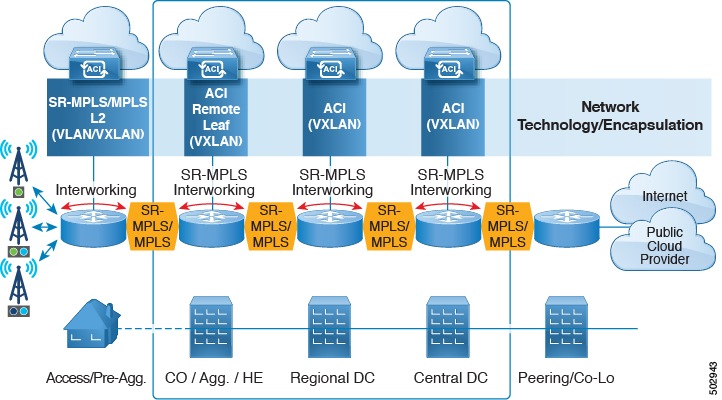
Unified segment routing transport deployment interconnects different ACI DC networks by leveraging VXLAN to SR-MPLS handoff at each location.
Figure 2. Unified segment routing transport
Monitoring DC-to-DC flows allows transport teams to use existing MPLS-based tools to track traffic that is encapsulated using segment routing instead of VXLAN.
Figure 3. Monitoring DC-to-DC flows
Single control plane sessions utilize MP-BGP EVPN for all VRFs, improving automation and scalability compared to per-VRF IP handoff configurations.
Figure 4. Single control plane session
SR-TE/Flex algo integration allows the DC-PE to create routing policies based on BGP color extended communities or destination prefixes advertised by the ACI border leaf.
Figure 5. SR-TE/Flex algo integration
DC and transport QoS enables the mapping of DSCP values to MPLS EXP or COS values, allowing the transport network to perform QoS actions based on data center policies.