Describes a load-balancing feature that distributes client traffic across multiple servers in a cluster configuration.
Microsoft Network Load Balancing (NLB) is a load-balancing feature that
-
distributes client traffic across many servers, with each server running its individual copy of the application
-
uses Layer 2 unknown unicast or multicast to simultaneously distribute incoming network traffic to all cluster hosts, and
-
operates as a group of nodes collectively known as an NLB cluster that serves one or more virtual IP (VIP) addresses.
Microsoft NLB operational modes
Nodes in the NLB cluster use a load-balancing algorithm to decide which individual node will service the particular traffic flow that is destined for the NLB VIP. Every node within the cluster receives every packet of traffic, but only one node services a request.
Microsoft NLB functions in three different operational modes:
-
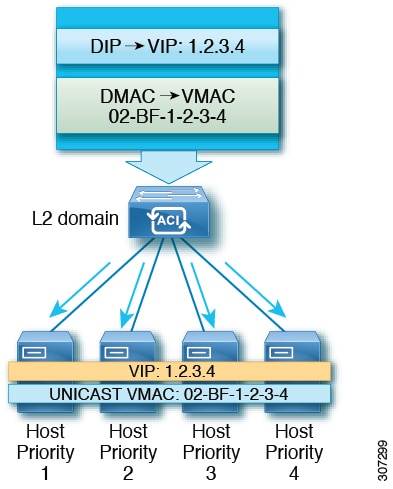
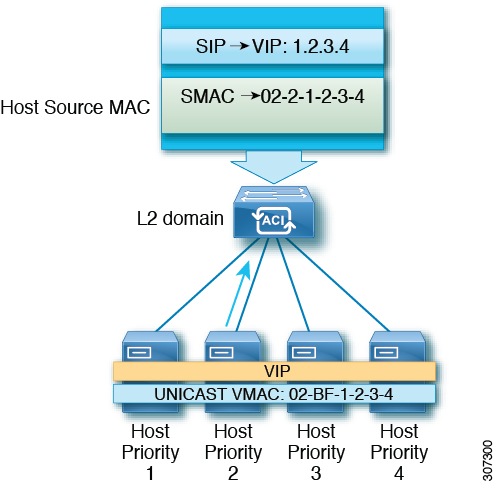
Unicast Mode: In this mode, each NLB cluster VIP is assigned a unicast MAC address. This mode relies on unknown unicast flooding to deliver traffic to the cluster.
-
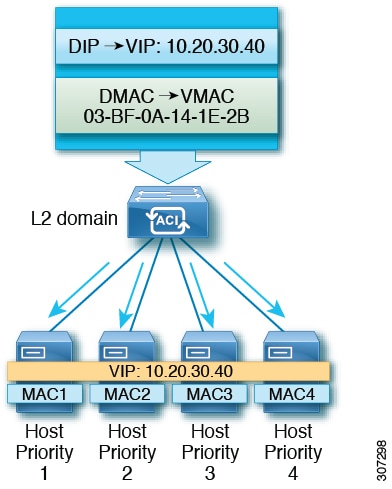
Multicast Mode: In this mode, each NLB cluster VIP is assigned a non-Internet Assigned Numbers Authority (IANA) multicast MAC address (03xx.xxxx.xxxx).
-
IGMP Mode: In this mode, an NLB cluster VIP is assigned a unique IPv4 multicast group address. The multicast MAC address for this is derived from the standard MAC derivation for IPv4 multicast addresses.
This figure shows a graphical representation of how Microsoft NLB is implemented with Cisco APIC.

In this figure, Server 1 and Server 2 are in the MS NLB cluster. These servers appear as a single-host server to outside clients. All servers in the MS NLB cluster receive all incoming requests, then MS NLB distributes the load between the servers.