Local area Bonjour for wireless local mode
Local Area Bonjour for wireless local mode is a network functionality that
-
introduces unicast mode function in Local Area Bonjour network domain
-
enables enhanced gateway function at the first hop of Wired and Wireless networks to communicate directly with any industry standard RFC 6762 compliant Multicast DNS (mDNS) end point in Layer 2 Unicast mode, and
-
introduces new service-peer mode expanding classic single-gateway controller to end-to-end service-routing with upstream SDG agent switch to enable unicast-mode, increased scale, performance and resiliency in the network.
Prerequisites for local area Bonjour for wireless local mode
Ensure that the Cisco Catalyst 9800 series controller is successfully configured and operational before implementing Cisco Local Area Bonjour for local mode wireless networks. This is necessary for the controller to be deployed in service-peer mode
-
Ensure that the targeted controller for the service-peer role has the required Cisco IOS-XE software version. See Supported SDG Agents with Supported Licenses and Software Requirements table in Cisco DNA Service for Bonjour Solution Overview chapter.
-
Ensure that the controller runs a valid Cisco DNA-Advantage license.
-
Ensure that the upstream distribution-layer Cisco Catalyst switch in SDG agent mode runs a valid Cisco DNA-Advantage license.
-
Ensure that the controller is interconnected as Layer 2 trunk in static 802.1Q mode, when Layer 2 Unicast service-routing is running between SDG agent in distribution-layer and the controller service-peer.
-
Ensure that the controller has IP reachability to upstream Cisco Catalyst 9000 series switches in SDG agent mode over same the IPv4 wireless management subnet.
-
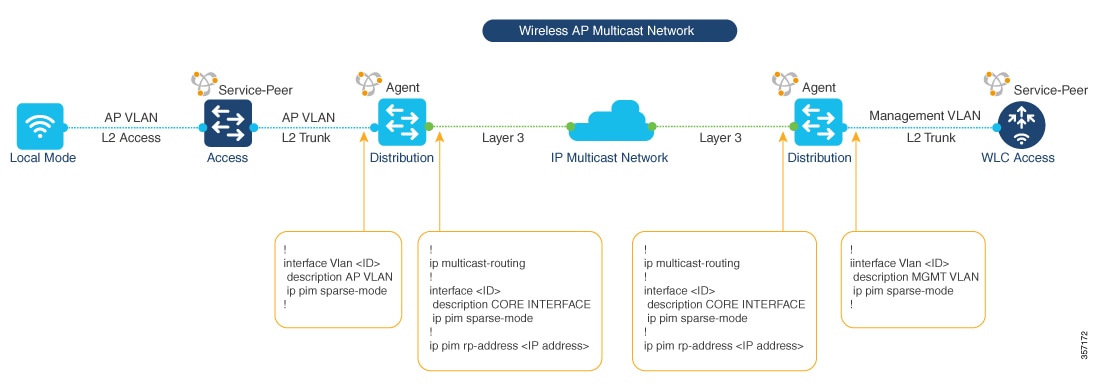
Ensure that global multicast is enabled on the controller and AP is set to multicast mode. All local mode APs must join the multicast group in the network to successfully process mDNS messages.
Restrictions for local area Bonjour for wireless local mode
-
Controller management port is not supported for service-routing with upstream Catalyst SDG Agent switch.
-
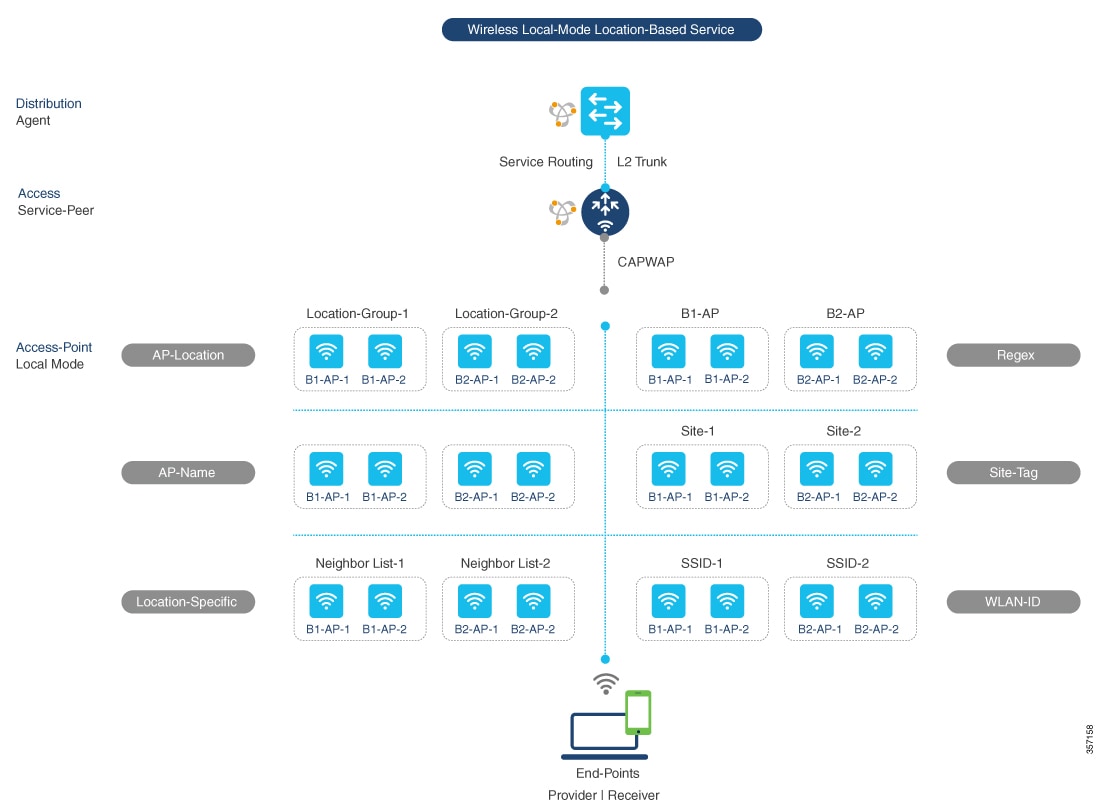
The controller in service peer mode supports location-based service for access points in local mode and FlexConnect central switching mode.
-
The controller supports location-based capabilities only between wireless connected service provider and the receiver.
-
The controller does not support service-routing configuration using GUI.
Local area Bonjour for wireless local mode
Local area Bonjour for wireless local mode is a network service that
-
enables distributed Bonjour gateway function at the network edge through unified Cisco IOS-XE operating system across Cisco Catalyst 9000 series LAN switches and Cisco Catalyst 9800 series controller
-
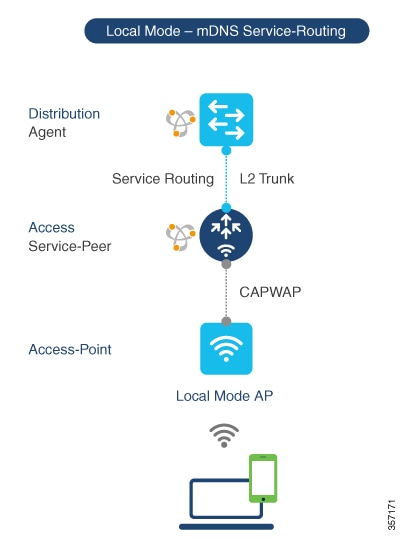
supports mDNS gateway function to wireless users in local mode with service-routing peering to upstream Cisco Catalyst 9000 series switch for network-wide services discovery and distribution, and
-
eliminates mDNS flooding over Layer 2 trunk ports through unicast based service-routing between the controller and upstream SDG-Agent switch.
Local area Bonjour capabilities
The traditional wireless controller supported mDNS snooping function with various advancements for wireless networks. As the enterprise requirements expands, IT drives the IT organization to introduce new network deployment models, supporting mobile devices and distributed zero-configuration services with increased scale, granular security control and resiliency for mission critical networks. With end-to-end Wide Area Bonjour service-routing, the new solution enables service-oriented enterprise networks with intuitive user-experience.
The controller platform supporting mDNS gateway function builds service-routing peering with upstream Cisco Catalyst 9000 series switch for network-wide services discovery and distribution based on IT-managed granular policies and locations. The unicast based service-routing between the controller in service-peer mode and upstream SDG-Agent switch provides increased bandwidth and eliminates mDNS flood over wireless networks and Layer 2 trunk to upstream network.
 Feedback