Use this concept to understand the application-layer SNMP protocols and their components for network device monitoring and management.
A SNMP protocol is a network communication protocol suite that
-
provides a standardized framework for monitoring and managing network devices,
-
defines roles for managers and agents, and
-
enables structured data exchange using Management Information Bases (MIBs).
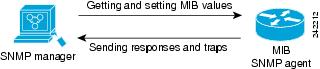
SNMP manager: The control system (often called a Network Management System, NMS) that sends requests to monitor or configure network devices.
SNMP agent: The software or firmware on managed devices that maintains local data and responds to requests from the SNMP manager, using information stored in the MIB.
Management Information Base (MIB): A structured repository of managed objects within a network device, grouped into modules and accessible through SNMP commands.
-
SNMP is specified as an application-layer protocol for exchanging messages such as Get, Set, and Trap.
-
Key MIB RFCs include STD 58, RFC 2578, RFC 2579, RFC 2580.
-
IP-MIB (RFC4293) provides separate support for IPv4 and IPv6 statistics, with implementation details evolving across IOS-XR releases (from 6.3.2, both IPv4 and IPv6 statistics can be collected).
-
Interface-specific statistics are indexed by address type (IPv4/IPv6) and interface ID (ifindex).
-
Important OIDs added for IPv4/IPv6 support include: ipIfStatsInReceives, ipIfStatsHCInReceives, ipIfStatsInOctets, ipIfStatsOutTransmits, etc.
-
For more details on supported MIBs, see the Cisco IOS XR MIBs tool and SNMP OID Navigator.