This section lists the key differences between SNMP traps and informs, including their reliability, resource usage, and best-use scenarios.
SNMP notifications are messages sent from an SNMP agent to an SNMP manager to alert about specific conditions or events on a network. The two main types of notifications are traps and informs, each with different reliability and resource requirements.
SNMP Traps
-
Traps are asynchronous SNMP notifications sent by the agent to report significant events to the SNMP manager.
-
They are less reliable because the manager does not acknowledge receipt, so the agent never knows if the notification arrived.
-
Traps consume fewer resources since they are immediately discarded after being sent.
-
They are suitable for non-critical alerts where resource efficiency is prioritized over guaranteed delivery.
-
On Cisco IOS XR software, only traps are supported for unsolicited notifications.
In recent Cisco IOS XR software releases, SNMP agents send traps to all unreachable hosts instead of dropping them after a timeout, increasing the likelihood of delivery.
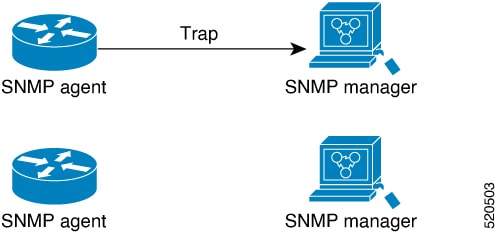
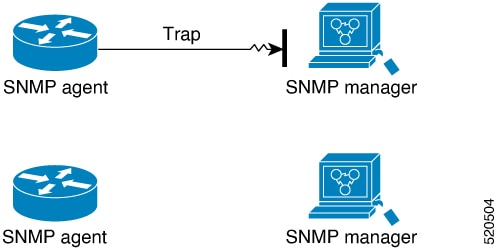
Trap Not Received by the SNMP Manager. In this illustration, the agent sends a trap to the manager, but the trap does not reach the manager. Because the agent has no way of knowing that the trap did not reach its destination, the trap is not sent again. The manager never receives the trap.
Trap Received by the SNMP Manager. In this illustration, the agent router sends a trap to the SNMP manager. Although the manager receives the trap, it does not send any acknowledgment to the agent. The agent has no way of knowing that the trap reached its destination.
Previously, the SNMP agent would drop traps after 5 minutes if the respective hosts were unreachable. In its new behavior, the SNMP agent now sends traps to all unreachable hosts instead of dropping them. There is no change in the trap delay timer behavior.
SNMP Informs
-
Informs are SNMP notifications that require acknowledgment from the SNMP manager.
-
If the manager receives an inform, it responds with an SNMP response Protocol Data Unit (PDU). If not, the agent resends the inform until it’s acknowledged or times out.
-
Informs are more reliable but also more resource intensive, as the agent retains the inform in memory until acknowledged.
-
They may be retried multiple times, increasing network traffic and overhead.
-
Inform requests are supported from Cisco IOS XR Software Release 4.1 onwards.
-
Informs are best for critical alerts where delivery assurance is essential.
| Feature |
Traps |
Informs |
|---|---|---|
| Reliability |
No acknowledgment; not retried |
Require acknowledgment; retried if not received |
| Resource Usage |
Minimal (immediately discarded after send) |
Higher (held in memory until acknowledged or timed out) |
| Network Overhead |
Low |
Higher (possible multiple retries) |
| Use Case |
Non-critical events, conserve resources |
Critical events, delivery assurance required |
| Supported in IOS XR |
Yes |
Yes (from Release 4.1 onwards) |