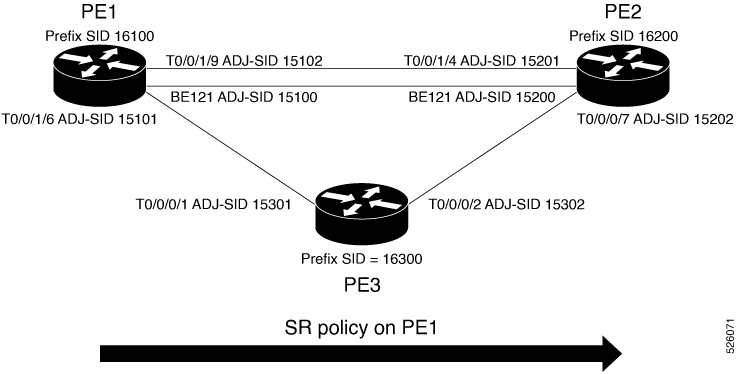
Outlines VPLS pseudowire path selection using SR-TE policies, integration with VPLS services, operational workflows, and provides configuration instructions for deploying VPLS preferred paths using Segment Routing Traffic Engineering.
VPLS preferred path over SR-TE policy is a traffic engineering feature that
-
steers VPLS pseudowire traffic through explicit SR-TE policies
-
overrides default IGP shortest-path behavior when a preferred path is configured, and
-
uses LDP for signaling while SR-TE determines forwarding.
Feature history
The feature history table lists release support for this feature.
| Feature Name |
Release Information |
Feature Description |
|
VPLS preferred path over SR-TE policy |
Release 25.4.1 |
Introduced in this release on: Fixed Systems (8100 [ASIC: Q200], 8200 [ASIC: Q200, P100], 8700 [ASIC: P100, K100], 8010 [ASIC: A100]); Centralized Systems (8600 [ASIC: Q200]); Modular Systems (8800 [LC ASIC: Q200, P100]) You can now steer VPLS pseudowire traffic over a specific SR-TE policy, ensuring precise control over routing, bandwidth, or latency for Layer 2 VPN services. This feature allows you to bind a VPLS pseudowire to an SR-TE tunnel interface, overriding the default IGP shortest path. By doing so, you can enforce traffic engineering constraints and optimize network performance. This feature is only supported with static neighbors and is not supported when neighbor discovery is used. |
SR-TE preferred-path behavior
-
VPLS preferred paths over SR-TE policies steer VPLS pseudowire traffic over specific SR-TE policies.
-
This behavior provides precise control over routing, bandwidth, or latency for Layer 2 VPN services.
-
The feature binds a VPLS pseudowire to an SR-TE tunnel interface and overrides the default IGP shortest path.