L2VPN Configuration Guide for Cisco 8000 Series Routers, Cisco IOS XR Releases

PDF

GTP load balancing

Want to summarize with AI?

Log in

Explains GTP load balancing, describing the GTP protocol’s operation, behavioral patterns, and guidelines for optimizing traffic distribution within Layer 2 bridging contexts.


A GTP load-balancing feature is a transit-router hashing feature that

  • adds the GTP tunnel endpoint identifier to the load-balancing calculation

  • uses TEID-based entropy for GTP traffic with otherwise limited unique fields, and

  • distributes traffic more evenly across equal-cost links and bundles.

Note

The Cisco 8010 Series Routers do not support this feature. For a list of supported features on the Cisco 8010 Series Routers, see Compatibility Matrix for Cisco 8010 Series Routers.

Table 1. Feature history table

Feature Name

Release Information

Feature Description

GTP Load Balancing

Release 25.4.1

Introduced in this release on: Fixed Systems (8700 [ASIC: K100])(select variants only*)

*This feature is supported on Cisco 8711-48Z-M routers.

GTP Load Balancing

Release 25.1.1

Introduced in this release on: Fixed Systems (8700 [ASIC: K100], 8010 [ASIC: A100])(select variants only*)

*This feature is supported on:

  • 8011-4G24Y4H-I

  • 8712-MOD-M

GTP Load Balancing

Release 24.4.1

Introduced in this release on: Fixed Systems (8200 [ASIC: P100], 8700 [ASIC: P100])(select variants only*); Modular Systems (8800 [LC ASIC: P100])(select variants only*)

*This feature is supported on:

  • 8212-48FH-M

  • 8711-32FH-M

  • 88-LC1-36EH

  • 88-LC1-12TH24FH-E

  • 88-LC1-52Y8H-EM

GTP Load Balancing

Release 7.3.2

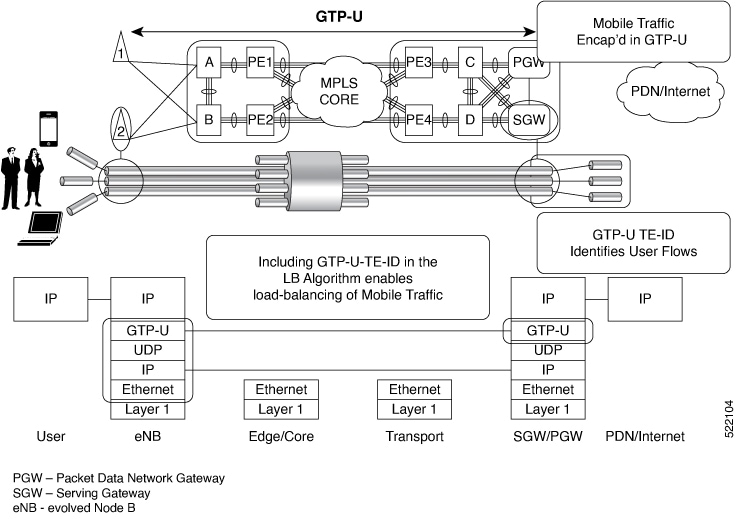
In addition to the source IP address, destination IP address, and port number, this functionality enables using the unique tunnel endpoint identifier (TEID) to compute load balancing (or hashing) of traffic in tunnels between endpoints. The load balancing occurring at the TEID is unique for each traffic flow and achieves better distribution of traffic over equal-cost links. It also helps in load balancing GTP traffic over bundles at transit routers. By default, this functionality is enabled on the Cisco 8000 Series routers, and you cannot disable it.


Key attributes of GTP

The GPRS Tunneling Protocol (GTP) is a tunnel control and management protocol used by General Packet Radio Service (GPRS) support nodes in wireless networks. GTP enables signaling and user-data transport, especially for delivering mobile data.

Key features of GTP include:

  • Tunnel management: GTP-C specifies control and management procedures for creating, modifying, and deleting tunnels between GPRS support nodes.

  • User data transportation: GTP-U uses a tunneling mechanism to carry user data packets efficiently across the wireless network.

  • Signaling and data separation: GTP distinguishes between control messages for signaling and actual user-data transfer, enhancing network flexibility and scalability.


How GTP load balancing works

This process describes how the router improves load balancing for GTP-U traffic in mobile transport networks, ensuring more even distribution across equal-cost links.

Summary

The key components involved in GTP load balancing are:

  • Transit router: Evaluates packet fields and calculates the load-balancing hash for traffic distribution.

  • Standard Layer 3 and Layer 4 hash fields: Provide the baseline inputs for the hash calculation.

  • GTP tunnel endpoint identifier (TEID): Adds entropy for GTP-U traffic when the standard fields are not unique enough.

GTP load balancing enables routers to distribute traffic more effectively, especially when traditional Layer 3 and Layer 4 fields are not sufficient for creating unique traffic flows.

Table 2. Global Layer 3 flow-based load-balancing fields

Source address

Destination address

Router ID

Source port

Destination port

These fields are not always unique enough for GTP traffic, so the router uses the GTP tunnel endpoint identifier to improve traffic distribution.

Workflow

GTP load balancing involves these stages:

  1. The router evaluates the standard Layer 3 flow-based load-balancing fields for the incoming packet.
  2. If the packet is TCP or UDP and the destination port is the GTP-U port 2152, the router includes the GTP TEID in the hash computation to add entropy for each traffic flow.
  3. If the TEID is present, the router supports tunnel-endpoint load balancing for GTP version 1 and version 2 packets. For GTP version 0, the router relies only on the standard fields because version 0 does not include a TEID.

Result

The router distributes GTP-U traffic more evenly across equal-cost links. GTP-C packets, which use destination port 2123, continue to use only the global Layer 3 flow-based load balancing.


Guidelines for GTP load balancing

Use GTP load balancing only for supported packet and encapsulation combinations.

  • GTP load balancing is supported only when the UDP or TCP destination port is 2152.

  • GTP load balancing is performed on IPv4 or IPv6 incoming packets with GTP payloads.

  • For MPLS packets with GTP payload, the load-balancing hash is based on the label stack and the GTP TEID. The maximum limit on the label stack is 14.

  • For IPv4 packets with GTP payload, the hash is based on Router ID, source IP, destination IP, Layer 4 protocol field, source port, destination port, and GTP TEID.

  • For IPv6 packets with GTP payload, the hash is based on Router ID, source IP, destination IP, flow label, Layer 4 protocol field, source port, destination port, and GTP TEID.

Do not expect to disable this feature or use it on a GPRS tunnel originator:

  • GTP load balancing is enabled by default and cannot be disabled.

  • For GTP hashing, the Cisco 8000 Series routers are transit routers but not GPRS tunnel originators.