Describes how Flex-Algo creates SLA-specific network slices and steers VPN traffic over paths optimized for cost, delay, or other IGP constraints.
SRv6 Flexible Algorithm is a feature that
-
allows operators to customize Interior Gateway Protocol (IGP) shortest path computation
-
enables forwarding beyond traditional link-cost-based shortest paths using custom SRv6 locators, and
-
provides automatically computed traffic-engineered paths to any destination reachable by the IGP.
Network Slices with Flexible Algorithm
Consider an SR domain with two distinct network slices, each assigned a /32 uSID Locator Block:
In the example below, the SR domain has 2 network slices. Each slice is assigned a /32 uSID Locator Block.
A slice can be realized with a user-defined Flex-Algo instances (for example, Flex Algo 128 = min-delay)
-
Min-Cost Slice — FCBB:BB00/32
-
Min-Delay Slice — FCBB:BB01/32
SR node2 gets a Shortest-Path Endpoint uSID (uN) from each slice:
-
uN min-cost of Node2 — FCBB:BB00:0002/48
-
uN min-delay of Node2 — FCBB:BB01:0002/48
Node2 announces locators via IS-IS:
-
FCBB:BB00:0002/48 Algo 0 (min-cost)
-
FCBB:BB01:0002/48 Algo 128 (min-delay)

IS-IS in Node1 computes shortest paths for each locator and programs them in the FIB:
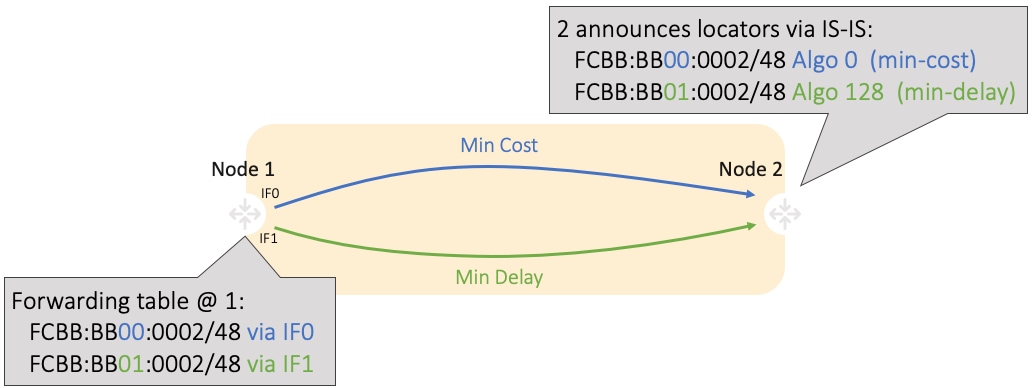
Node1 and Node2 are PEs of a common VPN. PEs advertise VPN routes via BGP with different transport SLAs. For example, traffic to a set of prefixes is to be delivered over the min-cost slice, while for another set of prefixes is to be delivered over the min-delay slice. To achieve this, the egress PE’s service route advertisement includes the locator of the intended transport SLA type.
Use-case: VPN over Min-Cost Slice (Control Plane Behavior)
-
Intuitive uSID program for routes advertised by Node2:
-
Within the Min-Cost Slice (FCBB:BB00)
-
Follow the shortest-path to Node2 (0002)
-
Execute VPN9 decapsulation function at Node2 (F009)
-
-
Hardware Efficiency
-
Egress PE Node2 processes multiple uSIDs with a single /64 lookup
-
FCBB:BB00:0002:F009/64
-

Use-case: VPN over Min-Delay Slice (Control Plane Behavior)
-
Intuitive uSID program for routes advertised by Node2:
-
Within the Min-Delay Slice (FCBB:BB01)
-
Follow the shortest-path to Node2 (0002)
-
Execute VPN9 decapsulation at Node2 (F009)
-
-
Hardware Efficiency
-
Egress PE 2 processes multiple uSIDs with a single /64 lookup
-
FCBB:BB01:0002:F009/64
-

Use-case: VPN over Min-Cost Slice (Data Plane Behavior)
-
Ingress PE (Node 1) learns via BGP that prefix 10.2.0.0/24 in VPN9 is reachable via SID FCBB:BB00:0002:F009
-
Node 1 programs the prefix with “VPN Encaps” behavior
-
When receiving traffic with DA IP matching the prefix 10.2.0.0/24 FIB entry, Node 1 encapsulates the incoming packet into IPv6 with DA of FCBB:BB00:0002:F009

-
SRv6 allows for seamless deployment where any transit node (SRv6-capable or not) simply routes based on a /48 longest prefix match lookup.
For example, transit node (Node 3) forwards traffic along the Algo 0 (min-cost) shortest path for the remote prefix FCBB:BB00:0002::/48.

-
Egress PE (Node 2) matches local SID FCBB:BB00:0002:F009/64. Node 2 applies “VPN Decaps” behavior into VRF9 by removing the IPv6 encapsulation and looking up the payload’s DA on the corresponding VPN table.

Use-case: VPN over Min-Delay Slice (Data Plane Behavior)
-
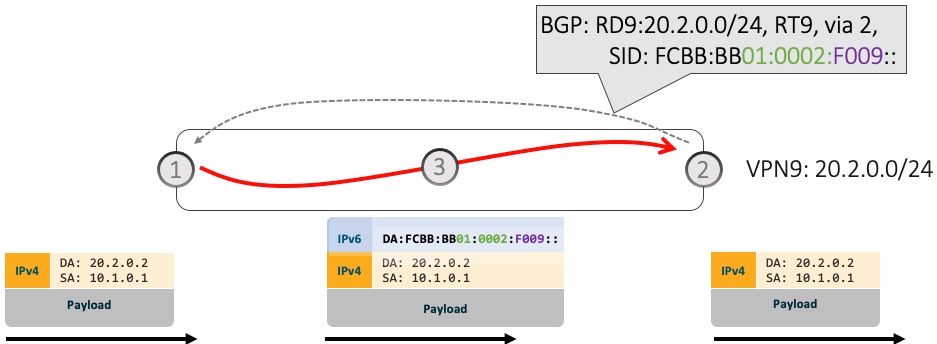
Ingress PE (Node 1) learns via BGP that prefix 20.2.0.0/24 in VPN9 is reachable via SID FCBB:BB01:0002:F009
-
Node 1 programs the prefix with “VPN Encaps” behavior
-
When receiving traffic with DA IP matching the prefix 20.2.0.0/24 FIB entry, Node 1 encapsulates the incoming packet into IPv6 with DA of FCBB:BB01:0002:F009
-
Transit node (Node 3) forwards traffic along the Algo 128 (min-delay) shortest path for the remote prefix FCBB:BB01:0002::/48.
-
Egress PE (Node 2) matches local SID FCBB:BB01:0002:F009/64. Node 2 applies “VPN Decaps” behavior into VRF9 by removing the IPv6 encapsulation and looking up the payload’s DA on the corresponding VPN table.