Segment Routing v6 Configuration Guide for Cisco 8000 Series Routers, Cisco IOS XR Releases

PDF

Segment Routing v6 Configuration Guide for Cisco 8000 Series Routers, Cisco IOS XR Releases

EVPN RT5 support for L3VPN over SRv6

Want to summarize with AI?

Log in

Explains how EVPN RT5 advertises IPv4 and IPv6 L3VPN routes across an SRv6 core and supports policy-based traffic steering between service endpoints.


EVPN RT5 support for L3VPN over SRv6 is a route advertisement feature that

  • carries L3VPN routes in the L2VPN EVPN Route Type 5 (RT5) address family

  • advertises IP prefixes to provide end-to-end Layer 3 connectivity, and

  • uses the EVPN control plane across an SRv6 core instead of the VPNv4 or VPNv6 unicast address families.

Table 1. Feature History Table

Feature Name

Release information

Feature Description

EVPN RT5 support for L3VPN over SRv6

Release 26.3.1

Introduced in this release on: Fixed Systems (8200 [ASIC: P100], 8700 [ASIC: P100, K100], 8010 [ASIC: A100]); Modular Systems (8800 [LC ASIC: P100])

Simplifies Layer 3 route advertisement across an SRv6 core by reducing the need for separate VPNv4 and VPNv6 unicast address families. This feature supports carrying L3VPN routes in the L2VPN EVPN Route Type 5 address family to provide end-to-end Layer 3 connectivity across an SRv6 core.

Supported route families, endpoint behaviors, and automated steering for EVPN RT5 L3VPN over SRv6

The following options are supported:

  • IPv4, IPv6, and IPv4/IPv6 (dual stack) L3 EVPN over SRv6

  • uDT4

  • uDT6

  • uDT46

  • Automated Steering to Flex-Algo (BGP per-VRF locator Flex-Algo (per-prefix))

  • Automated Steering to SRv6 Policy (ODN/AS)

Guidelines for EVPN RT5 support for L3VPN over SRv6

Follow these guidelines for mixed EVPN RT5 and VPNv4 or VPNv6 deployments:

  • Do not configure the dual VPNv4 or VPNv6 address family and the EVPN RT5 address family on the same BGP session.

  • Configure two pairs of loopback interfaces and two BGP loopback sessions between the route reflector and the provider edge device when the route reflector must receive both Type 5 EVPN routes and VPNv4 or VPNv6 routes.

  • Use one BGP loopback session for the VPNv4 or VPNv6 address family and one BGP loopback session for the EVPN address family.

  • Mark VRF routes with an export route policy and use a neighbor outbound policy to drop or pass the route for an address family when you need the same effective route-selection behavior.


How EVPN RT5 support for L3VPN over SRv6 works

EVPN Route Type 5 defines IP prefix advertisement in EVPN for Layer 3 reachability. In this feature, the network carries L3VPN routes using the EVPN Route Type 5 address family across an SRv6 core instead of traditional VPNv4 or VPNv6 address families.

Summary

The key components involved in the process are:

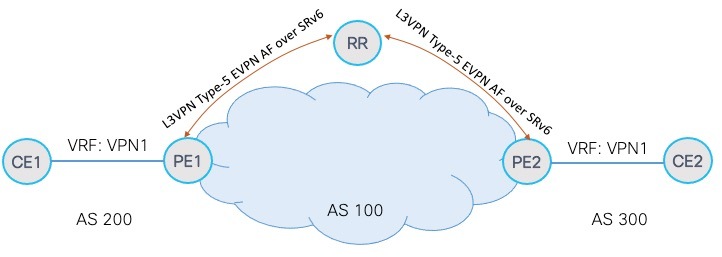
  • Customer edge devices (CE1 and CE2): Originate and receive L3VPN traffic and prefixes.

  • Provider edge devices (PE1 and PE2): Learn customer prefixes, advertise EVPN Route Type 5 routes, and forward traffic.

  • Route reflector: Propagates EVPN Route Type 5 routes across the SRv6 core between provider edge devices.

  • SRv6 core: Provides the underlying transport for forwarding traffic between provider edge devices.

EVPN Route Type 5 enables IP prefix advertisement for Layer 3 reachability in EVPN. This feature allows L3VPN routes to be carried in the EVPN Route Type 5 address family across an SRv6 core, providing seamless end-to-end Layer 3 connectivity.

Workflow

Figure 1. Configuration Example: Dual Stack L3 EVPN over SRv6

These stages describe how EVPN RT5 support for L3VPN over SRv6 works.

  1. Prefix learning and route creation: The ingress provider edge device (PE1) learns the customer prefix from CE1 within VRF VPN1. PE1 associates the prefix with the VPN context and creates an EVPN Route Type 5 route for advertisement.

  2. Route propagation across the SRv6 core: PE1 advertises the EVPN Route Type 5 route in the EVPN address family. The route reflector receives the route and propagates it across the SRv6 core toward PE2.

  3. Route import at the remote edge: The egress provider edge device (PE2) receives the EVPN Route Type 5 route, imports it into VRF VPN1, and installs the prefix for Layer 3 forwarding.

  4. Traffic forwarding toward the remote edge: PE1 receives traffic for the advertised destination prefix from CE1. The device performs a VPN lookup, applies SRv6 forwarding, and forwards the traffic across the core toward PE2.

  5. Traffic delivery to the destination: PE2 receives the traffic from the SRv6 core and uses the installed route in VRF VPN1 to forward the packet toward CE2.


Configure a dual-stack VRF for EVPN RT5 over SRv6

Set up a dual-stack VRF with appropriate route-targets and BGP settings to enable EVPN RT5 over SRv6, ensuring optimal path selection for both IPv4 and IPv6.

Use this task when deploying EVPN RT5 over SRv6 to configure both IPv4 and IPv6 route-targets within a VRF and adjust BGP address-family settings for additional path selection. This enables robust multi-protocol support needed for sophisticated, scalable EVPN deployments.

Procedure

  1. Configure the dual-stack VRF route targets.

    Example:

    Router(config)# vrf VPN1
    Router(config-vrf)# address-family ipv4 unicast 
    Router(config-vrf-af)# import route-target
    Router(config-vrf-import-rt)# 1:1
    Router(config-vrf-import-rt)# exit
    Router(config-vrf-af)# export route-target
    Router(config-vrf-export-rt)# 1:1
    Router(config-vrf-export-rt)# exit
    Router(config-vrf)# address-family ipv6 unicast 
    Router(config-vrf-af)# import route-target
    Router(config-vrf-import-rt)# 1:1
    Router(config-vrf-import-rt)# exit
    Router(config-vrf-af)# export route-target
    Router(config-vrf-export-rt)# 1:1
    Router(config-vrf-export-rt)# exit
    Router(config-vrf-af)# 
  2. Configure the SRv6 Locator for an individual VRF, with Per-VRF label allocation mode.

    Router(config)# router bgp 100
    Router(config-bgp)# address-family vpnv4 unicast
    Router(config-bgp-af)# additional-paths receive
    Router(config-bgp-af)# additional-paths send
    Router(config-bgp-af)# additional-paths selection route-policy add-path
    Router(config-bgp-af)# exit
    Router(config-bgp)# address-family vpnv6 unicast
    Router(config-bgp-af)# additional-paths receive
    Router(config-bgp-af)# additional-paths send
    Router(config-bgp-af)# additional-paths selection route-policy add-path
    Router(config-bgp-af)# exit
    Router(config-bgp)# address-family l2vpn evpn
    Router(config-bgp-af)# additional-paths receive
    Router(config-bgp-af)# additional-paths send
    Router(config-bgp-af)# additional-paths selection route-policy add-path
    Router(config-bgp-af)# exit
    
    Router(config-bgp)# neighbor 1111::1
    Router(config-bgp-nbr)# remote-as 100
    Router(config-bgp-nbr)# address-family l2vpn evpn
    Router(config-bgp-nbr-af)# advertise vpnv4 unicast
    Router(config-bgp-nbr-af)# advertise vpnv6 unicast
    Router(config-bgp-nbr-af)# exit
    Router(config-bgp-nbr)# exit
    
    Router(config-bgp)# vrf VPN1
    Router(config-bgp-vrf)# rd 100:1
    Router(config-bgp-vrf)# address-family ipv4 unicast
    Router(config-bgp-vrf-af)# segment-routing srv6
    Router(config-bgp-vrf-af-srv6)# locator LOC1
    Router(config-bgp-vrf-af-srv6)# alloc mode per-vrf
    Router(config-bgp-vrf-af-srv6)# exit
    Router(config-bgp-vrf-af)# exit
    Router(config-bgp-vrf)# address-family ipv6 unicast
    Router(config-bgp-vrf-af)# segment-routing srv6
    Router(config-bgp-vrf-af-srv6)# locator LOC1
    Router(config-bgp-vrf-af-srv6)# alloc mode per-vrf
    Router(config-bgp-vrf-af-srv6)# exit
    Router(config-bgp-vrf-af)# exit
    
    Router(config-bgp-vrf)# neighbor 10.1.1.1
    Router(config-bgp-vrf-nbr)# remote-as 200
    Router(config-bgp-vrf-nbr)# address-family ipv4 unicast
    Router(config-bgp-vrf-nbr-af)# exit
    Router(config-bgp-vrf-nbr)# exit
    Router(config-bgp-vrf)# neighbor 3333::3
    Router(config-bgp-vrf-nbr)# remote-as 200
    Router(config-bgp-vrf-nbr)# address-family ipv6 unicast
  3. Verify the VRF route-target running configuration.

    vrf VPN1
     address-family ipv4 unicast
      import route-target
       1:1
      !
      export route-target
       1:1
      !
     !
     address-family ipv6 unicast
      import route-target
       1:1
      !
      export route-target
       1:1
      !
     !
    !
    router bgp 100
     address-family vpnv4 unicast
      additional-paths receive
      additional-paths send
      additional-paths selection route-policy add-path
     !
     address-family vpnv6 unicast
      additional-paths receive
      additional-paths send
      additional-paths selection route-policy add-path
     !
     address-family l2vpn evpn
      additional-paths receive
      additional-paths send
      additional-paths selection route-policy add-path
     !
     neighbor 1111::1 
      remote-as 100
      address-family l2vpn evpn
       advertise vpnv4 unicast
       advertise vpnv6 unicast
      !
     !
     vrf VPN1
      rd 100:1
      address-family ipv4 unicast
       segment-routing srv6
        locator LOC1
        alloc mode per-vrf
       !
      !
      address-family ipv6 unicast
       segment-routing srv6
        locator LOC1
        alloc mode per-vrf
       !
      !
      neighbor 10.1.1.1
       remote-as 200
       address-family ipv4 unicast
       !
      !
      neighbor 3333::3
       remote-as 200
       address-family ipv6 unicast
       !
      !
     !
    !