Describes how routers detect possible microloops, install temporary SID-list paths, wait for network convergence, and transition traffic to native post-convergence forwarding.
Summary
The SRv6 Microloop Avoidance process involves a router detecting potential microloops following a topology change. The Interior Gateway Protocol (IGP) then computes and temporarily installs an SRv6 microloop-avoidant path using a Segment Identifier (SID) list. After the network converges and a configurable RIB update delay expires, the IGP replaces this temporary path with the native post-convergence forwarding path.
Workflow
These stages describe how SRv6 Microloop Avoidance works in a network:
-
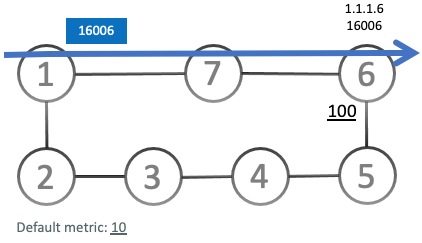
Initial network state: The network operates in a stable state. Node1 sends traffic to Node6 (prefix SID 16006) via Node7. Node7 is configured with TI-LFA to protect traffic to Node6.
-
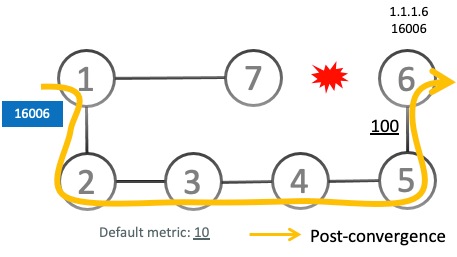
Topology change and failure detection: A link failure occurs, for example, between Node6 and Node7. All nodes are notified of this topology change. Node7's TI-LFA pre-computes a backup path for traffic to Node6 (prefix SID 16006), which would steer traffic toward Node5 (prefix SID 16005) and then via the link between Node5 and Node6 (adj-SID 24056).

-
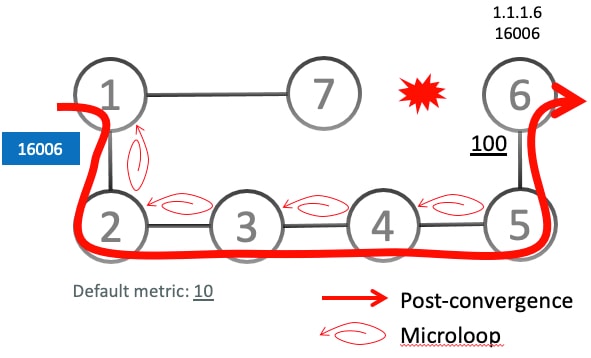
Microloop detection : A router with the SRv6 microloop avoidance feature detects if microloops are possible for a destination on the post-convergence path following the topology change. For example, if Node2 converges before Node3, Node3 might send traffic back to Node2 as the shortest IGP path to Node6, creating a microloop between Node2 and Node3.
-
Microloop-avoidant path computation and installation: If a node determines that a microloop could occur on the new topology (In this example, on Node1 for traffic to Node6), the IGP computes a microloop-avoidant path. This path is constructed to steer traffic to the destination loop-free over a temporary path. For Node6, this path might be {16005, 24056, 16006}. The IGP then updates the forwarding table and temporarily installs the SID-list imposition entries associated with this microloop-avoidant path for destinations with possible microloops.

-
Network convergence and temporary path usage: All nodes in the network converge and update their forwarding tables. Traffic for destinations prone to microloops is steered using the temporary microloop-avoidant SRv6 SID list.
-
Transition to native forwarding: After the RIB update delay timer expires, the IGP updates the forwarding table again. The microloop-avoidant SRv6 SID list is removed, and traffic now natively follows the post-convergence path.