Describes how a PLR activates a precalculated backup path after detecting a failure and maintains connectivity while the IGP converges on a new primary path.
SRv6 TI-LFA operates by proactively computing optimal, loop-free backup paths that traffic can immediately use upon a failure. This ensures rapid restoration of connectivity and minimal disruption, allowing the network's Interior Gateway Protocol (IGP) to converge to a new primary path without significant packet loss.
Summary
SRv6 TI-LFA is a mechanism that ensures rapid network connectivity restoration and minimal disruption by proactively computing and activating optimal, loop-free backup paths. It involves routers (acting as Points of Local Repair - PLRs) that pre-compute these backup paths for potential failures. Upon rapid failure detection (often via BFD), the PLR immediately activates the pre-computed backup path, encapsulating traffic with SRv6 Segment Identifiers (SIDs) to steer it around the failure. Concurrently, the Interior Gateway Protocol (IGP) re-converges the network, and traffic seamlessly transitions from the temporary SRv6 TI-LFA backup path to the newly established optimal primary paths.
Workflow
These stages describe how SRv6 TI-LFA works within a network:
-
Initial network state and primary path calculation :The Interior Gateway Protocol (IGP) establishes the primary forwarding paths across the network. Each router maintains its routing information base (RIB) and forwarding information base (FIB) based on the current network topology.
-
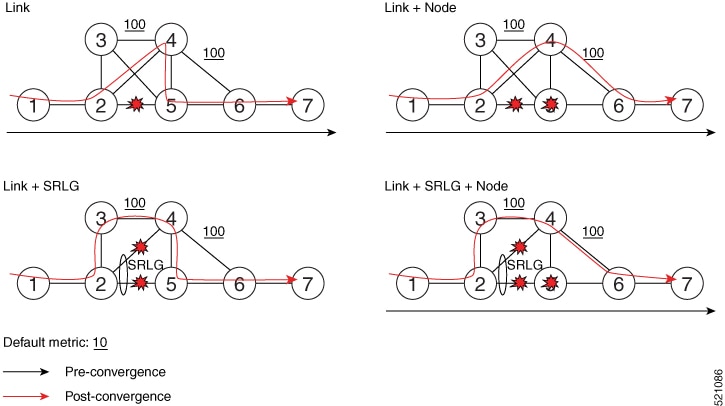
SRv6 TI-LFA backup path pre-computation: Each router, acting as a Point of Local Repair (PLR), proactively computes one or more optimal, loop-free backup paths that represent the "post-convergence path"—the exact path traffic would eventually take after the IGP fully re-converges. This pre-computation is done for every potential primary path failure, including link protection (where the failed link is excluded), node protection (where the neighbor node is excluded), and Shared Risk Link Group (SRLG) protection (where all local links sharing any SRLG with the protecting link are excluded during backup path calculation). This optimal path is preferred because it is optimal for capacity planning, simple to operate by avoiding case-by-case adjustments, and results in fewer traffic transitions since the repair path is equal to the post-convergence path. The PLR uses SRv6 segment routing principles to ensure these backup paths are safe and avoid the specific failed component. When enabling link protection, node protection, SRLG protection, or both can also be enabled, and a tiebreaker priority can be specified for multiple LFAs. For example, in a topology, Node2 can apply different protection models to protect traffic to Node7.
-
Failure detection: A link or node failure occurs in the network. The PLR rapidly detects this failure, often through mechanisms like Bidirectional Forwarding Detection (BFD), which provide sub-50ms detection times.
-
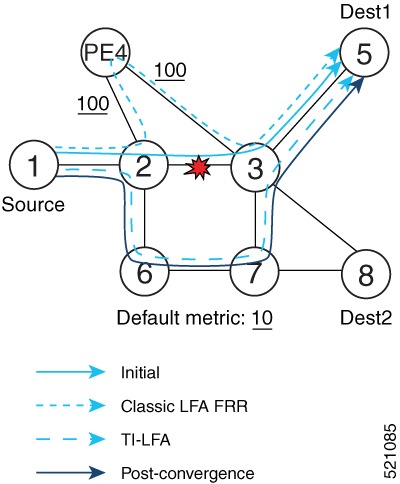
Fast reroute activation and traffic steering with SRv6 SIDs: Upon detecting the failure, the PLR immediately activates the pre-computed SRv6 TI-LFA backup path. TI-LFA calculates a post-convergence path and derives the segment list required to steer packets along this path without looping back. It encapsulates the traffic destined for the failed primary path with an SRv6 Segment Identifier (SID) list that explicitly directs the packets along the calculated backup path. For example, if Node 2 protects traffic to destination Node 5 and the protected link fails, the shortest post-convergence path might be Node2 → Node6 → Node7 → Node3 → Node5. If Node7 is the PQ-node for destination Node5, TI-LFA encodes a single segment (prefix SID of Node7) in the header of the packets on this repair path. This steering ensures traffic continues to flow around the failure without looping back or being dropped, unlike classic LFA which might steer traffic to a suboptimal path like Node 4 that is routed over edge nodes with lower capacity links.
-
Network-wide IGP convergence: IGP reacts to the detected failure. It floods updated topology information throughout the network, and all routers perform a full re-convergence, calculating new optimal primary paths that reflect the changed topology. This process typically takes longer than the initial fast reroute.
-
Traffic restoration to new primary path: Once the IGP has fully converged and new optimal primary paths are established, traffic naturally switches from the temporary SRv6 TI-LFA backup path to these newly converged primary paths. This transition is seamless, as the SRv6 TI-LFA backup path was designed to be the post-convergence path, minimizing further traffic shifts.