Segment Routing v6 Configuration Guide for Cisco 8000 Series Routers, Cisco IOS XR Releases

PDF

Segment Routing v6 Configuration Guide for Cisco 8000 Series Routers, Cisco IOS XR Releases

SRv6 L3 EVPN services

Want to summarize with AI?

Log in

Explains how EVPN RT5 carries L3VPN routes across an SRv6 core and provides the interworking requirements, service limitations, and configuration needed for scalable connectivity.


An SRv6 L3 EVPN services is a network service that

  • uses EVPN Route Type 5 (RT5) to advertise EVPN routes with IP prefixes

  • provides end-to-end Layer 3 connectivity, and

  • supports carrying L3VPN routes within the L2VPN EVPN RT5 address family instead of VPNv4 or VPNv6 unicast address families across an SRv6 core (EVPN over SRv6 underlay).

Table 1. Feature History Table

Feature Name

Release

Description

Support for SRv6 Services: L3 EVPN

Release 7.9.1

This feature adds support for carrying L3VPN routes in L2VPN EVPN RT5 address-family instead of VPNv4 unicast and/or VPNv6 unicast address-family across SRv6 core (EVPN over SRv6 underlay).

This allows for efficient and scalable delivery of VPN services using SRv6 technology.

Interworking and BGP session for EVPN RT5 over SRv6 and MPLS cores

Interworking between EVPN RT5 over SRv6 core and EVPN RT5 over MPLS core is supported through the L3 EVPN/SRv6 and L3 EVPN/MPLS interworking gateway.

Similarly, interworking between EVPN RT5 over SRv6 core and L3VPN over MPLS core is enabled through the L3 EVPN/SRv6 and L3VPN/MPLS interworking gateway.
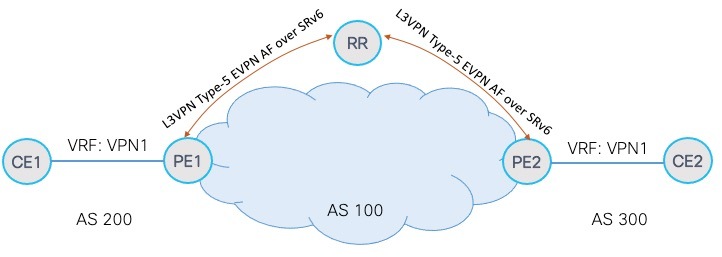

Limitations of SRv6 L3 EVPN services

This topic provides supported configurations for interworking EVPN RT5 with SRv6 and MPLS core.

Supported interworking

  • Interworking between EVPN RT5 over an SRv6 core and EVPN RT5 over an MPLS core is supported.

  • Interworking between EVPN RT5 over an SRv6 core and L3VPN over an MPLS core is supported.

BGP session configuration for route reflectors

  • BGP does not support configuring both VPNv4/v6 address families and EVPN RT5 address families on the same BGP session simultaneously.

    For the route reflector (RR) to receive both Type-5 EVPN route and VPNv4/v6 address family, we recommend that you configure two pairs of loopback interfaces and configure two BGP loopback sessions between the RR and the PE: one session for VPNv4/v6 address family and one session for EVPN address family.

VRF route advertisement

  • BGP advertises all VRF routes using either the VPNv4/v6 or EVPN address family.

    We recommend that you mark the VRF route via export route-policy and use neighbor out policy to either drop or pass the route for an address family to achieve the same net effect.

Supported behaviors for EVPN RT5 over SRv6

  • IPv4, IPv6, and IPv4/IPv6 (dual stack) L3 EVPN over SRv6

  • uDT4

  • uDT6

  • uDT46

  • Automated Steering to Flex-Algo (BGP per-VRF locator Flex-Algo (per-prefix))

  • Automated Steering to SRv6 Policy (ODN/AS)


Configure SRv6-based L3 EVPN

Enable and configure SRv6-based Layer 3 EVPN to support dual-stack IPv4/IPv6 environments.

Figure 1. Configuration Example: Dual Stack L3 EVPN over SRv6

Procedure

  1. Configure the VRF with dual-stack IPv4 and IPv6 address families.

    Example:

    Router(config)# vrf VPN1
    Router(config-vrf)# address-family ipv4 unicast 
    Router(config-vrf-af)# import route-target
    Router(config-vrf-import-rt)# 1:1
    Router(config-vrf-import-rt)# exit
    Router(config-vrf-af)# export route-target
    Router(config-vrf-export-rt)# 1:1
    Router(config-vrf-export-rt)# exit
    Router(config-vrf)# address-family ipv6 unicast 
    Router(config-vrf-af)# import route-target
    Router(config-vrf-import-rt)# 1:1
    Router(config-vrf-import-rt)# exit
    Router(config-vrf-af)# export route-target
    Router(config-vrf-export-rt)# 1:1
    Router(config-vrf-export-rt)# exit
    Router(config-vrf-af)# 
    
  2. Configure the SRv6 locator for an individual VRF, with per-VRF label allocation mode.

    Example:

    Router(config)# router bgp 100
    Router(config-bgp)# address-family vpnv4 unicast
    Router(config-bgp-af)# additional-paths receive
    Router(config-bgp-af)# additional-paths send
    Router(config-bgp-af)# additional-paths selection route-policy add-path
    Router(config-bgp-af)# exit
    Router(config-bgp)# address-family vpnv6 unicast
    Router(config-bgp-af)# additional-paths receive
    Router(config-bgp-af)# additional-paths send
    Router(config-bgp-af)# additional-paths selection route-policy add-path
    Router(config-bgp-af)# exit
    Router(config-bgp)# address-family l2vpn evpn
    Router(config-bgp-af)# additional-paths receive
    Router(config-bgp-af)# additional-paths send
    Router(config-bgp-af)# additional-paths selection route-policy add-path
    Router(config-bgp-af)# exit
    
    Router(config-bgp)# neighbor 1111::1
    Router(config-bgp-nbr)# remote-as 100
    Router(config-bgp-nbr)# address-family l2vpn evpn
    Router(config-bgp-nbr-af)# advertise vpnv4 unicast
    Router(config-bgp-nbr-af)# advertise vpnv6 unicast
    Router(config-bgp-nbr-af)# exit
    Router(config-bgp-nbr)# exit
    
    Router(config-bgp)# vrf VPN1
    Router(config-bgp-vrf)# rd 100:1
    Router(config-bgp-vrf)# address-family ipv4 unicast
    Router(config-bgp-vrf-af)# segment-routing srv6
    Router(config-bgp-vrf-af-srv6)# locator LOC1
    Router(config-bgp-vrf-af-srv6)# alloc mode per-vrf
    Router(config-bgp-vrf-af-srv6)# exit
    Router(config-bgp-vrf-af)# exit
    Router(config-bgp-vrf)# address-family ipv6 unicast
    Router(config-bgp-vrf-af)# segment-routing srv6
    Router(config-bgp-vrf-af-srv6)# locator LOC1
    Router(config-bgp-vrf-af-srv6)# alloc mode per-vrf -46
    Router(config-bgp-vrf-af-srv6)# exit
    Router(config-bgp-vrf-af)# exit
    
    Router(config-bgp-vrf)# neighbor 1.1.1.1
    Router(config-bgp-vrf-nbr)# remote-as 200
    Router(config-bgp-vrf-nbr)# address-family ipv4 unicast
    Router(config-bgp-vrf-nbr-af)# exit
    Router(config-bgp-vrf-nbr)# exit
    Router(config-bgp-vrf)# neighbor 3333::3
    Router(config-bgp-vrf-nbr)# remote-as 200
    Router(config-bgp-vrf-nbr)# address-family ipv6 unicast
    
    
  3. Running configuration of SRv6-based L3 EVPN

    Example:

    vrf VPN1
     address-family ipv4 unicast
      import route-target
       1:1
      !
      export route-target
       1:1
      !
     !
     address-family ipv6 unicast
      import route-target
       1:1
      !
      export route-target
       1:1
      !
     !
    !
    router bgp 100
     address-family vpnv4 unicast
      additional-paths receive
      additional-paths send
      additional-paths selection route-policy add-path
     !
     address-family vpnv6 unicast
      additional-paths receive
      additional-paths send
      additional-paths selection route-policy add-path
     !
     address-family l2vpn evpn
      additional-paths receive
      additional-paths send
      additional-paths selection route-policy add-path
     !
     neighbor 1111::1 
      remote-as 100
      address-family l2vpn evpn
       advertise vpnv4 unicast
       advertise vpnv6 unicast
      !
     !
     vrf VPN1
      rd 100:1
      address-family ipv4 unicast
       segment-routing srv6
        locator LOC1
        alloc mode per-vrf
       !
      !
      address-family ipv6 unicast
       segment-routing srv6
        locator LOC1
        alloc mode per-vrf -46
       !
      !
      neighbor 1.1.1.1
       remote-as 200
       address-family ipv4 unicast
       !
      !
      neighbor 3333::3
       remote-as 200
       address-family ipv6 unicast
       !
      !
     !
    !