Segment Routing v6 Configuration Guide for Cisco 8000 Series Routers, Cisco IOS XR Releases

PDF

Segment Routing v6 Configuration Guide for Cisco 8000 Series Routers, Cisco IOS XR Releases

SRv6 over IPv6 overview

Want to summarize with AI?

Log in

Explains segment Routing (SR) can be applied on both MPLS and IPv6 data planes. Segment Routing over IPv6 (SRv6) extends Segment Routing support with IPv6 data plane.


Segment Routing (SR) can be applied on both MPLS and IPv6 data planes. Segment Routing over IPv6 (SRv6) extends Segment Routing support with IPv6 data plane.

SRv6 introduces the Network Programming framework that enables a network operator or an application to specify a packet processing program by encoding a sequence of instructions in the IPv6 packet header. Each instruction is implemented on one or several nodes in the network and identified by an SRv6 Segment Identifier (SID) in the packet. The SRv6 Network Programming framework is defined in IETF RFC 8986 SRv6 Network Programming.

In SRv6, an IPv6 address represents an instruction. SRv6 uses a new type of IPv6 Routing Extension Header, called the Segment Routing Header (SRH), in order to encode an ordered list of instructions. The active segment is indicated by the destination address of the packet, and the next segment is indicated by a pointer in the SRH.

The SRv6 SRH is documented in IETF RFC 8986 SRv6 network programming.


SRv6 with Full-Length SIDs

A Segment Routing IPv6 (SRv6) full-length SID is an identifier format that

  • uses a 128-bit IPv6 address to uniquely identify network segments,

  • allows flexible end-to-end programming of packet forwarding paths across devices, and

  • enables explicit traffic steering, service chaining, and advanced network programming in IPv6 networks.

Table 1. Feature History Table

Feature Name

Release Information

Feature Description

SRv6 with Full-Length SIDs

Release 25.4.1

Introduced in this release on: Fixed Systems (8010 [ASIC: A100])(select variants only*)

*This feature is supported on:

  • 8011-32Y8L2H2FH

  • 8011-12G12X4Y-A/D

SRv6 with Full-Length SIDs

Release 25.1.1

Introduced in this release on: Fixed Systems (8700 [ASIC: K100], 8010 [ASIC: A100])

This feature is now supported on:

  • 8712-MOD-M

  • 8011-4G24Y4H-I

SRv6 with Full-Length SIDs

Release 24.4.1

Introduced in this release on: Fixed Systems (8200 [ASIC: P100], 8700 [ASIC: P100])(select variants only*); Modular Systems (8800 [LC ASIC: P100])(select variants only*)

*This feature is supported on:

  • 8212-48FH-M

  • 8711-32FH-M

  • 88-LC1-36EH

  • 88-LC1-12TH24FH-E

  • 88-LC1-52Y8H-EM

Release 7.5.2

This feature extends Segment Routing support with IPv6 data plane.

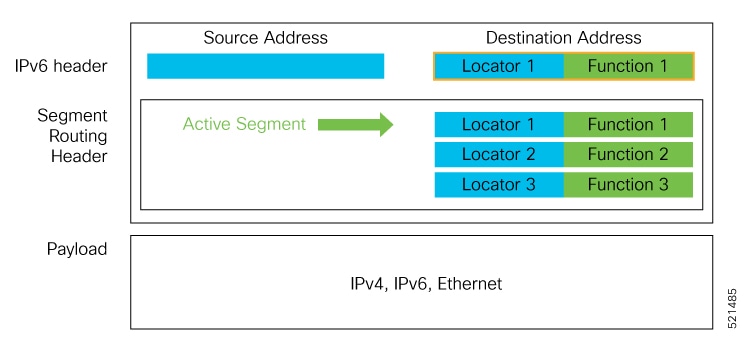
In a Segment Routing over IPv6 (SRv6) network, an IPv6 address serves as the Segment Identifier (SID). The source router encodes the path to destination as an ordered list of segments (list of IPv6 addresses) in the IPv6 packet using a new header for SRv6 called a Segment Routing Header (SRH). In an SRv6 enabled network, the active segment is indicated by the destination address of the packet, and the next segment is indicated by a pointer in the SRH.


SRv6 network program in the packet header

In SRv6, an IPv6 address represents an instruction. SRv6 uses a new type of IPv6 Routing Extension Header, called the Segment Routing Header (SRH), in order to encode an ordered list of instructions. The active segment is indicated by the destination address of the packet, and the next segment is indicated by a pointer in the SRH.

Figure 1. Network program in the packet header
Network program in the packer header

Segment Routing Header fields

In SRv6, an IPv6 address represents an instruction. SRv6 uses a new type of IPv6 Routing Extension Header, called the Segment Routing Header (SRH), in order to encode an ordered list of instructions. The active segment is indicated by the destination address of the packet, and the next segment is indicated by a pointer in the SRH.

The SRv6 SRH is documented in IETF RFC IPv6 Segment Routing Header (SRH).

The SRH is defined :


     0                   1                   2                   3
     0 1 2 3 4 5 6 7 8 9 0 1 2 3 4 5 6 7 8 9 0 1 2 3 4 5 6 7 8 9 0 1
    +-+-+-+-+-+-+-+-+-+-+-+-+-+-+-+-+-+-+-+-+-+-+-+-+-+-+-+-+-+-+-+-+
    | Next Header   |  Hdr Ext Len  | Routing Type  | Segments Left |
    +-+-+-+-+-+-+-+-+-+-+-+-+-+-+-+-+-+-+-+-+-+-+-+-+-+-+-+-+-+-+-+-+
    |  Last Entry   |     Flags     |              Tag              |
    +-+-+-+-+-+-+-+-+-+-+-+-+-+-+-+-+-+-+-+-+-+-+-+-+-+-+-+-+-+-+-+-+
    |                                                               |
    |            Segment List[0] (128-bit IPv6 address)             |
    |                                                               |
    |                                                               |
    +-+-+-+-+-+-+-+-+-+-+-+-+-+-+-+-+-+-+-+-+-+-+-+-+-+-+-+-+-+-+-+-+
    |                                                               |
    |                                                               |
                                  ...
    |                                                               |
    |                                                               |
    +-+-+-+-+-+-+-+-+-+-+-+-+-+-+-+-+-+-+-+-+-+-+-+-+-+-+-+-+-+-+-+-+
    |                                                               |
    |            Segment List[n] (128-bit IPv6 address)             |
    |                                                               |
    |                                                               |
    +-+-+-+-+-+-+-+-+-+-+-+-+-+-+-+-+-+-+-+-+-+-+-+-+-+-+-+-+-+-+-+-+
    //                                                             //
    //         Optional Type Length Value objects (variable)       //
    //                                                             //
    +-+-+-+-+-+-+-+-+-+-+-+-+-+-+-+-+-+-+-+-+-+-+-+-+-+-+-+-+-+-+-+-+

These list explains the fields in SRH:

  • Next header—Identifies the type of header immediately following the SRH.

  • Hdr Ext Len (header extension length)—The length of the SRH in 8-octet units, not including the first 8 octets.

  • Segments left—Specifies the number of route segments remaining. That means, the number of explicitly listed intermediate nodes still to be visited before reaching the final destination.

  • Last Entry—Contains the index (zero based) of the last element of the segment list.

  • Segment list—128-bit IPv6 addresses representing the nth segment in the segment list. The segment list encoding starts from the last segment of the SR policy (path). That means the first element of the segment list (Segment list [0]) contains the last segment of the SR policy, the second element contains the penultimate segment of the SR policy and so on.


SRv6 SID structure

In SRv6, a SID represents a 128-bit value, consisting of these three parts:

Locator: This is the first part of the SID with most significant bits and represents an address of a specific SRv6 node.

Function: This is the portion of the SID that is local to the owner node and designates a specific SRv6 function (network instruction) that is executed locally on a particular node, specified by the locator bits.

Args: This field is optional and represents optional arguments to the function.

SID Block: This field is the SRv6 network designator and is a fixed or known address space for an SRv6 domain. This is the most significant bit (MSB) portion of a locator subnet.

Node Id: This field is the node designator in an SRv6 network and is the Least Significant Bit (LSB) portion of a locator subnet.


SRv6 node roles

Each node along the SRv6 packet path has a different functionality:

Source node: A node that can generate an IPv6 packet with an SRH (an SRv6 packet), or an ingress node that can impose an SRH on an IPv6 packet.

Transit node:A node along the path of the SRv6 packet (IPv6 packet and SRH). The transit node does not inspect the SRH. The destination address of the IPv6 packet does not correspond to the transit node.

Endpoint node: A node in the SRv6 domain where the SRv6 segment is terminated. The destination address of the IPv6 packet with an SRH corresponds to the end point node. The segment endpoint node executes the function bound to the SID


SRv6 head-end behaviors


SRv6 endpoint behaviors

The SRv6 endpoint behaviors are documented in the IETF RFC 8986 SRv6 network programming.

The following is a subset of defined SRv6 endpoint behaviors that can be associated with a SID:

  • End—Endpoint function. The SRv6 instantiation of a Prefix SID [RFC8402].

  • End.X—Endpoint with Layer-3 cross-connect. The SRv6 instantiation of an Adj SID [RFC8402].

  • End.DX6—Endpoint with decapsulation and IPv6 cross-connect (IPv6-L3VPN - equivalent to per-CE VPN label).

  • End.DX4—Endpoint with decapsulation and IPv4 cross-connect (IPv4-L3VPN - equivalent to per-CE VPN label).

  • End.DT6—Endpoint with decapsulation and IPv6 table lookup (IPv6-L3VPN - equivalent to per-VRF VPN label).

  • End.DT4—Endpoint with decapsulation and IPv4 table lookup (IPv4-L3VPN - equivalent to per-VRF VPN label).

  • End.DX2—Endpoint with decapsulation and L2 cross-connect (L2VPN use-case).

  • End.B6.Encaps—Endpoint bound to an SRv6 policy with encapsulation. SRv6 instantiation of a Binding SID.

  • End.B6.Encaps.RED—End.B6.Encaps with reduced SRH. SRv6 instantiation of a Binding SID.


SRv6 endpoint behavior variants

Depending on how the SRH is handled, different behavior variants are defined for the End and End.X behaviors. The End and End.X behaviors can support these variants, either individually or in combinations.

Penultimate Segment Pop (PSP) of the SRH variant

Penultimate Segment Pop (PSP) of the SRH variant: An SR Segment Endpoint Nodes receive the IPv6 packet with the Destination Address field of the IPv6 Header equal to its SID address.

A penultimate SR Segment Endpoint Node is one that, as part of the SID processing, copies the last SID from the SRH into the IPv6 Destination Address and decrements the Segments Left value from one to zero.

The PSP operation takes place only at a penultimate SR Segment Endpoint Node and does not happen at non-penultimate endpoint nodes. When a SID of PSP-flavor is processed at a non-penultimate SR Segment Endpoint Node, the PSP behavior is not performed since Segments Left would not be zero.

The SR Segment Endpoint Nodes advertise the SIDs instantiated on them via control plane protocols. A PSP-flavored SID is used by the Source SR Node when it needs to instruct the penultimate SR Segment Endpoint Node listed in the SRH to remove the SRH from the IPv6 header.

Ultimate Segment Pop (USP) of the SRH variant

The SRH processing of the End and End.X behaviors are modified. If Segments Left is 0, then:

  1. Update the Next Header field in the preceding header to the Next Header value of the SRH.

  2. Decrease the IPv6 header Payload Length by 8*(Hdr Ext Len+1).

  3. Remove the SRH from the IPv6 extension header chain.

  4. Proceed to process the next header in the packet.

One of the applications of the USP flavor is when a packet with an SRH is destined to an application on hosts with smartNICs implementing SRv6. The USP flavor is used to remove the consumed SRH from the extension header chain before sending the packet to the host.

Ultimate Segment Decapsulation (USD) variant

The Upper-layer header processing of the End and End.X behaviors are modified:

  • End behavior: If the Upper-layer Header type is 41 (IPv6), then:

    1. Remove the outer IPv6 Header with all its extension headers.

    2. Submit the packet to the egress IPv6 FIB lookup and transmission to the new destination.

    3. Else, if the Upper-layer Header type is 4 (IPv4).

    4. Remove the outer IPv6 Header with all its extension headers.

    5. Submit the packet to the egress IPv4 FIB lookup and transmission to the new destination.

    6. Else, process as per Section 4.1.1 (Upper-Layer Header) of IETF RFC 8986 SRv6 network programming.

  • End.X behavior: If the Upper-layer Header type is 41 (IPv6) or 4 (IPv4), then:

    1. Remove the outer IPv6 Header with all its extension headers.

    2. Forward the exposed IP packet to the L3 adjacency.

    3. Else, process as per Section 4.1.1 (Upper-Layer Header) of IETF RFC 8986 SRv6 network programming.

    One of the applications of the USD flavor is the case of TI-LFA in P routers with encapsulation with H.Encaps. The USD flavor allows the last Segment Endpoint Node in the repair path list to decapsulate the IPv6 header added at the TI-LFA Point of Local Repair and forward the inner packet.

SRv6 guidelines and limitations

General Guidelines and Limitations

SRv6 Underlay support includes:

  • IGP redistribution/leaking between levels

  • Prefix Summarization on ABR routers

  • IS-IS TI-LFA

  • Microloop Avoidance

  • Flex-algo

  • SRv6 is supported on these Cisco 8000 series Q200-based line cards and fixed-port routers:

    • Cisco 8800 with 88-LC0-36FH-M, 88-LC0-36FH, 88-LC0-34H14FH line cards

    • Cisco 8201-32FH

    • Cisco 8102-64H, 8101-32-FH

  • SRv6 is not supported on Q100-based line cards and fixed-port routers.

  • Egress marking on the outer header during SRv6 encapsulation operations (TI-LFA) is not supported.

  • OAM: Ping and traceroute are supported.

  • This release supports these SRv6 behaviors and variants:

    • Endpoint behaviors:

      • END with PSP/USD

      • END.X with PSP/USD

      • END.DT4

      • END.DT6

    • Head-end behaviors:

      • H.Encap.Red

  • Cisco 8000 series routers are able to add an SRH with one segment. Therefore, a total of two segments are supported (1 SID in the outer DA, and 1 SID in the SRH).

  • The following describes the Cisco 8000 series router capabilities for setting or propagating certain fields in the outer IPv6 header for SRv6 encapsulated packets:

    • Source address: Cisco 8000 series routers support a single source address (SA) for SRv6 encapsulated packets. The SA is derived from the SRv6 global configuration; if not configured, it is derived from the IPv6 Loopback address.

    • Hop limit: Cisco 8000 series routers propagate the hop-limit of the inner packet into the outer IPv6 header during encapsulation and decapsulation operations. Propagation of the hop-limit value of locally generated OAM packets into the outer IPv6 header can be enabled via configuration.

      • Overlay encapsulation

        Default: propagate=No

        The hop-limit propagate command enables propagation from inner header to outer header.

      • Underlay encapsulation (TI-LFA) behavior is always in propagate mode, regardless of the CLI.

      • Previously, the segment-routing srv6 encapsulation command affected only the encapsulation behavior. From Release 26.1.1, the command also updates the hop-limit value of the inner header after END.DT, END.DX, uDT, and uDX decapsulation.

      Manual configuration of the hop-limit value in the outer IPv6 header is not supported.

  • Traffic-class: Cisco 8000 series routers propagate the traffic-class of the inner packet into the outer IPv6 header during encapsulation and decapsulation operations. Propagation of the traffic-class value of locally generated OAM packets into the outer IPv6 header can be enabled via configuration.

    • Overlay encapsulation

      Default: propagate=No

      The traffic-class propagate command enables propagation from inner header to outer header.

    • Underlay encapsulation (TI-LFA) behavior is always in propagate mode, regardless of the CLI.

    Manual configuration of the traffic-class value in the outer IPv6 header is not supported.

  • Flow Label:

    • Cisco 8000 series routers use the flow-label from the incoming IPv6 header. In case of USD operations, flow-label is used from the inner IPv6 header.

    • During H.Encap.Red operations, if the inner packet has a flow label (non-zero value), the Cisco 8000 series routers propagate it to the outer IPv6 header. If the flow label is not present (zero), it is computed.

Overlay H-Encaps: 3 sids (1 carrier with 3 sids per carrier).


SRv6 restrictions

The following usage guidelines and restrictions apply while configuring SRv6.

  • The locator length should be 64-bits long.

    • All routers in the SRv6 domain should have the same SID block (network designator) in their locator.

    • The SID block portion (MSBs) cannot exceed 40 bits. If this value is less than 40 bits, user should use a pattern of zeros as a filler.

    • The Node Id portion (LSBs) cannot exceed 24 bits.

  • You can configure up to 8 locators to support SRv6 Flexible Algorithm. All locators prefix must share the same SID block (first 40-bits).


Configure SRv6

Enable and validate SRv6 functionality for IPv6-based service chaining and traffic engineering.

SRv6 enhances network programmability by allowing segment routing using IPv6 addresses. You must enable SRv6, create a locator with a prefix, and confirm SID allocation to route and manage services efficiently.

Before you begin

To enable SRv6 globally, you should first configure a locator with its prefix. The IS-IS protocol announces the locator prefix in IPv6 network and SRv6 applications (like ISIS, BGP) use it to allocate SIDs.

  • Verify that IPv6 is enabled on your device.

  • Plan your locator prefix according to your network design.

  • The IS-IS protocol announces the locator prefix in IPv6 network and SRv6 applications (like ISIS, BGP) use it to allocate SIDs.

Follow these steps to configure SRv6:

Procedure

  1. Enable SRv6 and configure a locator prefix.

    Example:

    Router(config)# segment-routing srv6
    Router(config-srv6)# locators
    Router(config-srv6-locators)# locator myLoc1
    Router(config-srv6-locator)# prefix 2001:db8:0:a2::/64
  2. Enable syslog logging for locator status changes.

    Example:

    Router(config)# segment-routing srv6
    Router(config-srv6)# logging locator status
  3. Verify the overall SRv6 state from SRv6 Manager point of view. The output displays parameters in use, summary information, and platform specific capabilities.

    Router# SF-D#sh segment-routing srv6 manager 
    Parameters:
      SRv6 Enabled: No
      SRv6 Operational Mode: None
      Encapsulation:
        Source Address:
          Configured: ::
          Default: 77::77
        Hop-Limit: Default
        Traffic-class: Default
        SID Formats:
          f3216 <32B/16NFA> (2)
        uSID LIB Range:
        LIB Start : 0xe000
        ELIB Start : 0xfe00
        uSID WLIB Range:
        EWLIB Start : 0xfff7
    Summary:
      Number of Locators: 0 (0 operational)
      Number of SIDs: 0 (0 stale)
      Max SID resources: 24000
      Number of free SID resources: 24000
      OOR:
        Thresholds (resources): Green 1200, Warning 720
        Status: Resource Available
          History: (0 cleared, 0 warnings, 0 full)
    Platform Capabilities:
      SRv6: Yes
      TILFA: Yes
      Microloop-Avoidance: Yes
      Endpoint behaviors:
        End.DT6
        End.DT4
        End.DT46
        End (PSP/USD)
        End.X (PSP/USD)
        uN (PSP/USD)
        uA (PSP/USD)
        uDT6
        uDT4
        uDT46
    Headend behaviors:
      T
      H.Encaps.Red
    Security rules:
      SEC-1
      SEC-2
      SEC-3
    Counters:
      None
    Signaled parameters:
      Max-SL : 3
      Max-End-Pop-SRH : 3
      Max-H-Insert : 0 sids
      Max-H-Encap : 2 sids
      Max-End-D : 5
    Configurable parameters (under srv6):
      Ranges:
       LIB : Yes
       WLIB : Yes
      Encapsulation:
        Source Address: Yes
        Hop-Limit : value=No, propagate=Yes
        Traffic-class : value=No, propagate=Yes
        Default parameters (under srv6):
      Encapsulation:
        Hop-Limit : value=128, propagate=No
        Traffic-class : value=0, propagate=No
        Max Locators: 16
        Max SIDs: 24000
        SID Holdtime: 3 mins
    Router# :SF-D#
  4. Verify the locator configuration and its operational status.

    Router# show segment-routing srv6 locator myLoc1 detail 
    Name                 ID      Prefix                   Status
    -------------------- ------- ------------------------ -------
    myLoc1*              5       2001:db8:0:a2::/64       Up
      (*): is-default
      Interface:
        Name: srv6-myLoc1 
        IFH : 0x00000170
        IPv6 address: 2001:db8:0:a2::/64 
      Chkpt Obj ID: 0x2fc8
      Created: Apr 25 06:21:57.077 (00:03:37 ago)
  5. Verify the allocation of SRv6 local SIDs off locator(s).

    Router# show segment-routing srv6 locator myLoc1 sid
    
    SID                         Function     Context                           Owner               State  RW
    --------------------------  -----------  ------------------------------    ------------------  -----  --
    2001:db8:0:a2:1::           End (PSP)    'default':1                       sidmgr              InUse  Y
    2001:db8:0:a2:40::          End.DT4      'VRF1'                            bgp-100             InUse  Y
    2001:db8:0:a2:41::          End.X (PSP)  [Hu0/1/0/1, Link-Local]           isis-srv6           InUse  Y
  6. Verify SRv6 local SIDs.

    Router# show segment-routing srv6 locator myLoc1 sid 2001:db8:0:a2:40:: detail
    
    SID                         Function     Context                           Owner               State  RW
    --------------------------  -----------  ------------------------------    ------------------  -----  --
    2001:db8:0:a2:40::          End.DT4      'VRF1'                            bgp-100             InUse  Y
      SID context: { table-id=0xe0000011 ('VRF1':IPv4/Unicast) }
      Locator: myLoc1'
      Allocation type: Dynamic
      Created: Feb  1 14:04:02.901 (3d00h ago)

SRv6 is enabled, a locator is configured, SIDs are allocated, and you have verified SRv6 operation using CLI commands.


SRv6 show commands

You can use these show commands to verify the SRv6 global and locator configuration:

Table 2. Show commands

Command

Description

show segment-routing srv6 manager Displays the summary information from SRv6 manager, including platform capabilities.
show segment-routing srv6 locator locator-name [detail] Displays the SRv6 locator information on the router.
show segment-routing srv6 locator locator-name sid [[sid-ipv6-address [detail] Displays the information regarding SRv6 local SID(s) allocated from a given locator.
show segment-routing srv6 sid [sid-ipv6-address | all | stale] [detail] Displays SID information across locators. By default, only “active” (i.e. non-stale) SIDs are displayed.
show route ipv6 local-srv6 Displays all SRv6 local-SID prefixes in IPv6 RIB.