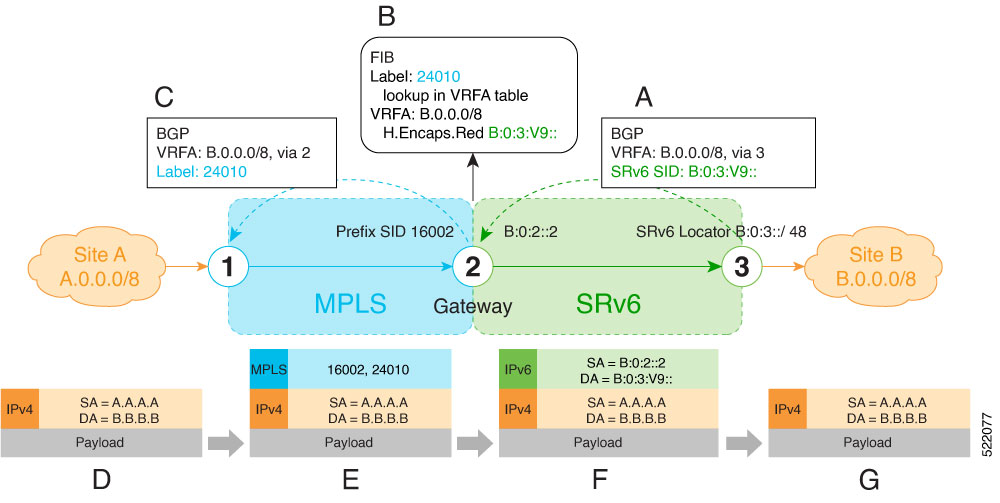
Explains how an interworking gateway exchanges routes and stitches data-plane traffic between SRv6 and MPLS domains, supporting service continuity and network migration.
An SRv6 MPLS L3 service interworking gateway is a gateway that
-
extends L3 services between MPLS and SRv6 domains by providing service continuity on the control plane and data plane
-
enables SRv6 L3VPN domains to interwork with existing MPLS L3VPN domains and supports migration from MPLS L3VPN to SRv6 L3VPN, and
-
provides both transport and service termination at the gateway node.
|
Feature Name |
Release |
Description |
|---|---|---|
|
SRv6/MPLS L3 Service Interworking Gateway (SRv6 Micro-SID) and Identical RD for Interworking Gateways between MPLS and SRv6 Domains |
Release 25.4.1 |
Introduced in this release on: Fixed Systems (8700 [ASIC: K100], 8010 [ASIC: A100])(select variants only*) *This feature is supported on:
|
|
Identical Route Distinguisher (RD) for Interworking Gateways between MPLS and SRv6 Domains |
Release 25.1.1 |
Introduced in this release on: Fixed Systems (8010 [ASIC: A100])(select variants only*) *This feature is supported on Cisco 8011-4G24Y4H-I routers. |
|
Identical Route Distinguisher (RD) for Interworking Gateways between MPLS and SRv6 Domains |
Release 24.4.1 |
Introduced in this release on: Fixed Systems (8200 [ASIC: P100], 8700 [ASIC: P100, K100])(select variants only*); Modular Systems (8800 [LC ASIC: P100])(select variants only*) *This feature is supported on:
|
|
Identical Route Distinguisher (RD) for Interworking Gateways between MPLS and SRv6 Domains |
Release 24.1.1 |
You can now configure the same Route Distinguisher (RD) for interworking gateways catering to both MPLS and SRv6 domains that help conserve hardware resources, reduce the BGP table scale and minimize the processing load on routers. At the same time, it ensures seamless connectivity across SRv6 and MPLS L3 EVPN domains, thus promoting interoperability and efficiency in modern network environments. Previously, a unique RD was required to extend L3 services between MPLS and SRv6 domains resulting in higher router load and resource consumption, which could have affected performance. |
|
SRv6/MPLS L3 Service Interworking Gateway (SRv6 Micro-SID) |
Release 25.4.1 |
Introduced in this release on: Fixed Systems (8010 [ASIC: A100])(select variants only*) *This feature is supported on:
|
|
SRv6/MPLS L3 Service Interworking Gateway (SRv6 Micro-SID) |
Release 25.1.1 |
Introduced in this release on: Fixed Systems (8010 [ASIC: A100], 8700 [ASIC: K100])(select variants only*) *This feature is supported on:
|
|
SRv6/MPLS L3 Service Interworking Gateway (SRv6 Micro-SID) |
Release 24.4.1 |
Introduced in this release on: Fixed Systems (8200 [ASIC: P100], 8700 [ASIC: P100])(select variants only*); Modular Systems (8800 [LC ASIC: P100])(select variants only*) *This feature is supported on:
|
|
SRv6/MPLS L3 Service Interworking Gateway (SRv6 Micro-SID) |
Release 7.8.1 |
This feature enables you to extend L3 services between MPLS and SRv6 domains by providing service continuity on the control plane and data plane. This feature allows for SRv6 L3VPN domains to interwork with existing MPLS L3VPN domains. The feature also allows migration from MPLS L3VPN to SRv6 L3VPN. |
Gateway mechanism
The gateway performs these key actions to enable interworking:
-
Imports service routes: The gateway imports service routes received from one domain (MPLS or SRv6).
-
Re-advertises exported service routes: It re-advertises exported service routes to the other domain (next-hop-self).
-
Stitches the service: The gateway stitches the service on the data plane (uDT4/H.Encaps.Red ↔ service label).
Virtual Routing and Forwarding (VRFs) on the gateway node are configured with two sets of route targets (RTs): MPLS L3VPN RTs and SRv6 L3VPN RTs (referred to as stitching RTs).
To understand the detailed control-plane and data-plane behaviors for specific traffic flows, refer to these process topics: