This section provides details about the Cisco NCS 1010 chassis and line cards, including WDM router connectivity, fiber multiplexing, degree scaling, transmission bands, and field-replaceable modules.
Use this reference to review Cisco NCS 1010 chassis and line cards information for the Cisco NCS 1010 optical line system.
Cisco NCS 1010 is a next-generation optical line system optimized for ZR/ZR+ WDM router interfaces. Its salient features are:
Provides point-to-point connectivity between routers with WDM interfaces.
Multiplexes the signals received from multiple routers over a single fiber.
With one MPO port, it can be scaled to 8 Degree.
Caters to C-band WDM transmission to maximize capacity, and can be enhanced to C+L combined band in the future.
Cisco NCS 1010 is a 3RU chassis that has an in-built External Interface Timing Unit (EITU) and the following field-replaceable modules.
Use this reference to review Optical line card variants information for the Cisco NCS 1010 optical line system.
There are five different variants of the line card:
OLT-C Line Card: C-band Optical Line Terminal without Raman
OLT-R-C Line Card: C-band Optical Line Terminal with Raman
ILA-C Line Card: C-band In-Line Amplifier without Raman
ILA-R-C Line Card: C-band In-Line Amplifier with one side Raman
ILA-2R-C Line Card: C-band In-Line Amplifier with both sides Raman
OLT-L Line Card: L-band Optical Line Terminal
ILA-L Line Card: L-band In-Line Amplifier
OLT-C line card
Use this reference to review OLT-C line card information for the Cisco NCS 1010 optical line system.
The C-band Optical Line Terminal without Raman (OLT-C) line card includes these features:
25-dBm line preamplifier True Variable Gain (TVG) Erbium-Doped Fiber Amplifier (EDFA) with two switchable gain ranges
Dedicated amplification of the odd and even add channels through an embedded Fixed Gain (FG) EDFA
23-dBm line boost-amplifier TVG EDFA single gain range
Dedicated EDFA for noise loading
Embedded Optical Time Domain Reflectometer (OTDR) for line RX and TX monitoring
37 ports Optical Channel Monitoring (OCM) and up to 30 EXP ports
Dedicated Tunable Laser (TL) enabling Connection Verification (CV) and patch cord discovery features
Embedded Optical Service Channel at Fast Ethernet (FE)
The OLT-C line card also includes these features:
Multiplexing and demultiplexing of odd and even channels
C+L combiner for multiplexing and demultiplexing L-band channels
2x2 switch to reverse transmit direction of Optical Service Channel (OSC)-C
Fiber reflectors to support fiber end detection by OTDR
OLT-R-C line card
Use this reference to review OLT-R-C line card information for the Cisco NCS 1010 optical line system.
The OLT-R-C line card includes the following details.
The C-band Optical Line Terminal with Raman (OLT-R-C) line card includes the features of the OLT-C line card along with the Raman amplifier.
The following are the features of the Raman amplifier:
Five different pump wavelengths for supporting C+L Raman amplification
Embedded Distributed Feedback (DFB) laser at 1568.77 nm (class 1M) to be used for optical safety (link continuity)
Full monitoring of pumps, DFB laser and signal power
Raman pump back-reflection detector
Meets class 1M Laser safety.
Additional Photodiode (PD) to monitor remnant pump power at the far end
ILA-C line card
Use this reference to review ILA-C line card information for the Cisco NCS 1010 optical line system.
The C-band In Line Amplifier without Raman (ILA-C) line card includes the following features:
Two independent TVG EDFA block, covering full operative gain ranging 8–36 dB
Each EDFA block can provide up to 23 dBm output power
Dynamic Gain Equalization (DGE) embedded capability to compensate for line tilt and ripple
Embedded OTDR for line1/2-RX/TX monitoring
Four-ports OCM for channels monitoring and embedded Optical Service Channel at Fast Ethernet (FE)
C+L combiner for multiplexing/demultiplexing L-band channels
Dedicated ports for amplifiers output monitoring
2x2 switch to reverse transmit direction of OSC-C for both directions
Fiber reflectors to support fiber end detection by OTDR
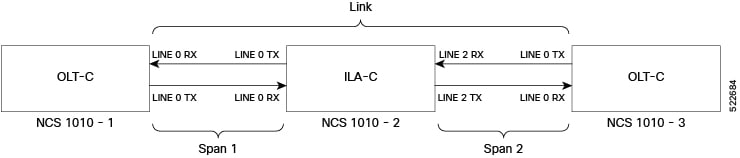
This image displays the port connection between the ILA-C line card and OLT-C line cards.
Figure 1. ILA-C Line Card Port Connection
ILA-R-C line card
Use this reference to review ILA-R-C line card information for the Cisco NCS 1010 optical line system.
The ILA-R-C line card includes the C-band In Line Amplifier with Raman (ILA-R-C) line card includes the features of ILA-C and Raman amplifier.
ILA-2R-C line card
Use this reference to review ILA-2R-C line card information for the Cisco NCS 1010 optical line system.
The ILA-2R-C line card includes the C-band In-Line Amplifier with two Raman (ILA-2R-C) line card includes the features of the ILA-C and Raman amplifier on both directions.
OLT-L line card
Use this reference to review OLT-L line card information for the Cisco NCS 1010 optical line system.
The L-band Optical Line Terminal (OLT-L) line card includes these features:
25-dBm line preamplifier True Variable Gain (TVG) Erbium-Doped Fiber Amplifier (EDFA) with two switchable gain ranges
Dedicated amplification of the odd and even add channels through an embedded Fixed Gain (FG) EDFA
24.5-dBm line boost-amplifier TVG EDFA single gain range
15-dBm ADD-side boost-amplifier TVG EDFA with single gain range of 16 dB
Dedicated EDFA for noise loading
37 ports Optical Channel Monitoring (OCM)
Dedicated Tunable Laser (TL) enabling Connection Verification (CV) and patch cord discovery features
Up to 30 EXP ports
The OLT-L line card also includes these features:
Embedded Optical Service Channel at Fast Ethernet (FE) at 184.45 THz (1625.33 nm)
Multiplexing and demultiplexing of odd and even channels
2x2 switch to reverse transmit direction of Optical Service Channel OSC-L
ILA-L line card
Use this reference to review ILA-L line card information for the Cisco NCS 1010 optical line system.
The L-band In Line Amplifier (ILA-L) line card includes these features:
Two independent TVG EDFA block, covering full operative gain ranging 10.8–32.8 dB
Each EDFA block can provide up to 24.5-dBm total output power
Dynamic Gain Equalization (DGE) embedded capability to compensate for line tilt and ripple
Four-ports OCM for channels monitoring
Embedded Optical Service Channel at Fast Ethernet (FE)
Dedicated ports for amplifiers output monitoring
2x2 switch to reverse transmit direction of OSC-L for both directions
External interface timing unit
Use this reference to review External interface timing unit information for the Cisco NCS 1010 optical line system.
The External interface timing unit
includes an External Interface Timing Unit (EITU) that manages the control plane interfaces and includes all user external interfaces (timing and management).
is connected to the controller with a redundant 10G Ethernet bus.
This list describes the available user interfaces:
Coaxial connector for GPS antenna RF input (with +5V antenna power, if necessary)