Cisco C9610 Series Smart Switches Hardware Installation Guide

PDF

Power supply modules

Want to summarize with AI?

Log in

Overview

An overview of the power supply units supported by the Cisco C9610 switch.

The switch chassis has eight redundant power supply slots that operate with one to eight power supply modules. The chassis supports field-replaceable AC-input and DC-input power supply modules.

The power supply modules generate 12 VDC output power and distribute it to the line cards and supervisor modules. The power supplies distribute power to all slots using an internal bus-bar based power distribution mechanism. All power supply modules have internal fans and support front-to-rear airflow.

Table 1. Power supply modules

Part number (add = for spare)

Description

C9600-PWR-2KWAC (=)

Cisco 9600 Series 2000W AC power supply

C9600-PWR-2KWDC (=)

Cisco 9600 Series 2000W DC power supply

C9600-PWR-3KWAC (=)

Cisco 9600 Series 3000W AC power supply


AC power supply modules

Cisco C9610 Series Smart Switches support both 2000W AC and 3000W AC power supply units (PSUs).

The switch is not designed to operate with a combination of 2000W and 3000W PSUs together in a chassis. If a combination of 2000W and 3000W is used, when the chassis is switched on, the following error message is displayed on the console:
*Jan 7 12:07:52.924 IST: %CMRP_PFU-2-PSU_MIX_PWR_CAPACITY: R0/0: cmand: 
Power supplies of mixed power capacity is not a supported configuration. 
This can lead to unstable behavior or system reload, please connect power supplies 
of the same power capacity to avoid any issues.

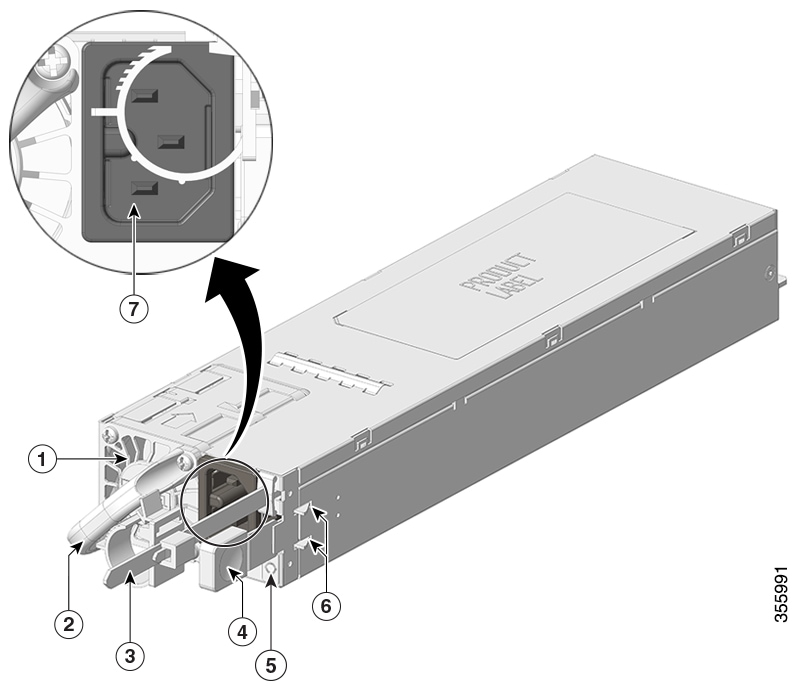
The 2000W AC is Platinum-rated and meets the Platinum certification standard for energy efficiency. Platinum-based PSUs typically provide around 92% efficacy at 50% load, with only 8% lost as heat.

Figure 1. 2000W AC power supply


1

PSU fan

5

Status LED

2

Release handle

6

Retainer clips

3

Power cord retainer

7

Power cord connector

4

Release latch

-

-

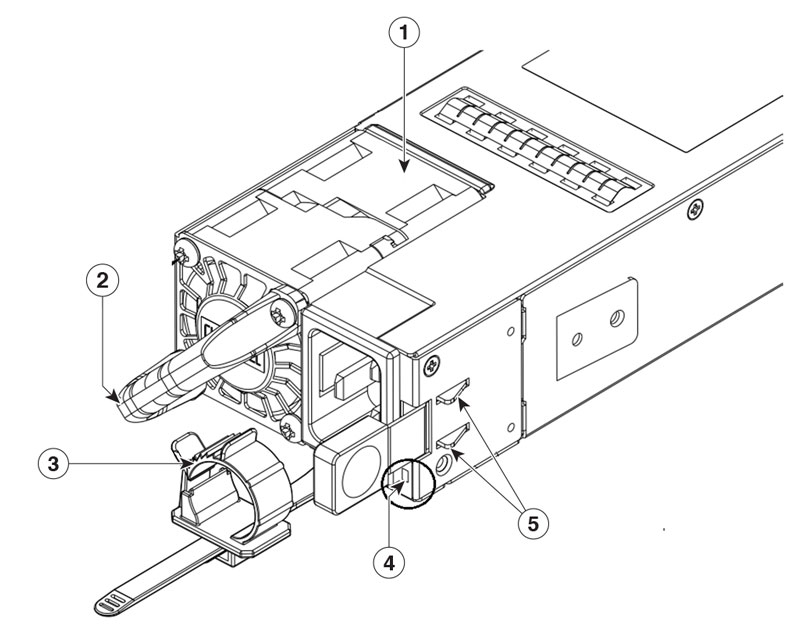
The 3000W AC power supply module is Titanium-rated, and refers to a power supply that meets the Titanium efficiency standard. This standard ensures minimal energy loss during power conversion, and is at present, the highest efficiency rating available for server power supplies. Titanium-based power supplies typically provide 96% or higher efficiency at 50% load, and up to 94% at full load.

Figure 2. 3000W AC power supply

1

PSU fan

4

Status LED

2

Release handle

5

Latch shrapnel

3

Cable tie

-

-

The features of the AC power supply module are

  • self-cooling, with a minimum airflow of 17 cubic feet per minute (CFM) at 100 percent load,

  • a single-phase source AC. Source AC can be out-of-phase between multiple power supplies or multiple AC-power plugs on the same power source because all AC power supply inputs are isolated,

  • a release latch and cord-retention mechanism on the front panel of the module, to avoid accidental removal of the module or the attached power cord, and

  • redundant and combined configuration modes.

A single (non-redundant) or a dual (redundant) power supply configuration, can support these loads.

Table 1. Output power capacity of AC PSUs at different input voltage
PID

Input voltage (VAC)

Output power in Watts

C9600-PWR-2KWAC

110 VAC

1050W

220 VAC

2000W

C9600-PWR-3KWAC

110 VAC

1500W

220 VAC

3000W


DC power supply modules

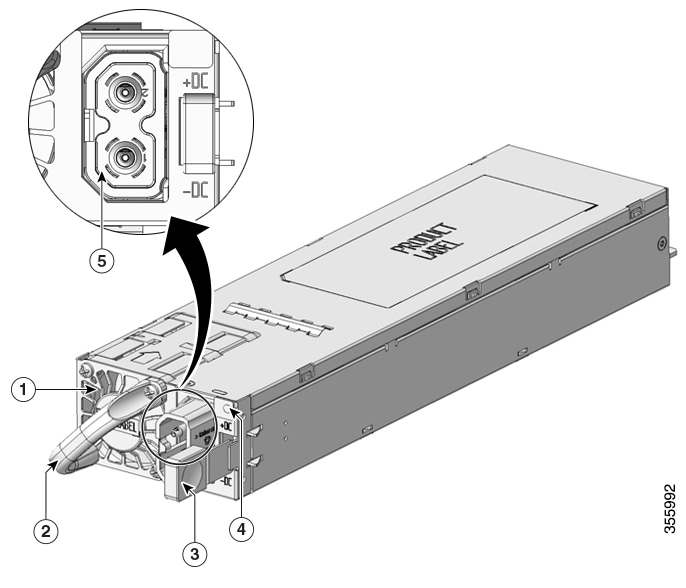
The section describes the 2000W DC power supply module supported on Cisco C9610 series smart switches.

Figure 1. 2000W DC power supply module


1

PSU fan

4

LED

2

Release handle

5

Power cord connector

3

Release latch

-

-

The features supported by the DC power supply module are

  • self-cooling, with a minimum airflow of 9.5 cubic feet per minute (CFM) at 100% load,

  • a release latch mechanism on the side of the module, to avoid accidental removal of the module,

  • a DC-input reversal protection such that the unit will survive this condition up to the full input voltage rating, and

  • redundant and combined configuration modes.

A single (non-redundant) or a dual (redundant) power supply configuration supports these loads.

PID

Input voltage (VDC)

Output power

C9600-PWR-2KWDC

-40 to -60 VDC (with extended range to -72 VDC)

2000W


Power supply modes

Cisco C9610 series smart switches offer redundant and combined configuration modes for power supplies. In both modes, the load is equally distributed among the power supplies.

The system load and number of power supply modules installed determine the power level required by the system from each power supply module, and consequently, the suitable power supply mode. For system power budgeting estimates and to determine power supply requirements, use the Cisco Power Calculator .

To configure a power supply mode, enter the power redundancy-mode command in global configuration mode. If you do not configure a mode, the default mode applies. The default mode is combined mode.

Combined mode

The system operates with one to eight power supply modules. The power available to the system is the sum of the power outputs of all the power supply modules in the chassis multiplied by the share ratio. All available power supply modules are active and sharing power, and can operate at up to 100 percent capacity. Additional power supply units operate at 97 percent capacity.

In combined mode, you can use a combination of AC or DC power supplies, provided the AC input voltage is 220V and the power supplies are of equal wattage. However, you cannot combine an AC power supply unit of 110V input with an AC power supply unit of 220V input.

Total combined mode power = P + (N-1) * (P-60)

  • where P is the power output of one of the power supply units and N is the number of power supply modules used.

  • and 60W is the power wastage for every additional PSU, other than the first one; regardless of the PSU capacity or input voltage.

Note

In case of a failure in combined mode, each operational power supply increases its output. If the output power does not meet the system requirements, all the operational power supply modules may be overloaded and go into overcurrent shutdown. All system power is then lost.

This table provides details about the power output in combined mode.

Table 1. Power output in combined mode
PID

Input voltage

One PSU

Two PSUs

Three PSUs

Four PSUs

Five PSUs

Six PSUs

Seven PSUs

Eight PSUs

C9600-PWR-2KWAC

110V

1050W

2040W

3030W

4020W

5010W

6000W

6990W

7980W

220V

2000W

3940W

5880W

7820W

9760W

11700W

13640W

15580W

C9600-PWR-3KWAC

110V

1500W

2940W

4380W

5820W

7260W

8700W

10140

11580W

220V

3000W

5940W

8880W

11820W

14760W

17700W

20640W

23580W

Redundant N+1 mode

In a redundant configuration, a given power supply module can either be active, or in a standby mode. You can configure either N+1 mode or N+N mode, where N is the number of active power supply modules.

In N+1 mode, N is the number of active power supply modules and +1 is the power supply module configured as the standby module.

When you configure the switch with N+1 redundancy, the Cisco IOS XE software ensures that there is a standby power supply available, and that sufficient power is available with the active power supply modules (N). All the power supplies including the active and standby shares the load equally. However, with a standby power supply installed, the system ensures that the additional output power available with a standby is always reserved for use in case of a failure. If the power supply mode is set to redundant and the total active output power is not sufficient to meet the power requirements, the switch will not enter redundant mode.

You can use a combination of AC or DC power supplies provided the AC input voltage is 220V and the power supplies are of equal wattage. However, you cannot combine an AC power supply unit of 110V input with a AC power supply unit of 220V input.

This table provides details about the power output in N+1 redundant mode.

Table 2. Power output in N+1 redundant mode
PID

Input voltage

Two PSUs

Three PSUs

Four PSUs

Five PSUs

Six PSUs

Seven PSUs

Eight PSUs

C9600-PWR-2KWAC

110V

1050W

2040W

3030W

4020W

5010W

6000W

6990W

220V

2000W

3940W

5880W

7820W

9760W

11700W

13640W

C9600-PWR-3KWAC

110V

1500W

2940W

4380W

5820W

7260W

8700W

10140W

220V

3000W

5940W

8880W

11820W

14760W

17700W

20640W

Redundant N+N mode

In N+N mode, N number of power supply modules are configured as active, and N number of power supply modules are configured as standby. For each active module, there is a standby power supply module.

Table 3. Power output in N+N redundant mode
PID

Input voltage

Two PSUs

Four PSUs

Six PSUs

Eight PSUs

C9600-PWR-2KWAC

110V

1050W

2040W

3030W

4020W

220V

2000W

3940W

5880W

7820W

C9600-PWR-3KWAC

110V

1500W

2940W

4380W

5820W

220V

3000W

5940W

8880W

11820W