Multihoming in a BGP EVPN VXLAN Fabric Configuration Guide, Cisco IOS XE 26.x.x and Later

PDF

EVPN multihoming in fabric networks

Want to summarize with AI?

Log in

Overview

Explains how EVPN multihoming works in fabric networks.

Modern enterprise campuses require a secure fabric networking solution that seamlessly supports large-scale virtual and logical networks over a robust physical network infrastructure. EVPN multihoming-based networks offer a simplified and resilient architecture evolving from legacy STP protocol-based enterprise campus networks to a non-blocking Layer 2 fabric.

The EVPN VXLAN-enabled fabric core networks introduce new possibilities for EVPN multihomed Layer 2 networks by enabling secured wired and wireless segmented and extended networks that address critical technical and business requirements.

The following illustration displays EVPN multihoming in fabric networks
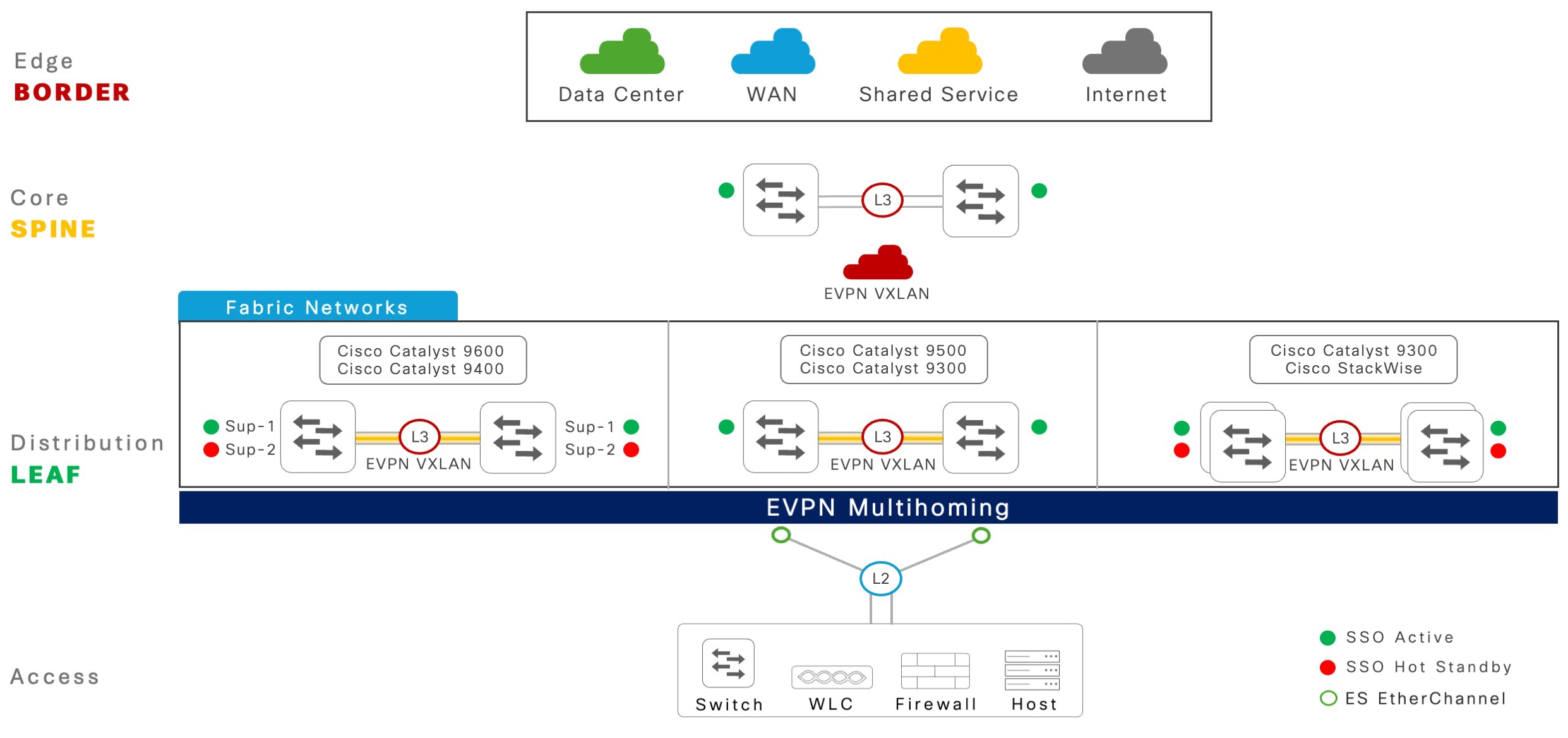
Figure 1. EVPN multihoming in fabric networks
EVPN multihoming for fabric networks


Single unified BGP control plane

Enterprise campuses can be designed and deployed using a single unified BGP control plane that addresses the traditional Layer 2 and Layer 3 networking requirements at the access layer while supporting a modern fabric network at the core. The unified BGP control plane simplifies network operations by distinctly managing multi-domain routing and bridging functions, enabling seamless integration of the access and core networks.

BGP EVPN multihoming-based networks represents a shift from the traditional flood-based networks to control-plane driven architecture that supports non-blocking and resilient enterprise campus networks. Host addresses—including the MAC, IPv4 or IPv6, multicast—are statefully discovered and synchronized across peer systems, enabling all-active data forwarding in BGP EVPN multihoming networks.

As the BGP control plane role expands into traditional networks, processing demands may increase due to additional BGP prefix tables supporting EVPN multihoming auto-generated prefixes.

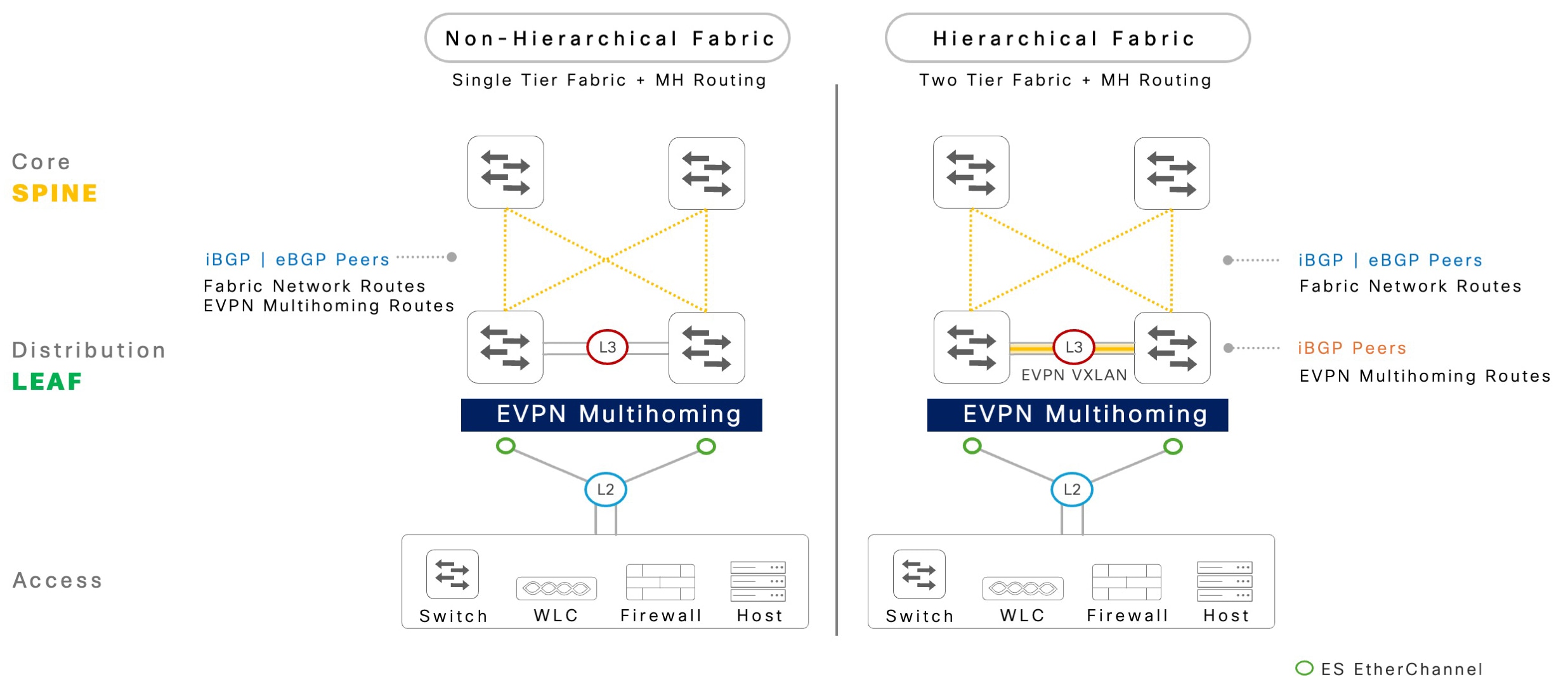
Cisco Catalyst 9000 series switches support both standard non-hierarchical and hierarchical BGP peering mode between leaf and spine devices, facilitating the exchange of fabric and EVPN multihoming network prefixes.

To address scalability and performance requirements, Catalyst 9000 series switches can implement a two-tier hierarchical control-plane network in large deployments.

Figure 2. BGP peering alternatives for fabric networks

BGP peering alternatives for fabric networks


Non-hierarchical fabric networks

The general non-hierarchical BGP EVPN VXLAN network implementation follows a standard single tier BGP peering model where all fabric devices peer directly with each other to dynamically exchange routes and build the VXLAN forwarding tunnels.

The EVPN multihoming-enabled non-hierarchical fabric network implementation follows a standard iBGP or eBGP peering model between the spine and EVPN multihoming-enabled leaf or border system.

In large scale enterprise campus network environments, spine layer devices require additional resources such as processing power and memory to handle standard fabric host information, such as MAC addresses, MAC/IP bindings and network prefixes (IPv4/IPv6) along with EVPN multihoming auto-generated routes received from each leaf or border system.


Hierarchical Fabric Networks

Hierarchical and structured networking is fundamental to supporting scalable and resilient campus networks, and EVPN multihoming-based fabric networks follow hierarchical BGP routing design principles for better scalable networking solutions.

The two-tier BGP peering in EVPN multihoming networks assists in subdividing route management between peers by separating Layer 2 networking from scalable network connectivity towards the spine layer.

The iBGP peering between a pair of Cisco Catalyst 9000 series switches exchanges all auto-generated EVPN multihoming network prefixes to build reliable and scalable traditional Layer 2 networks.

Cisco Catalyst 9000 series switches in EVPN multihoming leaf role follow standard parallel iBGP or eBGP peering with a pair of spine switches advertising network prefixes based on EVPN fabric overlay network types. The conditional network prefix announcement to spine switches enables enhanced flexibility, scale, performance, and resiliency across the network.

For more information on overlay networks, refer to Hierarchical EVPN Control-Plane.


EVPN fabric overlay network types overview

BGP EVPN VXLAN provides a flexible, virtual networking solution that addresses key networking use cases by combining a wide range of overlay architectures.

Such business-driven network architectures enable multidimensional benefits for scalable and secure segmented overlay networks in EVPN multihoming networks. Network administrators can build overlay networks with a “route first” mindset that can conditionally extend IP or VLAN networks between targeted Ethernet segment network devices to meet application requirements.

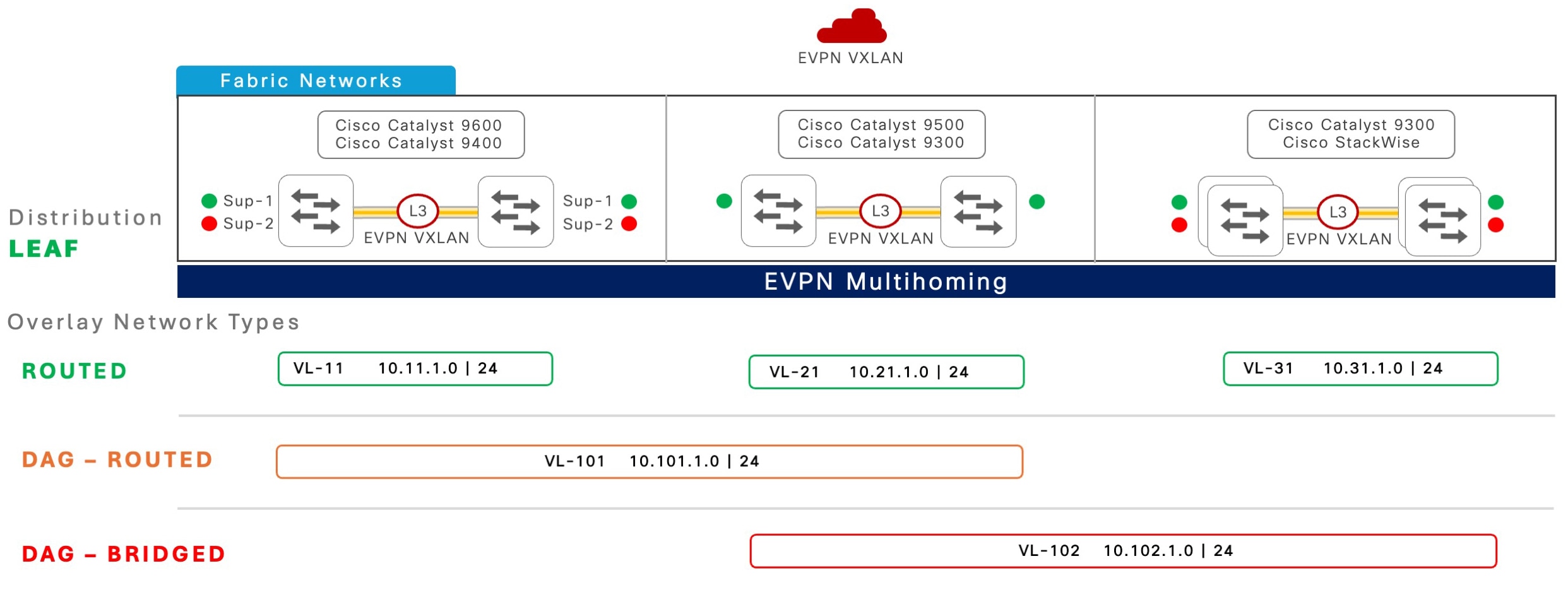
The following figure illustrates three overlay network types in EVPN multihoming networks.

Figure 3. BGP EVPN fabric overlay network types

BGP EVPN fabric overlay network types

Network administrators decide on the type of overlay networks to deploy across the fabric core based on the specific application requirements to achieve better scale and resiliency in EVPN multihoming networks.

Cisco Catalyst 9000 series switches provide a flexible solution that supports coexistence of all overlay network types within a single system. Based on technical requirements, each VLAN from an Ethernet segment EtherChannel on Cisco Catalyst 9000 series switches can be configured to support IP-routed network segmentation, conditionally stretch IP subnets, or bridge VLANs using Layer 2 flood mechanisms selectively between VLANs.

Table 1. Comparison of EVPN overlay network types

EVPN overlay network types

Routed

DAG routed

DAG bridged

Function

IP routing in core and Layer 3 segmented overlay.

Flood-free IP subnet stretch and Layer 3 segmented overlay.

Layer 2 flood stretch and Layer 3 segmented overlay.

Use case

Wired or wireless data. IT or OT endpoints

Wired or wireless data. IT or OT endpoints

Wired or wireless data. IT or OT endpoints. Non-IP endpoints
VLAN/subnet

One VLAN or subnet per distribution block

Stretched IP subnets between targeted distribution blocks

Stretched VLANs or subnets between targeted distribution blocks

Layer 2 flood boundary

Within the local Layer 2 network

Within the local Layer 2 network

Within the local Layer 2 network and across the fabric core

IP gateway

Anycast gateway per distribution block

Anycast gateway between targeted distribution blocks

Anycast gateway between targeted distribution blocks

IP subnet stretch

Not applicable

Yes—flood-free

Yes—flood-based

Seamless distributed wireless mobility

Within the local distribution block

Within the local distribution block and across targeted destination blocks

Within the local distribution block and across targeted destination blocks

Non-IP/silent host support

Within the local distribution block

Within the local distribution block

Within the local distribution block and across targeted destination blocks

Recommendation

Best scalable solution

Extends IP subnet selectively; use only if required

Extends Layer 2 flood selectively; use only if required


EVPN fabric and non-fabric network co-existence

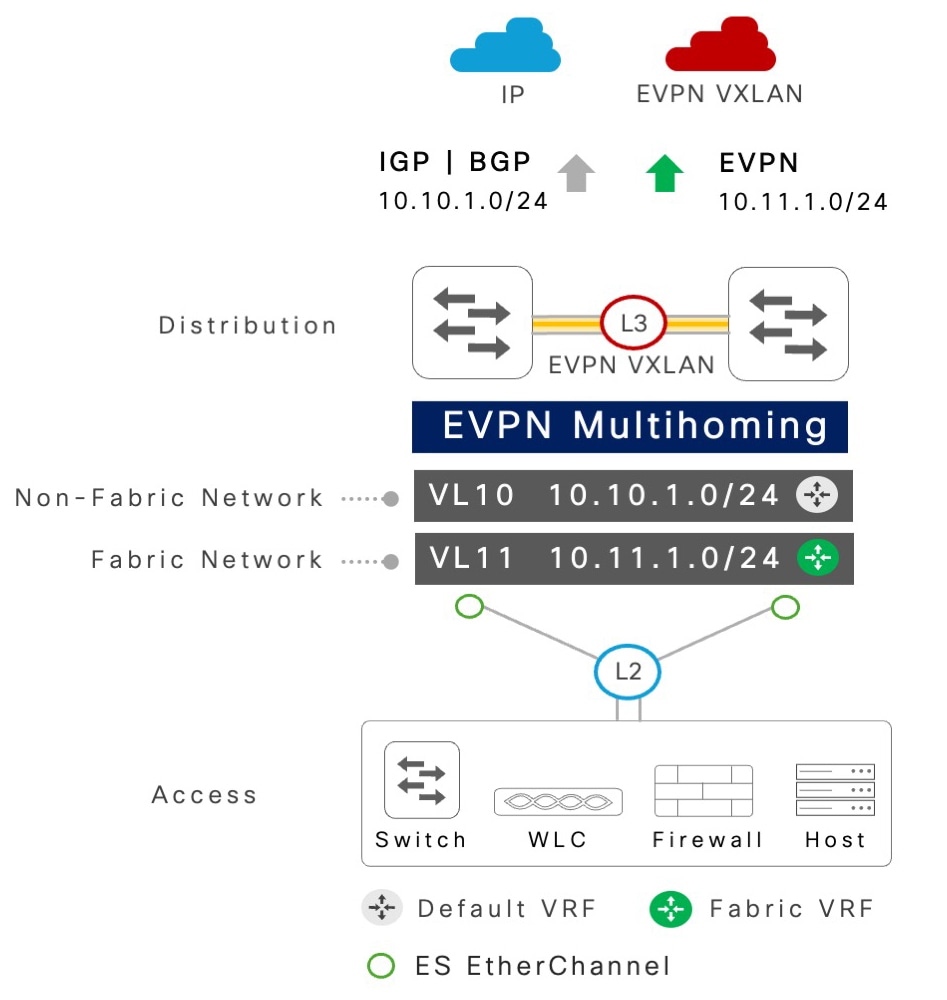
Enterprise campuses require flexible networking solutions that support both modern secure fabric networks and backward-compatible traditional Layer 2 or Layer 3 networks. Cisco Catalyst 9000 series switches with EVPN multihoming-enabled EtherChannel trunk interfaces provide this flexibility by bundling multiple VLANs, each delivering distinct networking services.

Network administrators can program some VLANs to operate traditional IP-based networks in the underlay, while mapping other VLANs to IP VRFs or MAC VRFs to route and bridge over the VXLAN fabric.

The following illustration shows a network deployment scenario with both fabric and non-fabric VLANs on EVPN multihoming-enabled networks.

Figure 4. EVPN multihoming: fabric and non-fabric network co-existence


To understand and implement EVPN multihoming for non-fabric deployments, refer to