Overview
Explains the Distributed Anycast Gateway (DAG) routed overlay network and how it works.
In modern enterprise campus environments, application traffic typically flows between wired and wireless users, and resources hosted either on-premises or across cloud environments. To manage this efficiently, network administrators implement a structured IP addressing plan with VLANs and subnets organized per distribution block. This approach enables segmentation through a routed overlay VXLAN fabric network, which provides scalable, flexible, and secure network segmentation.
In certain cases, the VLAN or subnet networks may require stretching beyond a single IP gateway boundary to support latency-sensitive or legacy enterprise applications. The Distributed Anycast Gateway (DAG) technology enables this by allowing secure and segmented communication between IP endpoints over a dynamic VXLAN tunnel.
With a Layer 2 flood-free network, the DAG-routed overlay network enables the stretching of IP subnets across Cisco Catalyst 9000 series switches implemented in EVPN multihoming fabric mode across targeted leaf switches. This approach supports scalable and secure network segmentation tailored to enterprise application requirements. Cisco Catalyst 9000 series switches support the co-existence of routed and DAG routed overlay networks.
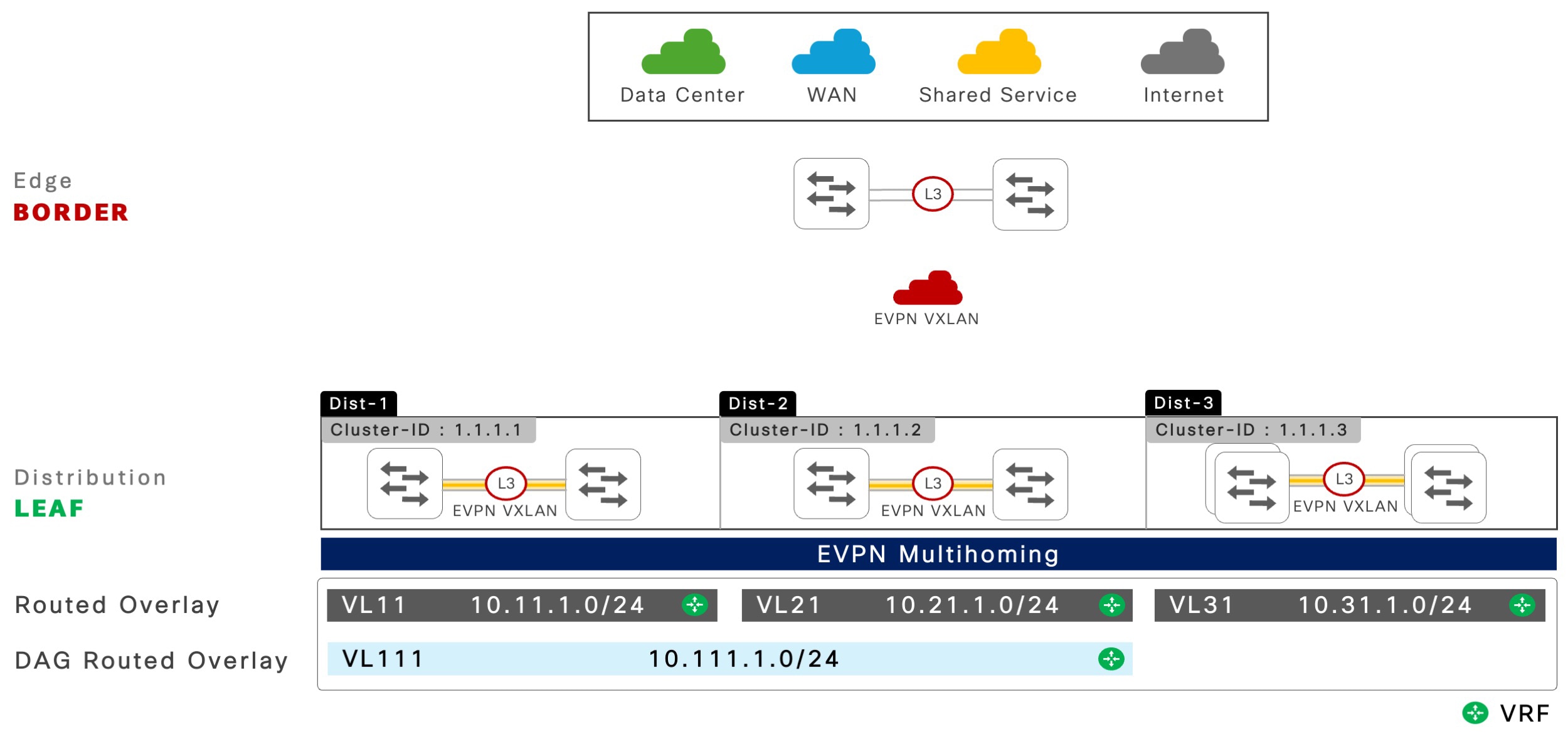
The following illustration shows a deployment scenario for an EVPN multihoming network with the co-existence of routed and DAG-routed overlay networks. The illustration also shows the stretching of a specific IP subnet, VLAN-111 between two targeted Cisco Catalyst 9000 series switches, one in network distribution Block 1 and the other in Block 2.