Overview
Explains the benefits of multihoming.
EVPN multihoming technology was introduced on Cisco Catalyst 9000 series switches in Cisco IOS XE 17.18.2, delivering a highly flexible and extensible deployment solution for global enterprise customers.
The key technology architecture benefits of Cisco Catalyst 9000 series switches combined with the advanced Cisco IOS XE software capabilities enable best of both worlds. Enterprise network administrators can implement EVPN multihoming within their existing traditional Layer 2 or Layer 3 network designs while laying a practical and gradual foundation for evolving towards modern, secure, fabric-based virtual networks.
The following illustration shows the EVPN multihoming solution for Cisco Catalyst 9000 series switches in two key flexible deployment models.
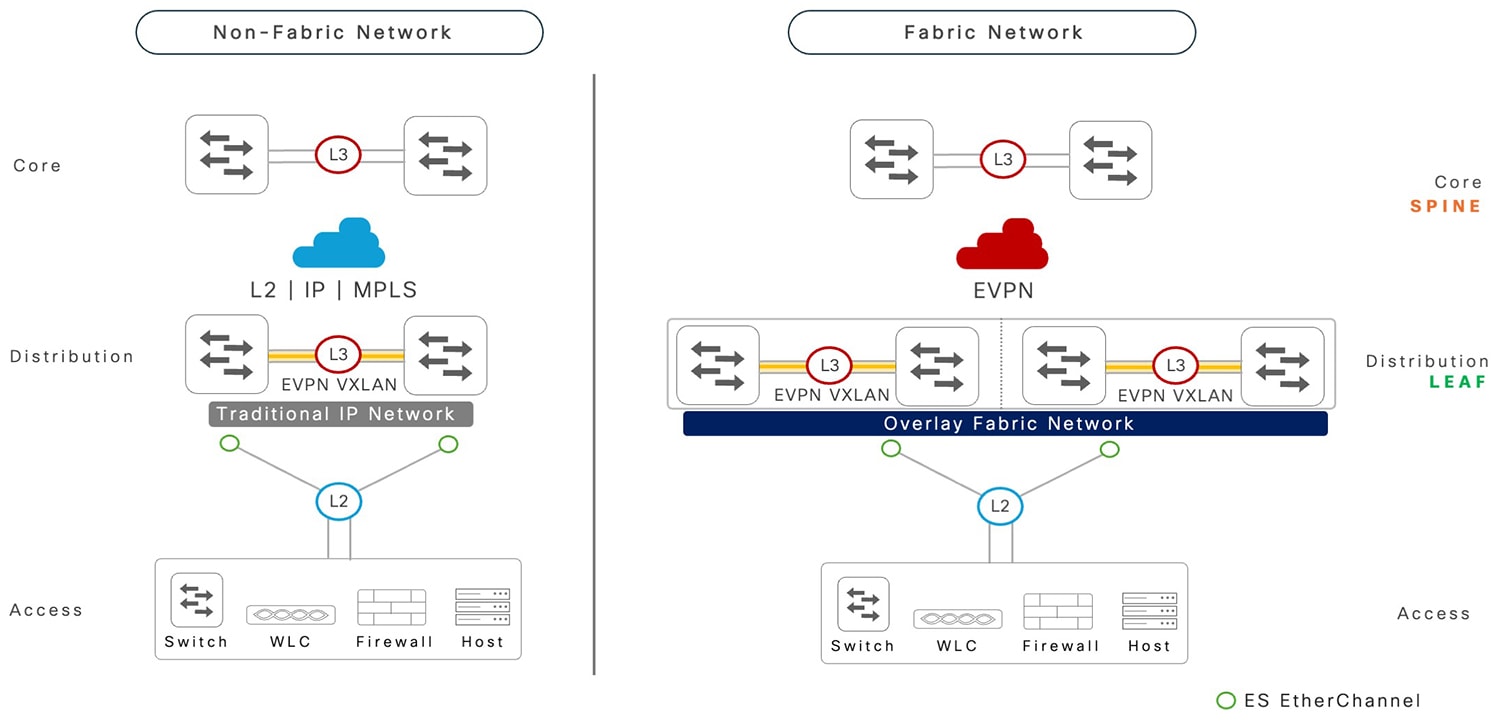
With flexible deployment model support, EVPN multihoming provides significant technological benefits to support enterprise-grade networking requirements.
-
Industry-standard Layer 2 multipath: RFC 7432 and RFC 8365-defined Layer 2 multipath technology with BGP control-plane eliminates the vendor proprietary complex solutions.
-
Flexible architecture: Purpose-built solution supports a wide range of networking use-cases for traditional Layer 2 and Layer 3, to modernized secure campus fabrics enabling network-wide, two-tier virtual network segmentation and extensions.
-
Distributed planes: A fully distributed architecture where each system maintains its own scalable and resilient control plane, independent management plane configuration, and software versions provide more resilience with synchronized data-plane between paired systems.
-
Increased performance: Non-blocking Spanning Tree Protocol (STP), Layer 2 loop-free network combined with advanced load-sharing technique assist in increasing forwarding capacity and improving application experience.
-
Seamless integration: Least disruptive integration in classic Layer 2 networks with a wide range of networking device types that support link-bundling capabilities. Flexible and seamless integration with existing core network system without a forklift architecture change.
-
Resilient: Deterministic fault detection and recovery technique during various types of planned and unplanned failure conditions, which reduces the Mean Time to Repair (MTTR) and increases the network reliability with a higher Mean Time Between Failure (MTBF).
A pair of modular-class platforms with redundancy (Quad-Sup NSF and SSO): Provides non-stop business communication in maintaining network availability and forwarding throughput capacity during software upgrades and other unplanned failure events.