Overview
Describes how a two-tier BGP-based EVPN multihoming and fabric networks help in subdividing the BGP route management between two domains.
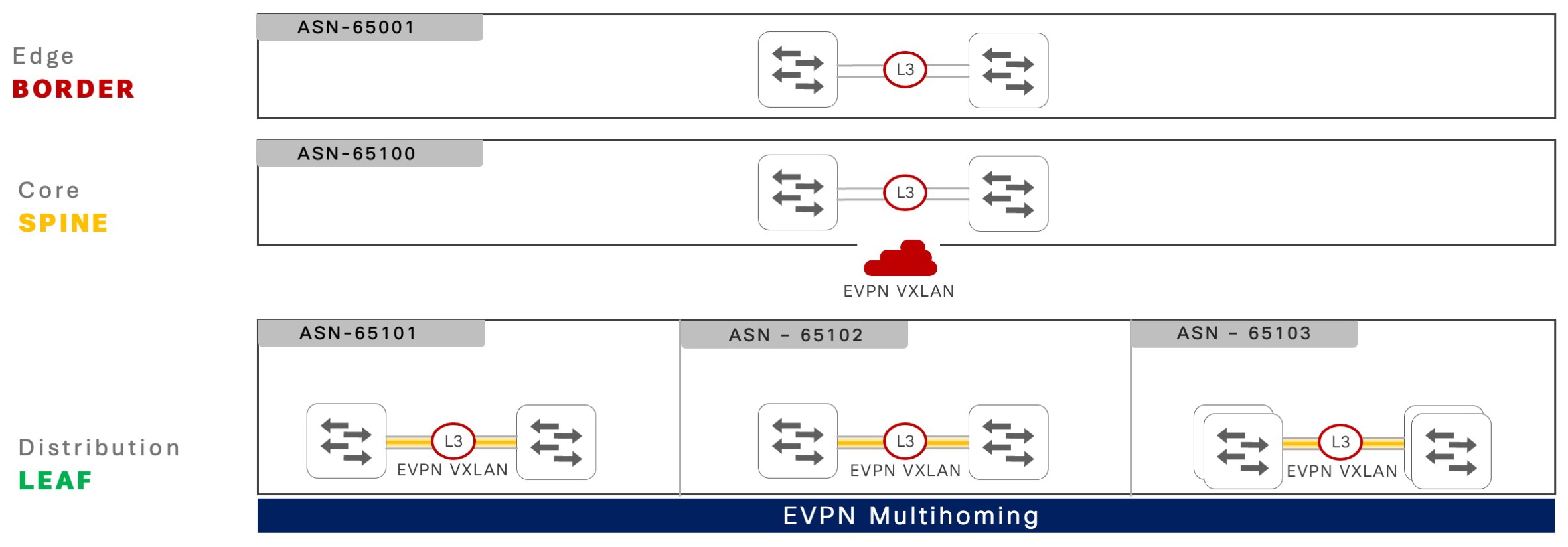
eBGP-based networks provide simplified and scalable underlay networks to build fabric networks between spine, leaf, and border devices using unique autonomous system numbers (ASNs). The hierarchical two-tier BGP-based EVPN multihoming and fabric network helps in subdividing the BGP route management between two domains.
In standard BGP ASN planning, each pair of EVPN multihoming leaf switches in the distribution block are typically designed with a common ASN. However, additional distribution networks follow unique ASN per network for the spine and border layers.
The spine system at the center of the BGP EVPN VXLAN fabric network functions as a route server that receives network prefixes and redistributes them transparently with policies applied to keep the BGP next-hop unchanged. This behavior enables all leaf systems and the fabric border systems to dynamically establish VXLAN tunnels for efficient data communication.