Overview
An overview of DAG bridged overlay networks and the benefits of having DAG bridged overlay networks.
In modern enterprise campus environments, most application traffic flows between wired and wireless users and between resources that are hosted within on-premises data centers or across cloud. Network administrators build structured IP addressing plans with VLAN and subnet on a per-distribution block and enable segmentation through routed overlay or selectively stretching flood-free IP subnets with Distributed Anycast Gateway Routed VXLAN fabric network.
With the digitally evolving IP-everywhere networks, in some scenarios network administrators are mandated to maintain modern fabric networks, while supporting scarce VLAN segments with legacy enterprise network applications and endpoints operating at link-layer without IP addresses. The Distributed Anycast Gateway (DAG) technology supports classic methods to extend the Layer 2 flood-boundary for selective VLANs over the dynamic Layer 2 VXLAN tunnels.
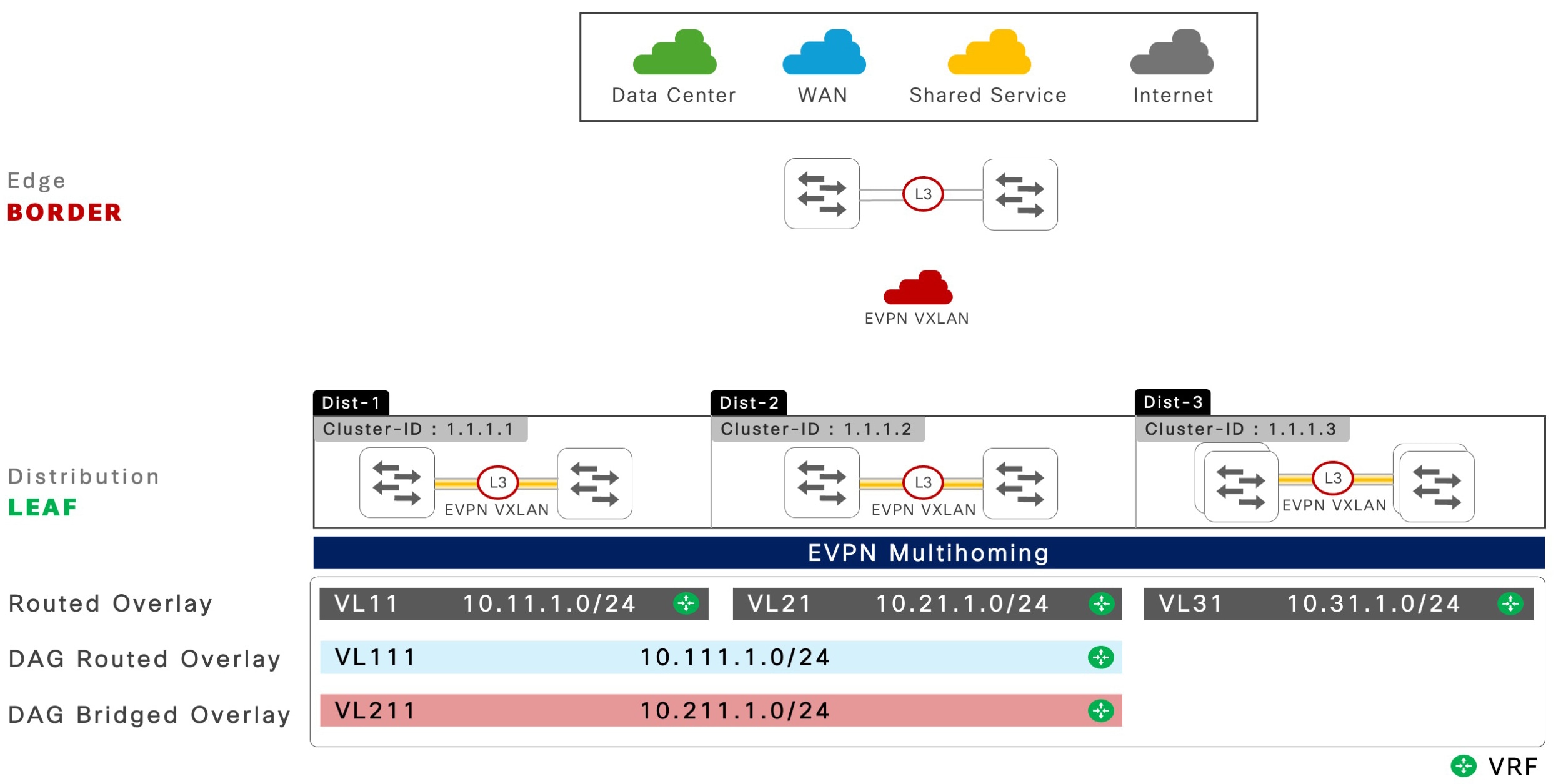
The DAG-bridged overlay networks stretch IP subnets and the Layer 2 VLAN flood-boundary with traditional Integrated Routing and Bridging (IRB) function between targeted Cisco Catalyst 9000 series switches implemented in EVPN multihoming fabric mode. The DAG-bridged overlay networks extend the Layer 2 flood boundary across fabric networks for all endpoints including hosts with and without IP addresses.
Cisco Catalyst 9000 series switches support the coexistence of routed, DAG-routed and DAG-bridged overlay networks that provide the flexibility to scale fabric networks while enabling enterprise application requirements.
The following figure shows a reference EVPN multihoming network with DAG-bridged overlay for extending Layer 2 flood-boundary for a specific VLAN or IP subnet between pairs of Cisco Catalyst 9000 series switches.