Describes how service chain VPNs can be shared across multiple user VPNs and how traffic between different VPNs can be service chained.
Summary
The key components involved in the service chain sharing process are:
-
Service chain VPN: A dedicated VPN that provides service chaining functionality and can be shared across multiple user VPNs
-
User VPNs: Individual VPNs that can utilize shared service chains for traffic processing
-
Route leaking: Required mechanism when source and destination VPNs are different to enable traffic flow
Workflow
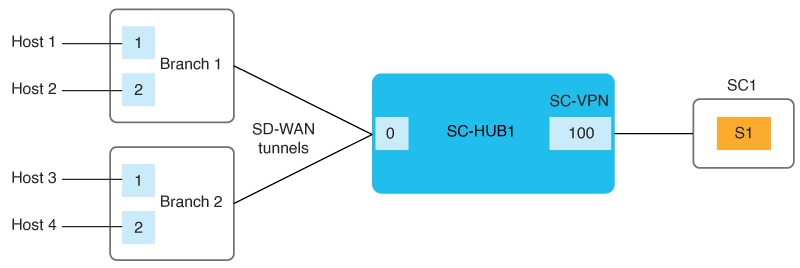
These stages describe how service chains share across user VPNs:
-
The service chain VPN is automatically made available to traffic from multiple user VPNs.
-
SC1 (service chain 1) is attached to VPN100 can be automatically shared by traffic in VPN1 (H1) and VPN2 (H4)
-
-
Traffic between different VPNs can be service chained through various VPN locations.
-
Traffic between VPN1 (H1) and VPN2 (H4) can be service chained in VPN1 or VPN2 or in a shared service chain (VPN100)
-