Describes how service chains operate when the transmitting router differs from the receiving router, requiring identical configuration on each device for intra-VPN traffic processing.
When the router that transmits traffic to a service chain differs from the router that receives traffic from the service chain, a specific configuration approach is required. This scenario applies to intra-VPN traffic only and involves service chains with a single service.
Summary
The key components involved in the service chain process between two routers are:
-
Transmitting router: Sends traffic to the service chain for processing
-
Receiving router: Receives processed traffic from the service chain
-
Service chain: Contains only one service and processes intra-VPN traffic
The process requires identical service chain configuration on both routers to ensure proper traffic flow and processing.
Workflow
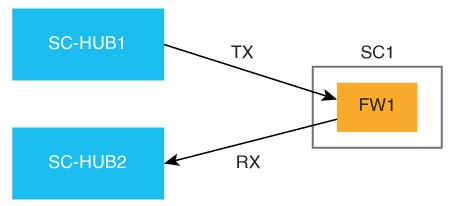
These stages describe how service chains operate between two routers:
-
The transmitting router sends intra-VPN traffic to the configured service chain for processing.
-
The service chain processes the traffic using its single configured service.
-
The receiving router receives the processed traffic from the service chain and continues routing operations.