Control policy types and operation
Two types of control policy provide routing customization:
-
Centralized control policy: Provisioned on the Cisco SD-WAN Controller and customizes network-wide routing decisions through the overlay network
-
Local control policy: Provisioned on a Cisco IOS XE Catalyst SD-WAN device and allows customization of routing decisions made by BGP and OSPF on site-local branch or enterprise networks
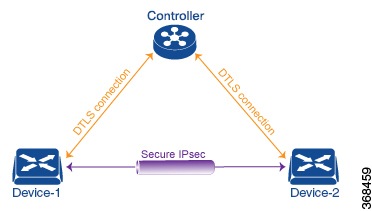
The routing information that forms the basis of centralized control policy is carried in Cisco IOS XE Catalyst SD-WAN route advertisements, which are transmitted on the DTLS or TLS control connections between Cisco SD-WAN Controllers and Cisco IOS XE Catalyst SD-WAN devices.
Centralized control policy determines which routes and route information are placed into the centralized route table on the Cisco SD-WAN Controller and which routes and route information are advertised to the Cisco IOS XE Catalyst SD-WAN devices in the overlay network. Basic centralized control policy establish traffic engineering, to set the path that traffic takes through the network. Advanced control policy supports a number of features, which allows Cisco IOS XE Catalyst SD-WAN devices in the overlay network to share network services, such as firewalls and load balancers.
Centralized control policy affects the OMP routes that are distributed by the Cisco SD-WAN Controller throughout the overlay network. The Cisco SD-WAN Controller learns the overlay network topology from OMP routes that are advertised by the Cisco IOS XE Catalyst SD-WAN devices over the OMP sessions inside the DTLS or TLS connections between the Cisco SD-WAN Controller and the devices.
Three types of OMP routes carry the information that the Cisco SD-WAN Controller uses to determine the network topology:
-
Cisco Catalyst SD-WAN OMP routes: Similar to IP route advertisements, advertise routing information that the devices have learned from their local site and the local routing protocols (BGP and OSPF) to the Cisco SD-WAN Controller. These routes are also referred to as OMP routes or Routes.
-
TLOC routes: Carry overlay network–specific locator properties, including the IP address of the interface that connects to the transport network, a link color, which identifies a traffic flow, and the encapsulation type.
-
Service routes: Advertise the network services, such as firewalls, available to VPN members at the local site.
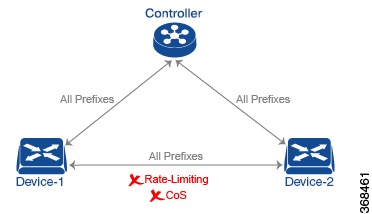
By default, no centralized control policy is provisioned. In this bare, unpolicied network, all OMP routes are placed in the Cisco SD-WAN Controller's route table as is, and the Cisco SD-WAN Controller advertises all OMP routes, as is, to all the devices in the same VPN in the network domain.
By provisioning centralized control policy, you can affect which OMP routes are placed in the Cisco SD-WAN Controller's route table, what route information is advertised to the devices, and whether the OMP routes are modified before being put into the route table or before being advertised.
Cisco IOS XE Catalyst SD-WAN devices place all the route information learned from the Cisco SD-WAN Controllers, as is, into their local route tables, for use when forwarding data traffic. Because the Cisco SD-WAN Controller's role is to be the centralized routing system in the network, edge devices do not perform any policy actions on routes learned from the Cisco SD-WAN Controllers.
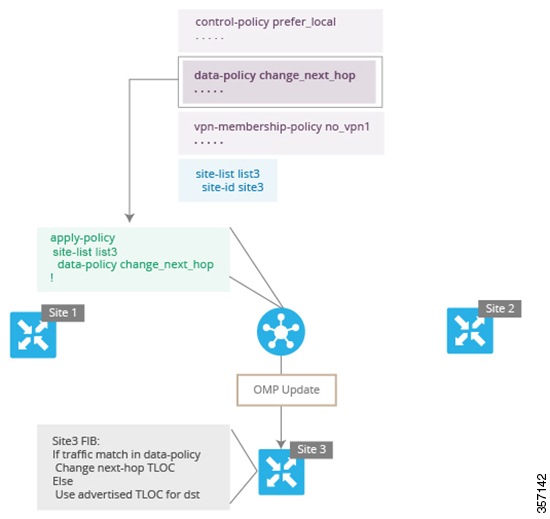
The figure below shows the OMP route flow in the overlay network and illustrates the effects of centralized control policy. Centralized control policy affects the exchange of routing information between the Cisco IOS XE Catalyst SD-WAN devices and the Cisco SD-WAN Controllers. As shown in the figure, you can apply a policy in two directions:
-
Inbound—A policy applied to routes being received by the Cisco SD-WAN Controller from the Cisco IOS XE Catalyst SD-WAN devices in the network
-
Outbound—A policy applied to routes being sent by the Cisco SD-WAN Controller to the Cisco IOS XE Catalyst SD-WAN devices in the network
For inbound policy, the routes received from the Cisco IOS XE Catalyst SD-WAN devices are modified before they are placed in the Cisco SD-WAN Controller's route table, and the modified routes are also sent to all other Cisco IOS XE Catalyst SD-WAN devices. Inbound policies affect all the devices in the network domain because the Cisco SD-WAN Controller advertises the modified routes to all the Cisco IOS XE Catalyst SD-WAN devices in the VPN.
For an outbound policy, the routes in the Cisco SD-WAN Controller's route table are not modified. Instead, the Cisco SD-WAN Controller reads a route from its route table, creates a copy of the route, modifies the copy as directed by the policy, and sends this modified copy to the destination devices. The original route in the Cisco SD-WAN Controller's route table remains unchanged after the update. Again, note that the direction is outbound from the perpspective of the Cisco SD-WAN Controller.
In contrast to an inbound policy, which affects the centralized route table on the Cisco SD-WAN Controller and has a broad effect on the route attributes advertised to all the devices in the overlay network. A control policy applied in the outbound direction influences only the route tables on the individual devices included in the site-list.
The same control policy (the prefer_local policy) is applied to both the inbound and outbound OMP updates. However, the effects of applying the same policy to inbound and outbound are different. The usage shown in the figure illustrates the flexibility of the Cisco IOS XE Catalyst SD-WAN control policy design architecture and configuration.