Cisco Catalyst SD-WAN Rugged Series Router Configuration Guide, Release 26.x and Later

PDF

Cisco Catalyst SD-WAN Rugged Series Router Configuration Guide, Release 26.x and Later

Raw socket in SD-WAN Manager

Want to summarize with AI?

Log in

Describes how raw socket transports serial data over IP networks, enabling SCADA data transfer from RTUs. Provides an alternative to BSTUN and supports both TCP and UDP protocols for flexible application needs.


Raw socket is a transport mechanism that enables serial data to be sent over an IP network, supporting SCADA data transfer from RTUs and serving as an alternative to BSTUN.

  • Supports both TCP and UDP as transport protocols, but only one can be configured at a time per interface.

  • TCP transport is suitable for control applications requiring acknowledged and sequenced delivery, while UDP is preferred for latency-sensitive applications.

  • Provides VRF-awareness, allowing traffic to be sent through a VRF interface to a server host.

Raw socket transport features and configuration

Raw Socket Transport provides several features for asynchronous serial interfaces, including protocol selection, session management, and interface roles.

  • Includes a built-in auto TCP connection retry mechanism.

  • Supports up to 32 TCP sessions.

  • Allows configuration of the interface as a server, a client, or both.

  • Permits one server interface and multiple clients.

TCP transport

TCP raw socket transport is a method for transferring serial data between devices over an IP network using a client-server model.

  • Supports one server and multiple clients on a single asynchronous serial line.

  • Allows the client device to initiate up to 32 TCP sessions to raw socket servers.

  • Enables packetization of serial data for efficient transmission across the network.

TCP raw socket transport operation and configuration

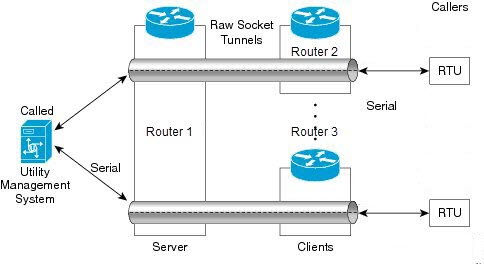
TCP raw socket transport uses a client-server model. At most one server and multiple clients can be configured on a single asynchronous serial line. In client mode, the IR1800 can initiate up to 32 TCP sessions to raw socket servers, which can be other IR1800 routers or third-party devices. Serial data is transferred between RTUs and a utility management system across an IP network that includes several IR1800 routers. One IR1800 router (Router 1) acts as a raw socket server, listening for TCP connection requests from the other IR1800 routers (Router 2 and Router 3), which are configured as raw socket clients. A raw socket client receives streams of serial data from the RTUs and accumulates this data in its buffer, then places the data into packets, based on user-specified packetization criteria. The raw socket client initiates a TCP connection with the raw socket server and sends the packetized data across the IP network to the raw socket server, which retrieves the serial data from the packets and sends it to the serial interface, and on to the utility management system.

When you configure the router's serial link interface as a server, the client router's serial link interface acts as its peer, and vice versa.

Figure 1. TCP raw socket transport connections

UDP transport

UDP transport is a method that uses a peer-to-peer model to transfer serial data between devices over an IP network.

  • Supports multiple UDP connections on an asynchronous serial line.

  • Transfers serial data between RTUs and utility management systems using routers as raw socket UDP peers.

  • Packetizes serial data based on user-specified criteria for transmission across the network.

UDP transport reference information

UDP transport enables the transfer of serial data between remote terminal units and utility management systems using routers configured as raw socket UDP peers.

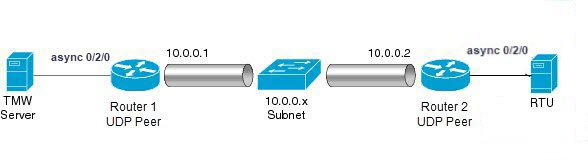
The following figure shows a sample raw socket UDP configuration. In this example, serial data is transferred between RTUs and a utility management system across an IP network that includes two routers (Router 1 which is an IR1800 and Router 2 which is an IR807) that are configured as raw socket UDP peers. The raw socket UDP peer receives streams of serial data from the RTUs and accumulates this data in its buffer, then places the data into packets, based on user-specified packetization criteria. The raw socket UDP peer sends the packetized data across the IP network to the raw socket peer at the other end, which retrieves the serial data from the packets and sends it to the serial interface, and on to the utility management system.
Figure 2. UDP transport reference

Serial data processing

Serial data processing refers to the method by which the IR1800 packetizes streams of serial data received by a raw socket peer using the Asynchronous Communication Protocol.

  • Packet length – A specified packet length prompts the IR1800 to transmit serial data to the peer once the buffer reaches this amount.

  • Packet-timer value – The IR1800 uses a timer to determine how long to wait for the next character before packetizing and sending accumulated data.

  • Special character – A designated character, such as CR/LF, triggers the IR1800 to packetize and forward the buffered data.


VRF-aware raw sockets

The VRF-aware raw socket transport feature allows isolation of raw socket traffic using a VRF, enabling efficient management and control of serial data.